
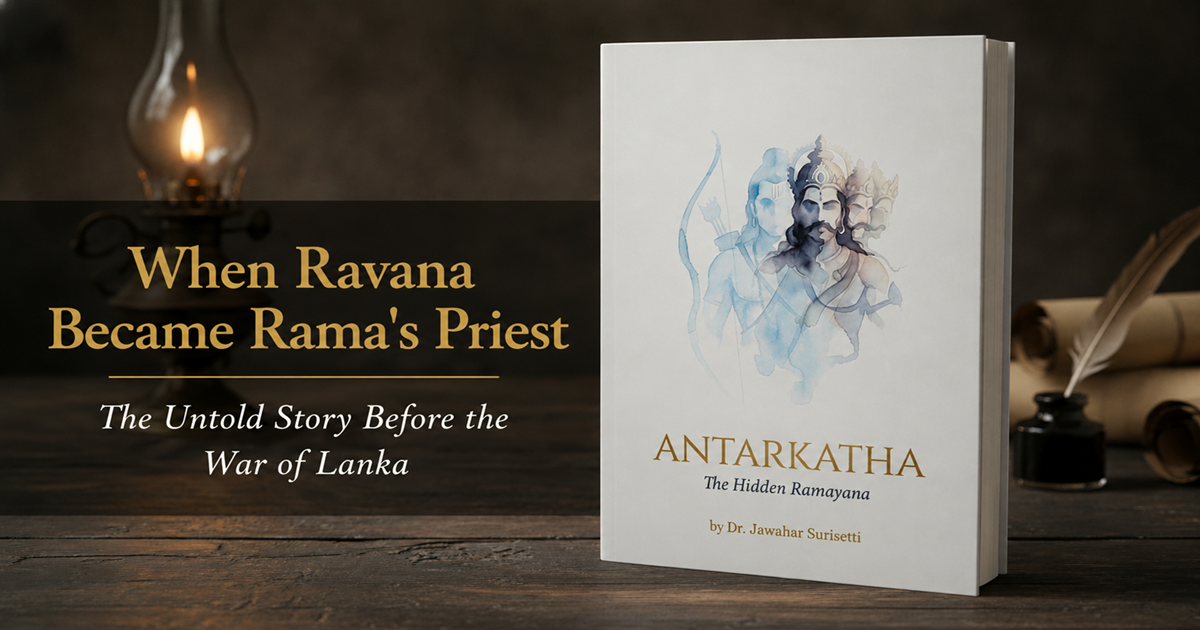
You know the Ramayana. The war, the exile, the bridge, the battle. You know who won and who fell.
But do you know what happened the morning before it all began?
Not on the battlefield. Not in Lanka's golden court. On a quiet shore, at dawn, with no army in sight.
A man in white robes stepped off a small wooden boat. Bare feet on the sand. No crown. No weapons.
That man was Ravana.
And he had come, not to fight, but to pray.
The Request No One Expected
Before the armies could march, Rama needed to consecrate a sacred Shiva Linga at Rameshwaram. It was not optional. It was dharma. A warrior who honours the sacred before battle is not weaker for it. He is bound by something larger than war.
But the ritual demanded the most learned scholar and devotee of Shiva alive. Someone whose knowledge of the Vedas was unmatched. Someone whose devotion was beyond question.
Every sage around Rama pointed to the same name.
Ravana.
King of Lanka. Conqueror of the three worlds. Composer of the Shiva Tandava Stotram. The man Rama was about to go to war with.
Why Did Ravana Say Yes?
This is the question that has fascinated scholars, storytellers and readers for generations.
Ravana knew what was coming. He knew Rama would cross the ocean, lay siege to Lanka, and come for him. He had every reason to refuse. To let the ritual fail. To weaken his enemy before the first arrow was even drawn.
But he did not refuse.
Because for Ravana, some things existed beyond kingdoms. Beyond pride. Beyond war. His devotion to Shiva was not a weapon he could set aside when it was inconvenient. It was the truest part of him. The part that the ten thousand years of achievement had been built on. And when the god he loved called, through the form of his greatest enemy, he answered.
The Most Extraordinary Scene in the Ramayana
Picture it. Two men. The most powerful forces in the ancient world. One destined to kill, the other destined to fall.
And yet, in this moment, neither of them is a warrior.
One is a devotee. The other is a priest.
Antarkatha: The Hidden Ramayana by Dr. Jawahar Surisetti builds this single morning into a story that asks something the epic rarely stops to ask. What does it truly mean to be great? And what happens when the same force that builds a man also destroys him?
This Is Not the Ramayana of Heroes and Villains
Most retellings of the Ramayana give us a simple moral map. Rama is good. Ravana is evil. The war is justice.
Antarkatha refuses that comfort.
It gives us a Ravana who is brilliant, devoted, and deeply flawed. A man capable of the highest act of spiritual service, and also the catastrophic act that undid everything. It asks a question that is not ancient at all.
What do we do when our greatest strengths become the source of our ruin?
A Story That Survived Because It Demanded
The Ramayana has been retold for three thousand years across six languages and twelve countries. Not because it flatters. Because it demands that every generation sit with something unresolved.
The story of the puja before the war is one of those unresolved things.
It is not comfortable. It does not let you keep Ravana in a box. It makes you see him as something far more difficult and far more human than a villain. And it makes the war that follows mean something entirely different.
Antarkatha: The Hidden Ramayana
The epic you know. The stories you don't.
Now available. Pick it up before you think you already know how this story ends.
About the Author
Dr. Jawahar Surisetti is an internationally acclaimed futurist, psychologist, TED speaker, advisor to governments, and bestselling author known worldwide as the Think Professor. With over 1,700 seminars and public lectures delivered across the globe, he is celebrated for his ability to blend philosophy, psychology, and storytelling. Author of Art of Thinking and Theory of Conservation of Love. In Antarkatha: The Hidden Ramayana, he explores the untold human stories hidden within one of India's greatest epics.