
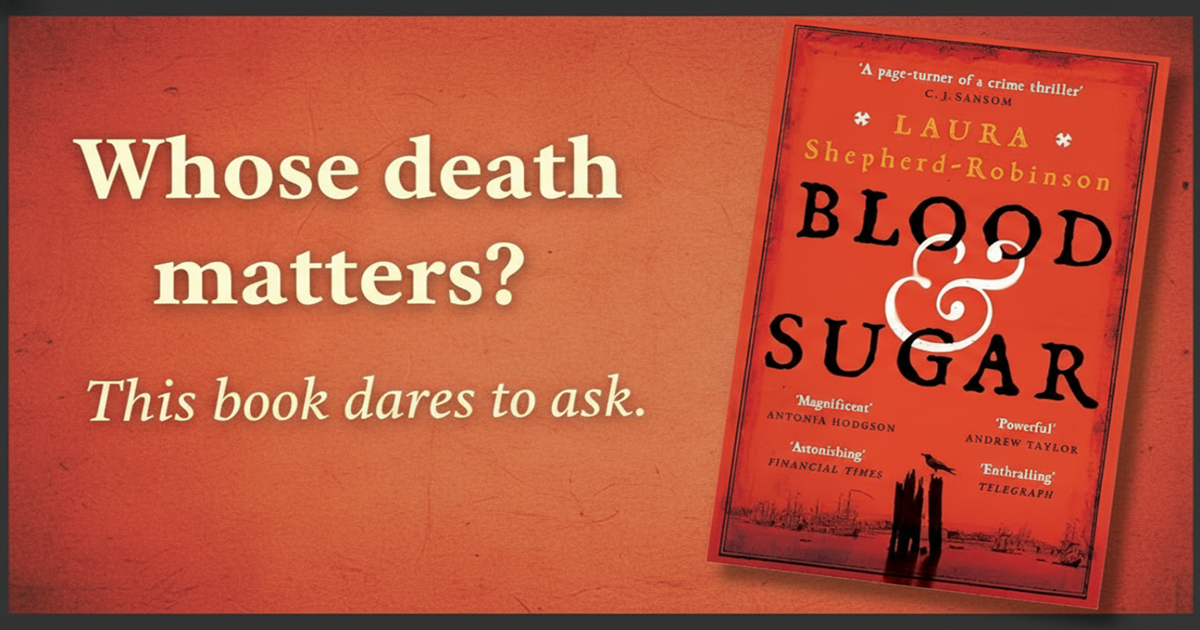
A 300-year-old mystery. A city built on blood money. And a detective who refuses to look away.
What would you do if the murder victim was someone society wanted erased?
That is the question at the heart of Blood & Sugar by Laura Shepherd-Robinson, a historical thriller so richly constructed and morally urgent that it reads less like fiction and more like a reckoning.
Set in 1781 in Deptford, a London dockside town drenched in the profits of the transatlantic slave trade, the novel opens with a discovery that is as brutal as it is deliberate: a man has been tortured and killed aboard a slave ship. He is Titus Okafor, a formerly enslaved abolitionist lawyer. And because of who he was, and what he stood for, almost no one in power wants to know how he died.
Almost no one.
A Hero for the Uncomfortable Truths
Enter Captain Harry Corsham, a war veteran, a politician in the making, and a man standing at a crossroads. When he is asked to investigate the death of his old friend Titus, Harry steps into a world that his class and privilege have allowed him to comfortably ignore until now: the world of the slave trade, operating openly, legally, and lucratively right on English soil.
Shepherd-Robinson does something rare here. She does not let her protagonist off the hook. Harry is not a saint. He has benefited, however indirectly, from the same system he is now forced to confront. Watching him grapple with that complicity, while still pursuing justice, is what gives the novel its real tension.
This is not a comfortable read. It was never meant to be.
History That Burns
What makes Blood & Sugar extraordinary is the research beneath it. Shepherd-Robinson spent years immersing herself in the historical record of the slave trade, and it shows on every page. The sights, sounds, and smells of Deptford are visceral. The political machinations around the abolitionist movement feel achingly familiar. The way wealth silences truth, the way institutions protect themselves, the way good people convince themselves that complicity is neutrality: none of it feels distant.
It feels like now.
The 1781 setting is not accidental. It places the story at a pivotal moment, just before the movement against the trade began to gain serious ground, when abolitionists were still considered radical troublemakers and slave merchants were pillars of the community. Shepherd-Robinson forces us to sit inside that contradiction.
More Than a Mystery
Yes, there is a mystery. Yes, there are suspects and secrets and a plot that twists in ways you will not see coming. The procedural elements are genuinely gripping, and Shepherd-Robinson has the pacing instincts of a natural storyteller.
But Blood & Sugar is also a novel about whose lives we decide are worth investigating. About how history chooses its heroes and erases its victims. About the price of speaking inconvenient truths in polite society.
It is the kind of book that makes you turn the last page and then sit very still for a while.
Why You Should Read This Book Now
If you have ever loved the atmospheric crime fiction of C.J. Sansom, the moral weight of Hilary Mantel, or the propulsive plotting of Antonia Hodgson, Blood & Sugar belongs on your shelf immediately.
And if historical fiction usually feels like it lives too safely in the past, this novel will change your mind. Laura Shepherd-Robinson wrote a story about 1781 that somehow refuses to stay there.
Pick up Blood & Sugar. Let it disturb you. It should.