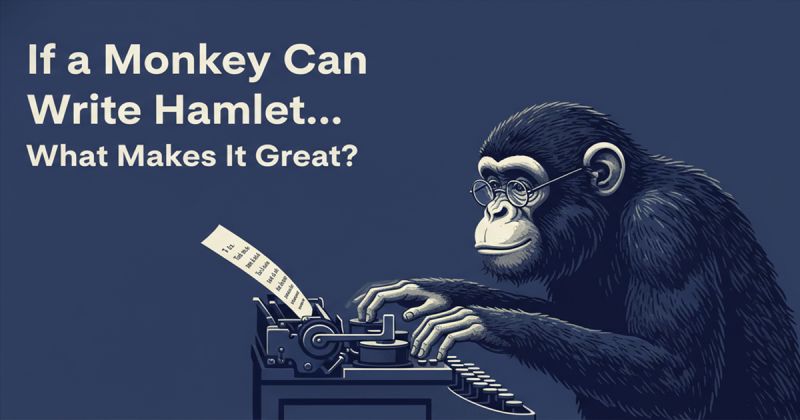
A monkey sits in front of a typewriter. It has no goals, no grammar, no genius. It simply hits random keys, one after another, forever. Mathematicians will tell you that given infinite time, this monkey will eventually type out every word of Shakespeare's Hamlet, letter perfect. This is the Infinite Monkey Theorem, and it is both a beautiful idea and a quietly devastating one. Because here is the question it forces you to ask: if even a monkey could theoretically produce Hamlet by accident, what makes a great book truly great?
What Exactly Is the Infinite Monkey Theorem?
The Infinite Monkey Theorem is a concept in probability theory. It states that a monkey pressing random keys on a typewriter for an infinite amount of time will almost surely produce any given text, including the complete works of William Shakespeare. The word 'almost surely' is precise mathematical language. It does not mean the monkey might do it someday. It means that the probability approaches 1 as time approaches infinity.
The theorem was popularized by the French mathematician Emile Borel in 1913, though its philosophical roots stretch back further into questions about randomness, infinity, and the nature of meaning. Mathematicians use it to illustrate how improbable events become inevitable when time is removed as a limiting factor.
The Numbers That Will Make Your Head Spin
Let us pause for a moment and actually confront what we are talking about. Hamlet contains roughly 130,000 characters. A standard keyboard has about 50 keys. The probability of a monkey typing the first character correctly is 1 in 50. The probability of getting the first two characters correct is 1 in 2,500. The probability of typing all 130,000 characters in the correct order is 1 in 50 raised to the power of 130,000.
That number is so large it dwarfs the estimated number of atoms in the observable universe. You would sooner count every grain of sand on every beach on Earth a billion times over. And yet, mathematically, with infinite time, it happens. This is not magic. This is what infinity does to probability.
So If a Monkey Can Do It, Why Does Hamlet Still Matter?
Here is where the theorem quietly turns on itself and becomes something far more interesting than a probability puzzle. It tells us that the text of Hamlet, as a sequence of characters, is not inherently impossible to produce randomly. What it cannot produce, not in infinite time, not ever, is the intention behind those words.
When Shakespeare wrote 'To be, or not to be, that is the question,' he was not arranging letters. He was reaching into the darkest corner of human experience and pulling out something true. He was writing about indecision, mortality, and the terrifying weight of consciousness. A monkey producing those exact characters produces nothing, because without intention, without a mind that has suffered and wondered and observed, the words are empty shells.
Classic Books and the Miracle of Meaning
The Infinite Monkey Theorem actually deepens our appreciation for classic literature rather than diminishing it. Think about the books that have survived centuries. Think about Homer's Odyssey, Cervantes's Don Quixote, Tolstoy's War and Peace, or Dostoevsky's The Brothers Karamazov. These works did not emerge from randomness. They emerged from the full weight of a human life pressing itself into language.
A classic book is not great because its sentences are arranged perfectly, though they often are. It is great because behind every sentence is a writer who chose that word over ten thousand others, who revised and rewrote and suffered over the rhythm of a paragraph, who was trying to tell us something true about being alive. No algorithm, no monkey, no infinite machine can replicate that process. They can only, in theory, replicate the result.
Reading Is the Other Half of the Miracle
There is another dimension to this conversation that the theorem quietly raises. Even if a monkey produced a perfect copy of Hamlet, who would read it? And more importantly, who would understand it?
A text, on its own, is inert. It becomes literature only in the act of reading. The reader brings their own grief, their own curiosity, their own memory to the page. The meaning of a classic book is not stored between its covers. It is created in the space between the writer's mind and the reader's heart.
This is why reading great books is not a passive activity. You are not simply absorbing information. You are completing a circuit that started with a human being who had something urgent to say. When you read a classic, you are in conversation with one of the most carefully constructed acts of communication in human history. The monkey produces symbols. The reader and the writer together produce meaning.
What the Theorem Teaches Us About Attention
Here is perhaps the most practical insight the Infinite Monkey Theorem offers to readers: not all reading is equal. Skimming a book is closer to the monkey than you might be comfortable admitting. You are running your eyes across symbols, letting some register and others slide past. Real reading, the kind that changes you, requires attention. It requires you to slow down, to let the words land, to ask why a sentence is shaped the way it is.
Classic books reward this kind of attention spectacularly. They are engineered, over decades of craft and revision, to give back more than you put in. Every careful reading of Hamlet reveals something new, not because the text changes but because you do. The monkey could theoretically produce the text. Only you can do what a reader does.
In the Age of AI, the Theorem Feels More Urgent Than Ever
We live in a moment when artificial intelligence can generate fluent, grammatically correct, emotionally plausible text at extraordinary speed. It can produce something that looks like literature. It can imitate voice, adopt style, and generate plot. In many ways, modern AI is the real-world approximation of the infinite monkey. It operates through probability and pattern, not experience and intention.
And yet, the classics endure. We still return to Hamlet. We still read Tolstoy. We still find things in Dostoevsky that no algorithm has reached. Because the theorem was always right. It is not the arrangement of letters that makes a great book. It is the irreducible human life compressed into every choice of every word.
Infinity Cannot Write What You Can Read
The Infinite Monkey Theorem is one of the most beautiful and disturbing thought experiments in mathematics. It tells us that in infinite time, anything that can happen will happen. But it also, quietly and powerfully, tells us the opposite of what it seems to say. It tells us that randomness, given all the time in the universe, can only produce the surface of a great book. It cannot produce the reason it was written. It cannot produce the sorrow or the joy or the observation that made a writer reach for a pen in the first place.
So the next time you hold a classic book in your hands, let the theorem work in reverse. Understand that what you are holding is not an accident of letters. It is a deliberate, improbable, irreplaceable act of human consciousness. No monkey could have written it. And only a reader who shows up with their full attention can do it justice.
Read the Book That Started It All
The Infinite Monkey Theorem was inspired in part by the enduring mystery of Shakespeare's genius. If this article sparked something in you, there is no better time to go back to the source. Pick up a copy of Hamlet by William Shakespeare. Read it slowly. Read it with the attention the theorem demands of you. You will find, as generations of readers have found before you, that it gives back far more than the monkey ever could.
Get your copy of Hamlet today and experience the text that no monkey, no algorithm, and no accident of chance could ever truly replicate.