
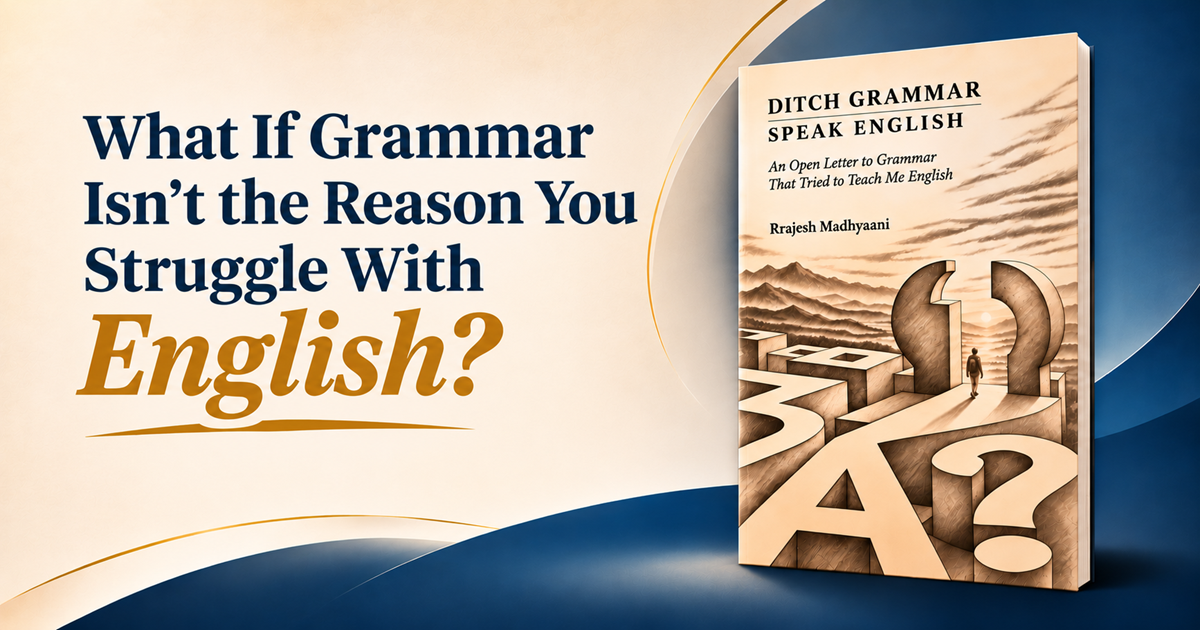
Quick Summary: Ditch Grammar by Rrajesh Madhyaani is a 16-chapter guide for learners who understand English but freeze when they have to speak it. Its core argument is simple. Grammar should follow communication, not stand in front of it like a locked gate.
The Student Who Knew Every Rule and Said Nothing
Think of someone who has studied English for ten or fifteen years. They can name every tense and solve every fill-in-the-blank. Then someone asks a simple question in English, and they go quiet.
This is not a rare story in India. It is one of the most common experiences in the country’s classrooms, and it points to a problem that no workbook has fixed. A language learned as a subject to be marked is very different from a language used to say something.
Ditch Grammar is written for exactly this learner.
What “Ditch” Really Means
The title is provocative on purpose, and it is easy to misread. The book does not say grammar is useless. It does not say accuracy is optional. It asks you to drop one belief: that you must master grammar before you are allowed to speak.
That belief produces a quiet and costly habit. Learners choose silence because silence cannot be corrected. The book treats this as the real obstacle, far bigger than any missing rule.
A Different Order of Learning
Instead of rules first and speech later, the book proposes a different sequence. Start with meaning. Read and listen to English you can follow. Speak using the words you already own. Write about subjects you care about. Then let grammar arrive as a tool that sharpens what you already say.
Under this approach, a mistake stops being a verdict on your intelligence. It becomes information.
The book is equally clear about context. Casual conversation, job applications, interviews and examinations do not ask for the same English. The aim is freedom with good judgement, not carelessness.
Inside the Book
Without giving away the whole journey, here is the kind of ground it covers:
Why the belief took hold. The opening chapters examine how the idea of “perfect grammar first” became so common, and what it costs learners.
How language actually grows. A chapter on how the brain picks up language explains why exposure, attention and practice matter so much.
Reading as a private language lab. Several chapters show how to choose material, how to read without turning it into homework, and how to build a habit that lasts.
Speaking before you feel ready. The book makes a practical case for starting imperfectly and improving through use.
The role of schools. A frank chapter looks at what classrooms got wrong and, more usefully, what learners can rebuild on their own.
Identity. One chapter addresses a question many Indian learners quietly carry: how to use English fully without feeling you are giving up who you are.
Every chapter also ends with a set of explained example sentences that show how real English often bends the simplified rules taught in school. The book also closes with ready-to-use practice tools, including a structured challenge, speaking prompts, a reading ladder and a monthly review. Their details are best discovered on the page.
Who Should Read It
This book suits you if you:
understand English well but hesitate to speak it
feel judged by your own mistakes
want a practical routine rather than another rulebook
are a teacher or parent looking for a calmer way to support a learner
It is also honest about its limits. It does not promise overnight fluency. It offers a sustainable structure and asks for consistency.
About the Author
Rrajesh Madhyaani is an author, educationist and curious observer who writes about education, language and India. A long professional association with education has shaped a deep interest in how children learn and why conventional methods so often fall short of what they promise. That questioning habit runs through Ditch Grammar, which asks whether good English really begins with rules. Other work includes India’s Broken Education, an examination of the weaknesses in the country’s education system, and Critic India, a project that asks honest questions about national priorities.
Frequently Asked Questions
Does Ditch Grammar say grammar does not matter?
No. It argues that grammar works best as a finishing tool, studied once you have something to say, rather than as a barrier before you begin.
Who is Ditch Grammar for?
It is written mainly for Indian learners who read and understand English but lack confidence in speaking, and for teachers who want to support them.
Will this book make me fluent in thirty days?
No, and it says so itself. The practice material is a starting framework meant to be repeated, not a promise of instant results.
Who wrote Ditch Grammar?
Rrajesh Madhyaani, an author and educationist who writes about education, language and India. You can read more at rrajeshmadhyaani.com.
Confidence Comes Before Perfection
Confidence in English rarely comes from knowing one more rule. It comes from reading more, listening more and speaking more, even when the sentence is not perfect. Ditch Grammar gives that idea a clear structure and a voice that treats the learner with respect.
If the fear of making mistakes has been holding your English back, this is the book to start with.
Your first confident sentence is closer than you think. Get your copy of Ditch Grammar on Amazon.