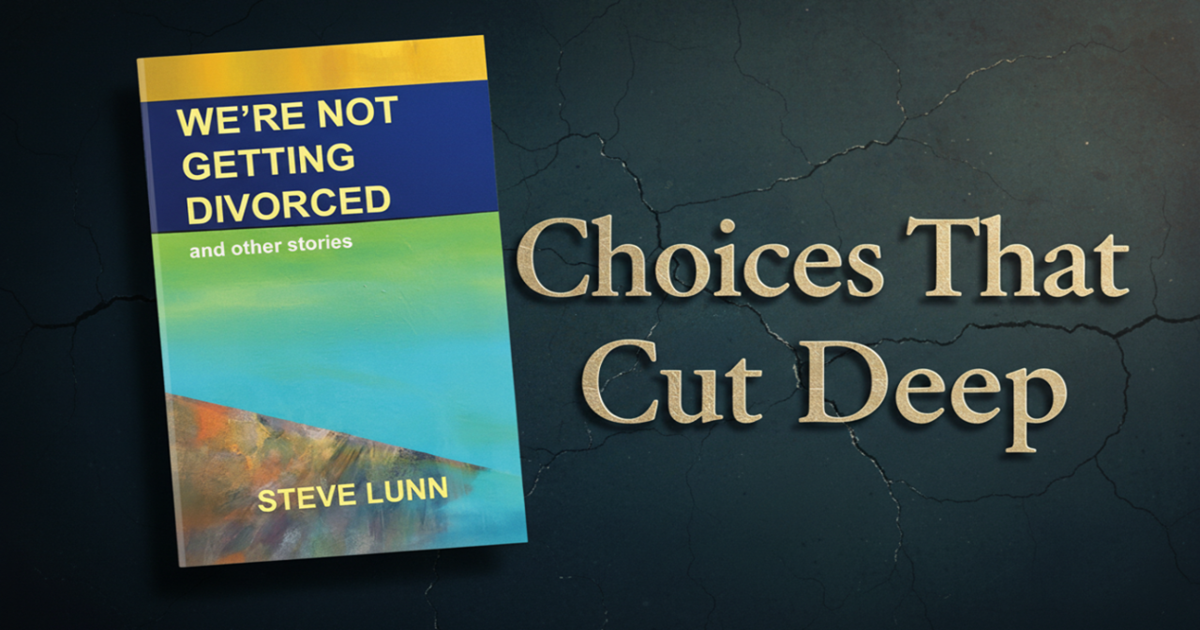
There's a moment in Steve Lunn's "We're Not Getting Divorced: and other stories" where an elderly woman prepares hemlock tea for her dying husband, not from cruelty, but from love. It's her final act of care, honoring a pact they made years ago when facing his cancer diagnosis. The scene is quiet, ordinary even. She boils roots. He drinks. In seconds, he's gone.
This is how life actually ends and begins, not with fanfare, but with silent decisions made in sitting rooms while Christmas records spin.
When Fiction Tells the Truth We're Afraid to Speak
Lunn's debut collection doesn't traffic in comfort. Instead, it offers something rarer: radical honesty about the moments that cleave our lives in two. A busker becomes a fifty-six-year marriage. A woman faces prison for mercy killing. Two strangers meet on a Victoria Line train and recognize that their lives will never be the same.
These aren't stories about divorce, despite the title. They're about the invisible fault lines running through every relationship, every choice, every ending that masquerades as stability.
The Author Who Lived Nine Lives Before Writing One Book
Steve Lunn 's life reads like a collection of short stories itself. Mining village in Derbyshire. Elementary school teacher. Software developer. Farmer. Caterer. Research fellow at The Open University. Co-founder of southern England's first community-owned wind farm. Now dividing time between Inverness-shire and Brittany, writing fiction and rewilding land.
This isn't the résumé of someone playing at authenticity. It's the life map of someone who understands that we contain multitudes, and our stories should too.
Why Lunn's Honesty Feels Radical in 2026
In an era of curated LinkedIn lives and Instagram authenticity, Lunn's collection does something subversive: it shows the actual texture of human decision-making. The compromise. The ambiguity. The love that looks like cruelty and the cruelty that masquerades as love.
Consider "Vector Analysis," where a man named Banx meets a woman on a train and realizes in real-time that his life is changing direction "like the resultant in a vector diagram they'll move in a new direction." The physics metaphor isn't pretentious; it's precisely how pivotal moments feel. We recognize the force. We know we're being moved. We're helpless to resist.
What You'll Find Between These Pages
Justice vs. Fairness: A woman pleads guilty to unlawful killing, facing years in prison for ending her husband's suffering. Her lawyer says it's the right choice legally. But was it the right choice morally?
Authenticity vs. Truth: Relationships built on fifty-six years of small deceptions and large love. What matters more what we hide or what we share?
Youth vs. Age: A seventeen-year-old secretary meets an eighteen-year-old engineering student in 1966 Dublin. They marry the next year. Decades later, she's preparing his final drink.
Lunn writes with what he calls "compassion, respect and sometimes humour" but don't mistake this for sentimentality. His compassion has teeth. His respect doesn't flinch from difficult truths.
The Craft Behind the Compassion
Notice how Lunn uses music as a through-line in "All is Bright." The widow plays her late husband's folk Christmas LP, the asterisked "Folking Christmas" by Adam and Eve Anwick. The songs were recorded in railway stations. You can hear trains in the background.
This isn't decoration, it's the story's architecture. Just as the station announcements intrude on the music, reality intrudes on memory. But she loses herself in the harmonies anyway, imagining herself "young again, going somewhere, waiting to hear my destination called."
We've all been there. The past preserved in vinyl. The future reduced to a bottle in the fridge.
For Readers Who Want Fiction That Does Something
This collection isn't for everyone. If you want easy resolutions, redemptive arcs, or stories that confirm what you already believe about love and death and meaning, look elsewhere.
But if you want fiction that respects your intelligence enough to leave questions unanswered, that trusts you to sit with discomfort, that understands life's most important moments often happen in the time it takes to boil water then Steve Lunn has written something for you.
The Invitation
"We're Not Getting Divorced: and other stories" is available now. It's the kind of book you'll read once, then return to when your own life hits those fault lines. When you're making a pact with someone you love. When you're standing on a Victoria Line platform, recognizing a stranger who might change everything.
When you need stories that tell the truth about endings and beginnings.
Because as Lunn shows us: we're always building our lives on both.