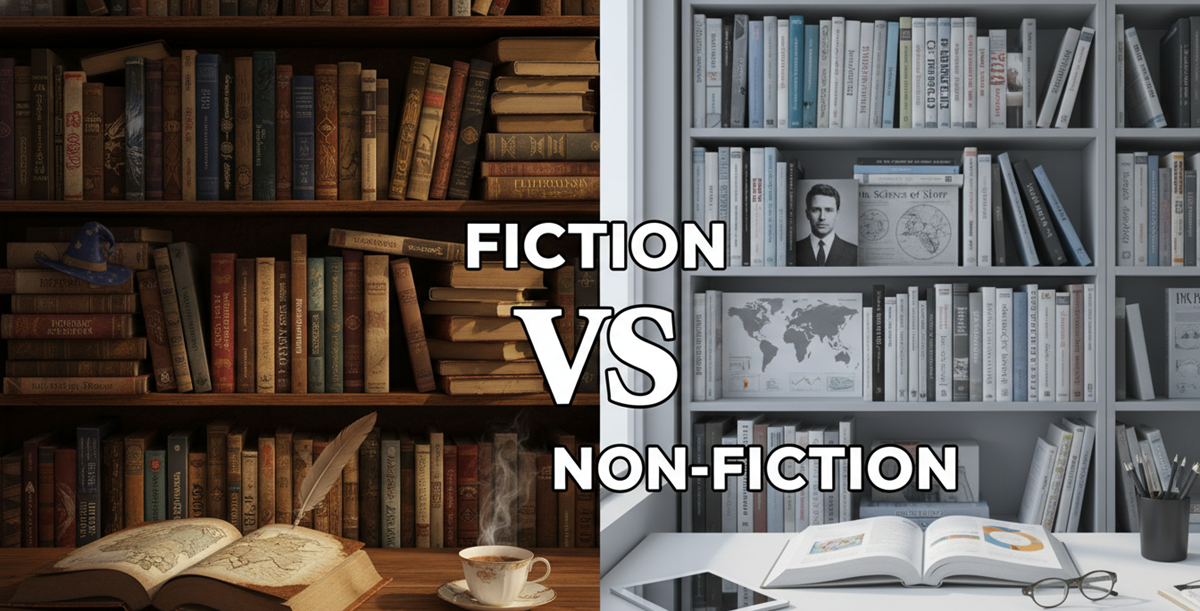
When you walk into a bookstore or browse an online library, you'll notice books are typically divided into two main categories: fiction and non-fiction. Understanding these fundamental classifications helps readers make informed choices about what to read next and enables writers to position their work effectively.
What Are Fiction Books?
Fiction books contain stories created from the author's imagination. These narratives feature invented characters, plots, and settings that may be inspired by reality but are not bound by factual accuracy. The primary purpose of fiction is to entertain, evoke emotions, and explore the human experience through creative storytelling.
Key Characteristics of Fiction:
Imaginary characters and events
Creative narrative structures
Dialogue and descriptive language
Plot-driven or character-driven stories
Emotional engagement and entertainment
Popular Types of Fiction Books:
Literary Fiction focuses on character development and artistic writing style, often exploring complex themes and the human condition.
Mystery and Thriller novels revolve around solving crimes, uncovering secrets, or escaping dangerous situations with suspenseful plots.
Science Fiction explores futuristic concepts, advanced technology, space exploration, and speculative scientific ideas.
Fantasy creates magical worlds with supernatural elements, mythical creatures, and imaginative settings beyond our reality.
Romance centers on love stories and emotional relationships between characters, typically with a satisfying resolution.
Historical Fiction sets fictional stories against real historical periods, blending imagination with actual events and settings.
What Are Non-Fiction Books?
Non-fiction books present factual information, real events, and true stories. Authors research and document actual people, places, events, and concepts to educate, inform, or persuade readers. The purpose of non-fiction is to convey truth and knowledge.
Key Characteristics of Non-Fiction:
Based on facts and reality
Real people, places, and events
Research and evidence-based content
Educational or informative purpose
Objective or subjective analysis of truth
Popular Types of Non-Fiction Books:
Biography and Autobiography tell the life stories of real people, written by others or by the subjects themselves.
Self-Help and Personal Development provide guidance, strategies, and advice for improving various aspects of life.
History examines past events, civilizations, and significant moments that shaped our world.
Science and Nature explore scientific discoveries, natural phenomena, and the workings of our universe.
Business and Economics discuss entrepreneurship, management, finance, and economic principles.
True Crime investigates real criminal cases, offering detailed accounts of actual crimes and their investigations.
How to Choose Between Fiction and Non-Fiction
Your reading choice depends on your current goals and mood:
Choose Fiction When:
You want to escape reality and relax
You're seeking emotional experiences
You want to explore different perspectives through characters
You're looking for entertainment and creativity
Choose Non-Fiction When:
You want to learn something specific
You're researching a topic
You need practical advice or guidance
You're interested in real events and people
Can Books Be Both Fiction and Non-Fiction?
Some books blur the lines between these categories. Creative non-fiction uses literary techniques found in fiction while remaining factually accurate. Historical fiction combines real events with imaginary characters. Understanding these hybrid genres helps readers appreciate the full spectrum of literature.
The Value of Reading Both Genres
Balanced readers benefit from exploring both fiction and non-fiction. Fiction develops empathy, creativity, and emotional intelligence, while non-fiction builds knowledge, critical thinking, and practical skills. Many successful readers alternate between genres to enjoy diverse benefits.
Conclusion
Understanding the meaning of fiction and non-fiction books empowers you to make better reading choices aligned with your interests and goals. Fiction offers imaginative escapism and emotional exploration, while non-fiction provides factual knowledge and real-world insights. Both genres hold unique value in expanding our minds and enriching our lives. Whether you prefer invented worlds or factual accounts, there's an entire library waiting to be discovered.