
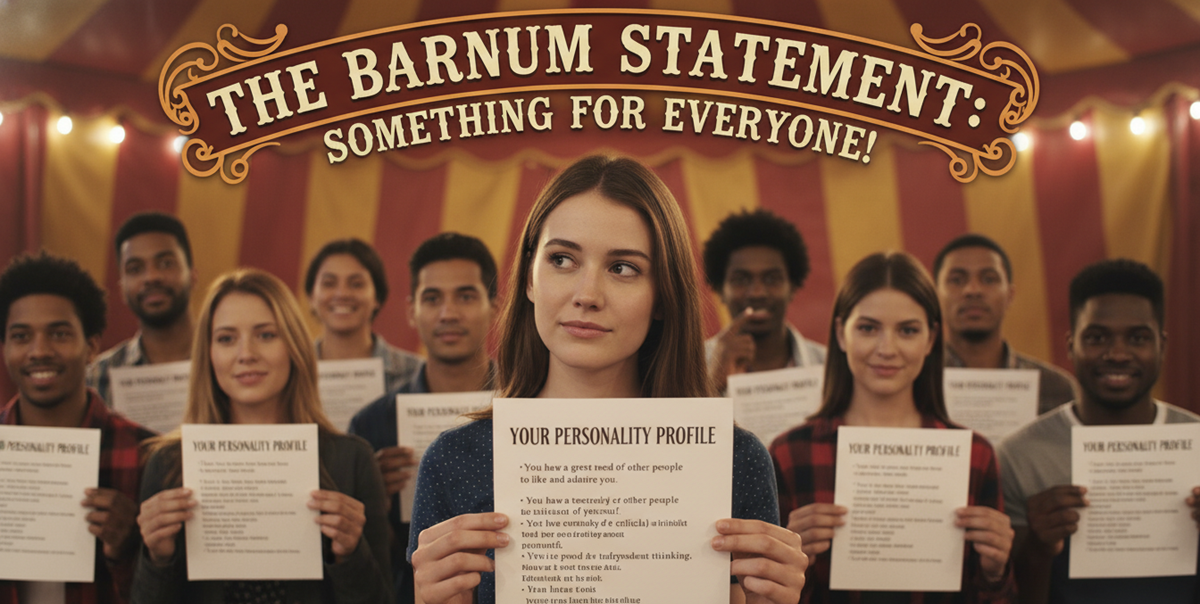
Have you ever read your horoscope and thought, "That's exactly me!"? Or taken a personality quiz that seemed eerily accurate? You've likely experienced the Forer Effect, a fascinating psychological phenomenon that explains why people accept vague, general statements as uniquely applicable to themselves.
What Is the Forer Effect?
The Forer Effect, also known as the Barnum Effect, is a cognitive bias where individuals believe that generic personality descriptions specifically apply to them, even when the same descriptions could apply to almost anyone. Named after psychologist Bertram Forer, who conducted a landmark experiment in 1948, this effect reveals how easily our minds can be tricked into seeing personal relevance in universal statements.
In his original study, Forer gave students a personality test and then provided each with supposedly personalized feedback. In reality, every student received identical descriptions compiled from horoscope columns. When asked to rate the accuracy of their "unique" personality analysis on a scale from 0 to 5, the average rating was 4.26, indicating students found the generic feedback remarkably accurate.
Understanding Barnum Statements
At the heart of the Forer Effect lies what psychologists call Barnum statements. Named after showman P.T. Barnum, who famously said there's "a sucker born every minute," these are vague, flattering statements designed to apply to most people while seeming highly specific.
Common characteristics of Barnum statements include:
Vagueness and generality. The statements use broad language that could describe many people. For example: "You have a tendency to be critical of yourself" applies to most individuals at some point.
Positive bias. Barnum statements typically flatter the recipient, making them more likely to accept the description. People prefer believing positive things about themselves.
Double-headed statements. These contain contradictions that cover multiple possibilities, such as "While you are generally confident, you sometimes experience self-doubt." This ensures the statement resonates regardless of the person's actual traits.
Universal experiences. The statements reference common human experiences like wanting acceptance, having unfulfilled potential, or experiencing occasional loneliness.
Why Does the Forer Effect Work?
Several psychological mechanisms contribute to the power of the Forer Effect:
Confirmation bias plays a major role. When reading Barnum statements, people tend to focus on aspects that match their self-perception while ignoring or minimizing parts that don't fit. This selective attention reinforces the illusion of accuracy.
The desire for validation drives acceptance of these descriptions. Humans naturally seek understanding and affirmation of their identity. When presented with personality feedback, especially from perceived authorities, people want it to be true and meaningful.
Authority and context influence belief. When Barnum statements come from sources perceived as credible—psychologists, astrologers, or sophisticated-looking personality tests—people are more likely to accept them as accurate.
Subjective validation occurs when people find personal meaning in random or vague information. The human brain excels at pattern recognition, sometimes finding connections that don't actually exist.
Real-World Applications of the Forer Effect
Understanding the Forer Effect helps explain the enduring popularity of various practices:
Astrology and horoscopes thrive on Barnum statements. Daily horoscopes provide vague predictions that readers interpret as personally meaningful, even though millions read identical forecasts.
Personality assessments, particularly unscientific ones found online or in magazines, often rely heavily on Forer Effect principles. While legitimate psychological tests exist, many popular quizzes use Barnum statements to create an illusion of insight.
Cold reading techniques employed by psychics and fortune tellers utilize Barnum statements combined with careful observation. By making general statements and watching for reactions, practitioners create the impression of supernatural knowledge.
Marketing and advertising frequently incorporate Barnum statements to create feelings of personal connection with brands. Messages like "You're unique and deserve the best" resonate because they feel personally directed while actually targeting everyone.
How to Recognize Barnum Statements
Developing awareness of Barnum statements helps you think more critically about personality descriptions and predictions:
Watch for flattering language that makes you feel special or understood without providing specific, verifiable information.
Notice contradictory statements that could apply regardless of your actual personality. If a description covers opposite traits, it's designed to seem accurate no matter what.
Question the source. Consider whether the person or system providing the analysis has genuine knowledge about you or is using generic templates.
Test universality. Ask whether the same statement could apply to your friends, family, or random strangers. If yes, it's likely a Barnum statement.
Seek specificity. Genuine personality insights include specific examples, behaviors, or patterns unique to you, not vague generalities.
The Scientific Perspective
Research has consistently replicated Forer's findings across cultures and contexts. Studies show that people rate the accuracy of Barnum statements between 4.0 and 4.5 on a 5-point scale, regardless of the actual content.
Interestingly, the effect strengthens under certain conditions. When people believe the feedback comes from a prestigious source, when it's labeled "for you alone," or when subjects have high levels of anxiety about self-understanding, acceptance of Barnum statements increases significantly.
However, not everyone falls equally for the Forer Effect. Critical thinkers, skeptics, and those familiar with the phenomenon show greater resistance to accepting generic descriptions as personally accurate.
Protecting Yourself from the Forer Effect
While the Forer Effect is a natural cognitive tendency, awareness provides protection:
Approach personality assessments with healthy skepticism. Before accepting results as accurate, evaluate whether the feedback contains specific, falsifiable information or merely flattering generalities.
Seek evidence-based tools when you want genuine self-understanding. Validated psychological assessments developed through rigorous research provide more reliable insights than casual online quizzes.
Recognize emotional vulnerability. When feeling uncertain or seeking validation, you're more susceptible to accepting Barnum statements. Take time before making important decisions based on personality feedback.
Compare and verify. Share your "personalized" results with others. You might discover your unique analysis matches theirs word-for-word.
Value authentic self-knowledge. Real self-understanding comes from reflection, honest feedback from trusted sources, and observation of your actual behaviors over time—not from generic descriptions that could apply to anyone.
The Value of Understanding the Forer Effect
Recognizing the Forer Effect doesn't mean dismissing all personality insights or avoiding self-reflection. Rather, it encourages more discerning evaluation of the information we receive about ourselves.
This knowledge empowers you to distinguish between genuine psychological insight and cleverly worded generalities designed to seem personal. It helps you invest time and trust in tools and practices that offer real value rather than illusions of understanding.
The Forer Effect reminds us that human psychology is complex and that our desire for self-understanding can sometimes lead us astray. By remaining aware of how Barnum statements work and why they feel so convincing, you can navigate personality assessments, predictions, and advice with greater wisdom and discernment.
Understanding these psychological principles ultimately supports better decision-making, more accurate self-perception, and healthier skepticism toward claims of special insight into your personality or future.