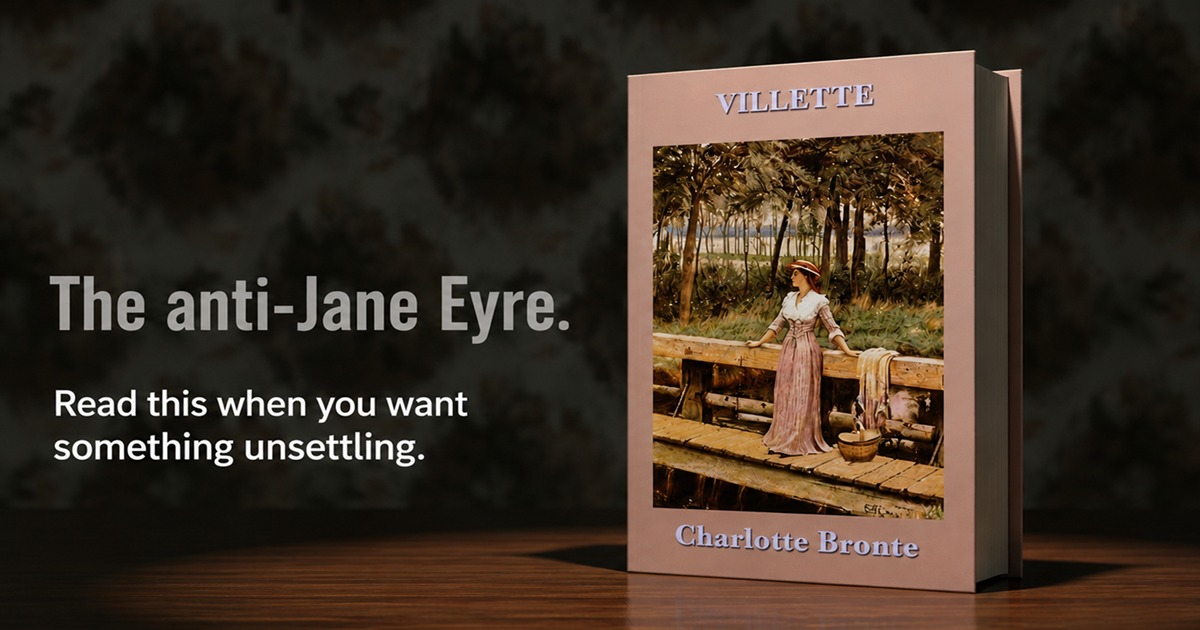
Forget everything you think you know about Charlotte Bronte. Yes, she gave us Jane Eyre, one of the most beloved heroines in English literature. But her final novel, Villette, published in 1853, is something else entirely. It is rawer, lonelier, and far more willing to sit with discomfort than anything she wrote before. If Jane Eyre is a fire, Villette is a candle in the wind, stubborn, flickering, refusing to go out.
And somehow, most readers have never picked it up.
The Book That Almost Did Not Get Written
By the time Charlotte Bronte sat down to write Villette, she had already lived through more grief than most people encounter in a lifetime. Her brother Branwell had died. Her sisters Emily and Anne followed, within months of each other. She was, for the first time in her adult life, completely alone at Haworth Parsonage.
Villette was written in that grief. It shows. The novel follows Lucy Snowe, a young woman of uncertain origins and few prospects, who travels alone to the fictional city of Villette (modelled on Brussels, where Bronte herself had lived and loved and suffered) to find work as a teacher. There is no fairy godmother. No dramatic rescue. Just a woman, a suitcase, and a city that does not speak her language.
Meet Lucy Snowe: The Heroine Who Will Not Perform for You
Lucy Snowe is not an easy character to love, and Bronte knows it. She is guarded to the point of evasiveness, self-aware in ways that make her uncomfortable to read, and frequently unkind in her private observations of the people around her. She does not invite sympathy. She barely invites understanding.
But that is precisely what makes her one of the most radical heroines in Victorian fiction.
At a time when women in novels were expected to be good, beautiful, or at the very least pitiable, Lucy Snowe refuses all three. She simply exists, survives, and observes with a clarity that borders on cruelty. Bronte gives her no softening romance to redeem her. No tidy resolution to comfort the reader. Lucy does not end up with the man. She does not end up with certainty. She ends up, as most real people do, somewhere in the middle, holding herself together.
The Novel That Made Even Its Publisher Nervous
When Villette was published, it made people uncomfortable. Readers who had loved Jane Eyre expected the same kind of arc: hardship, romance, resolution, triumph. Villette offers none of that in any clean way. The romance, such as it is, remains unresolved. The ending is deliberately ambiguous. Bronte refused to clarify it, even when her publisher asked her to soften it.
Her friend and biographer Elizabeth Gaskell later admitted that the ending made her cry, then made her furious, then made her cry again. That reaction is basically the Villette experience in miniature.
Why This Novel Feels So Contemporary
There is something almost eerie about reading Villette in the present day. Lucy Snowe's inner life, the way she masks her emotions even from herself, the way she performs competence while quietly unravelling inside, reads less like a Victorian character and more like a recognisable modern experience.
There is a section in the novel where Lucy has a breakdown, quiet and total, over a long school holiday when she is left entirely alone. Bronte describes it not with melodrama but with a kind of clinical distance that makes it more devastating, not less. Readers who have experienced depression, anxiety, or prolonged loneliness often say this passage felt like someone had written their own experience down before they were born.
That is what great fiction does. Villette does it without apology.
The Ghost, the Garden, and the Opium Dream
Villette is also, it should be said, a genuinely strange book. There is a ghost. There is an opium-fuelled night sequence through illuminated gardens that reads like something out of a fever dream. There is a school with a buried nun. There are moments of gothic strangeness that sit alongside the most grounded psychological realism, and somehow Bronte makes it all cohere.
The novel rewards slow reading. Its secrets accumulate. What seems like a minor detail in chapter three becomes essential by chapter thirty. Lucy is an unreliable narrator in the most interesting sense: not because she lies, exactly, but because she withholds. She tells us less than she knows, and we only realise how much she has been hiding when it is too late.
What Bronte Was Really Writing About
Most scholars agree that Villette is deeply autobiographical. The city is Brussels. The school is the Pensionnat Heger, where Bronte herself taught. The man Lucy falls for, Monsieur Paul Emanuel, is widely understood to be based on Constantin Heger, a married professor with whom Bronte was intensely, unhappily in love.
Bronte's letters to Heger, desperate and later returned to her torn up, are some of the most painful documents in literary history. Villette is what happened when she turned that pain into art. The result is a novel that does not flinch, does not prettify, and does not let anyone off the hook, least of all Lucy, least of all the reader.
Should You Read Villette?
If you want a comfortable read with a satisfying resolution, then honestly, no. Pick up Jane Eyre again and enjoy every page.
But if you want a novel that treats you as an adult, that refuses to resolve its tensions just to make you feel better, that gives you a heroine who is complicated and real and sometimes maddening and ultimately unforgettable, then yes. Villette is waiting.
Stay with it past the first few chapters. That is where Bronte begins to show her hand.
Lucy does not perform resilience. She just survives, and Bronte makes you feel every cold inch of it.