
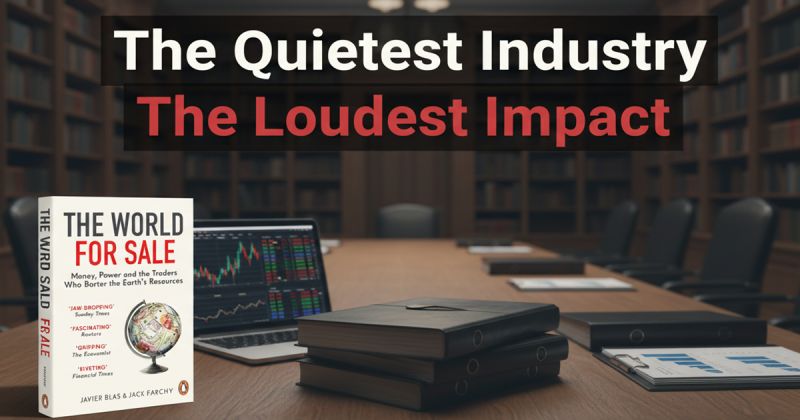
What if the most powerful people in the world were not politicians, tech billionaires, or central bankers, but a small group of secretive traders who buy and sell the raw materials that keep civilization running? That is not a conspiracy theory. That is the reality exposed in The World for Sale, written by two veteran Bloomberg journalists, Javier Blas and Jack Farchy.
Published in 2021, this book reads like a financial thriller while being deeply rooted in fact. It is one of the most important books written about how the modern global economy truly operates, and yet most people have never heard of the companies it profiles. That invisibility, the authors argue, is precisely the point.
What Is This Book About?
The World for Sale tells the story of the global commodity trading industry and the men, mostly men, who built it into one of the most influential forces on the planet. The book traces the rise of the secretive trading houses that control the flow of oil, grain, metals, and other raw materials across the world.
Blas and Farchy follow the traders from the backroom deals of the Cold War era all the way through to the chaotic commodity booms of the 21st century. They profile some of the biggest names in the industry, including Marc Rich, the controversial figure who invented modern oil trading and later became one of the most wanted fugitives in the United States. They also look at corporate giants like Vitol, Glencore, Cargill, and Trafigura, companies that most consumers have never heard of but whose decisions affect the price of everything from bread to gasoline.
The Men Behind the Curtain of the Global Economy
One of the most striking things about this book is how it introduces readers to figures who wield extraordinary global power but operate in near total anonymity. Marc Rich built a commodity trading empire worth billions by doing business with regimes that others refused to touch, including Iran during the hostage crisis, apartheid South Africa, and the Soviet Union. He was indicted in the United States on charges of tax evasion and trading with the enemy, fled to Switzerland, and then received a controversial presidential pardon from Bill Clinton in his final hours in office.
Rich is just one of many colorful and morally complex figures in this book. The authors introduce traders who helped prop up desperate governments, who kept supply chains moving during wars and sanctions, and who sometimes crossed legal and ethical lines in pursuit of profit. What makes the book balanced is that it does not simply vilify these traders. It also acknowledges that their work, for all its controversy, kept the global economy functioning during some of its most unstable moments.
Why Commodity Trading Matters More Than You Think
Many readers may wonder why they should care about commodity trading. The answer becomes clear within the first few chapters of the book. Commodity traders determine whether a country can afford to import oil to heat its homes. They decide where grain goes when a drought hits a farming region. They control the flow of the metals needed to manufacture cars, computers, and smartphones.
Blas and Farchy explain that during moments of crisis, whether it was the 1970s oil shock, the collapse of the Soviet Union, or the food price spikes that triggered the Arab Spring, commodity traders were often at the center of events, profiting enormously while also playing a critical role in keeping supplies moving. This is a world where information is power and secrecy is a competitive advantage. The authors give readers a rare look inside this opaque industry.
The Writing: Journalism at Its Best
Javier Blas is the chief energy correspondent at Bloomberg News and has spent decades covering commodity markets. Jack Farchy is a seasoned reporter who has covered metals, mining, and global trade. Together, they bring a level of detail and sourcing to this topic that is rare in business journalism.
What sets this book apart from a dry financial textbook is the storytelling. The authors use specific deals, specific people, and specific moments in history to bring abstract economic forces to life. You read about a trader making a phone call that reroutes millions of barrels of oil. You follow a grain merchant negotiating in a war zone. These are not hypotheticals. These are real events that shaped the world, and the book makes you feel the weight of them.
The prose is accessible without being simplistic. Even readers with no background in economics or trading will find the book easy to follow. Technical concepts are explained clearly, and the pace rarely drags. It is a book that business professionals and general readers alike can enjoy.
The Moral Questions the Book Raises
One of the great strengths of The World for Sale is its willingness to sit with moral complexity. The commodity trading industry is not simply good or bad, heroic or villainous. It is both, often at the same time.
The book asks difficult questions. Should traders be blamed for doing business with authoritarian governments when that trade keeps food or energy flowing to ordinary people? Is profiting from scarcity morally acceptable if you are also the one taking the risk of moving goods through conflict zones? Where does smart arbitrage end and exploitation begin?
Blas and Farchy do not pretend to have neat answers to these questions. They present the evidence and let readers draw their own conclusions. This intellectual honesty is one of the reasons the book has received so much critical praise.
Key Themes in the Book
Secrecy and Power: Commodity trading companies have deliberately avoided the spotlight. Unlike banks or tech firms, they do not seek public recognition. Their power comes from information asymmetry and relationships that most outsiders never see.
Geopolitics and Trade: The book shows how closely connected commodity trading is to geopolitical events. Traders often worked alongside or around governments, sometimes filling the gaps that official policy could not cover.
Risk and Reward: The enormous profits in this industry came with enormous risks, both financial and legal. The book documents traders who made fortunes and lost them, who operated on the edge of legality and sometimes crossed the line.
Inequality and Access: The book raises uncomfortable questions about how a small group of traders profiting from global scarcity relates to food insecurity and energy poverty in poorer parts of the world.
Who Should Read This Book?
This book is essential reading for anyone who works in finance, commodities, energy, or international business. It is also highly recommended for anyone interested in geopolitics, economic history, or investigative journalism. Even readers with no professional connection to these fields will find it gripping and eye-opening.
If you have ever wondered why fuel prices spike during a crisis on the other side of the world, or why food prices can rise sharply even when local harvests are fine, this book gives you the answers. It shows you the system behind the prices, and the people who run that system.
Final Verdict: A Modern Classic of Business Journalism
The World for Sale is a masterclass in investigative business journalism. Javier Blas and Jack Farchy have spent decades cultivating sources in one of the most secretive industries in the world, and this book is the result of that patient, rigorous reporting. It is balanced, well-written, and genuinely important.
In an age when people rightly question who holds power and how they use it, this book shines a light into one of the darkest corners of global capitalism. It will change how you think about the economy, about energy, about food, and about the quiet, invisible forces that shape your daily life.
If you only read one business book this year, make it this one.