
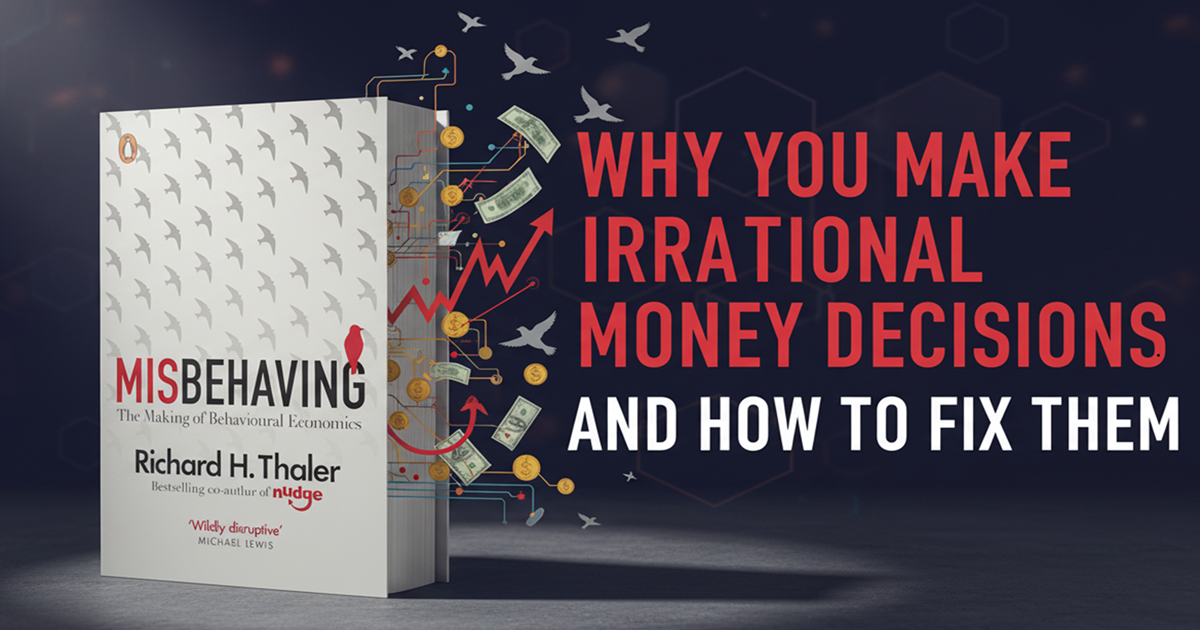
A Deep Dive Into Richard H. Thaler's "Misbehaving" and Why It Should Be On Every Bookshelf
What if economists had it all wrong? What if the perfectly rational "Homo Economicus" they spent decades theorizing about never actually existed? Richard H. Thaler, winner of the 2017 Nobel Prize in Economics, spent his entire career proving exactly that. His book Misbehaving: The Making of Behavioral Economics is part memoir, part intellectual manifesto, and entirely mind-bending.
Whether you are a finance professional, a student of psychology, or just someone who has ever made a questionable financial decision, this book will make you see your own choices in a completely different light. And trust us, you have misbehaved more than you think.
Who is Richard H. Thaler and Why Should You Care?
Richard Thaler is not your typical economist. While most of his peers were building elegant mathematical models of human behavior, Thaler was busy collecting stories of people doing things that those models could not explain. A professor at the University of Chicago's Booth School of Business, Thaler spent decades at the fringes of mainstream economics before his work was finally recognized as transformative.
Alongside psychologists Daniel Kahneman and Amos Tversky, Thaler helped build the field of behavioral economics, a discipline that fuses psychology with economic theory to understand why people make the decisions they actually make, rather than the decisions they theoretically should make.
What Is "Misbehaving" Actually About?
At its core, Misbehaving is Thaler's personal account of how behavioral economics came to be. It reads more like a captivating story than an academic textbook, which is a big reason why it became a bestseller.
Thaler walks the reader through decades of research, from his early career observations of irrational behavior to his groundbreaking contributions that reshaped public policy and financial regulation. He introduces readers to concepts like:
Mental Accounting: Why we treat money differently depending on where it came from or how we intend to use it. Found 100 dollars on the street? You are probably more likely to spend it frivolously than if you had earned it.
The Endowment Effect: Why people value things more once they own them. Thaler's famous mug experiment showed that people demanded nearly twice as much to sell a mug they had been given than they were willing to pay to buy that same mug.
Loss Aversion: Why losing 50 dollars hurts about twice as much as gaining 50 dollars feels good. This asymmetry drives countless irrational decisions in finance, health, and everyday life.
Bounded Rationality: The idea that our rationality is limited by the information we have, the cognitive limitations of our minds, and the finite amount of time we have to make decisions.
The Nudge: Thaler's Most Powerful Idea
Perhaps Thaler's most celebrated and practically applied idea is the concept of the "nudge", developed further in his co-authored book Nudge (written with Cass Sunstein). A nudge is any small design choice that influences people's behavior in a predictable way without restricting freedom of choice.
A classic example: changing workplace retirement plans from opt-in to opt-out dramatically increased employee participation in savings programs. The choice was still there, but the default was changed. This simple insight has been adopted by governments around the world to improve public health outcomes, boost pension savings, and promote organ donation.
In the United Kingdom, the government even created a Behavioural Insights Team, informally called the Nudge Unit, directly inspired by Thaler's work. The results have been remarkable, saving millions of pounds in taxpayer money and improving public outcomes across health, tax compliance, and education.
Why Traditional Economics Got It So Wrong
One of the most entertaining aspects of Misbehaving is Thaler's candid account of how fiercely mainstream economists resisted behavioral economics. For years, the prevailing view was that even if individuals made irrational decisions, markets would correct for this irrationality and produce rational outcomes overall.
Thaler demolishes this argument with a combination of humor and hard evidence. He walks through case studies from financial markets, sports drafts, game shows, and corporate boardrooms to show that irrational behavior is not just an individual quirk but a systemic force that shapes markets, institutions, and policy.
The resistance Thaler faced is itself a lesson in human psychology. Even brilliant economists, it turns out, are not immune to cognitive bias, particularly when a new idea threatens to upend the models they have spent careers defending.
Real-World Applications That Will Surprise You
What makes Misbehaving stand out from other economics books is how grounded it is in real situations. Thaler draws on:
The NFL Draft: Teams systematically overpay for high draft picks, driven by overconfidence and the winner's curse, a form of irrational bidding behavior.
The 2008 Financial Crisis: Thaler traces how behavioral failures contributed to the collapse and why purely rational models failed to predict or prevent it.
Household Savings: His Save More Tomorrow (SMarT) program, which automatically increases employee contribution rates over time, has helped millions of Americans build retirement wealth they would never have accumulated on their own.
Short Answer: Yes. Long Answer: You Have No Excuse Not To
Absolutely. The ideas in Misbehaving are more relevant today than ever. As artificial intelligence begins making decisions on behalf of humans, understanding the psychological flaws that AI is being designed to account for becomes critically important. From algorithmic trading to public health policy, the lessons of behavioral economics are shaping the world in ways most people do not even notice.
The book is accessible to anyone with curiosity and a willingness to question assumptions. It does not require a background in economics or psychology. It requires only a basic interest in why humans do what they do, which is to say, it is a book for everyone.
Key Takeaways at a Glance
Mental Accounting
We treat money differently based on its source or intended use, leading to irrational spending choices.
Endowment Effect
We overvalue things simply because we own them, making it hard to let go even when logic says we should.
Loss Aversion
Losses hurt roughly twice as much as equivalent gains feel good, distorting decision-making.
Nudge Theory
Small, thoughtful design changes can guide better decisions without removing freedom of choice.
Bounded Rationality
Human rationality is limited by time, information, and cognitive capacity.
A Book That Earns Its Nobel Prize
Richard Thaler did not just write a book. He rewrote the rules of economics. Misbehaving is smart without being smug, rigorous without being dry, and personal without being indulgent. It is the rare kind of nonfiction that you will finish and immediately want to recommend to everyone you know.
More importantly, it gives readers a framework for understanding their own decisions better. By the time you finish the last page, you will never look at a price tag, a retirement plan, or a negotiation the same way again.
Read the Book. Question Everything. Misbehave Smarter.