
And most founders don't even know it.
Here's a scenario I've seen play out dozens of times:
A startup builds a genuinely great product. They hire a solid marketing team. They run campaigns, write blogs, test ads. The pipeline is... fine. Conversions are... okay. But something feels off. The sales cycle drags. Prospects say "interesting" and then disappear. Customers love it once they're in but getting them in is like pushing a boulder uphill.
The diagnosis everyone reaches for: "We need better messaging."
The real diagnosis? You've never actually positioned your product.
Enter April Dunford
April Dunford has spent 25+ years as a VP of Marketing and executive at B2B tech companies. She's positioned and repositioned over a dozen products and watched companies waste millions of dollars solving the wrong problem.
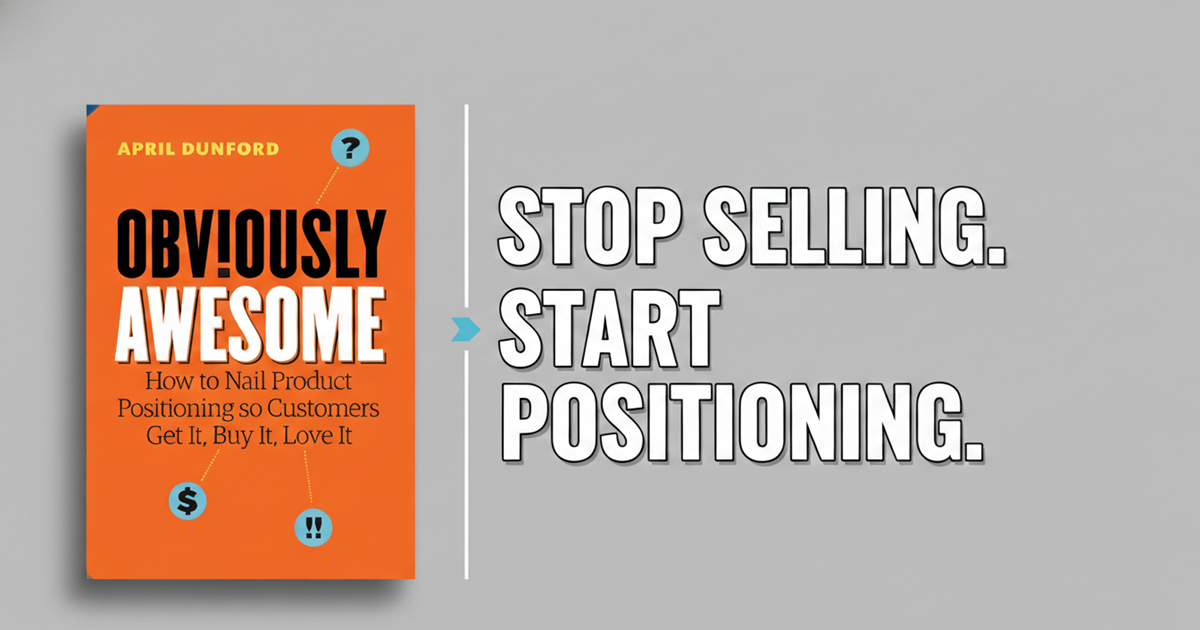
Her book, Obviously Awesome, is the most practical, no-fluff guide to product positioning I've ever read. And I say that as someone who has waded through a lot of marketing books.
So What Even Is Positioning?
Dunford's definition cuts straight through the noise:
Positioning defines how your product is the best in the world at delivering some value that a well-defined set of customers cares a lot about.
Notice what that definition does NOT say:
It doesn't say "what your product does"
It doesn't say "your mission statement"
It doesn't say "your tagline"
Positioning is the context you set in a customer's mind before they evaluate you. It's the answer to: "What is this, and why should I care?"
Get it wrong, and your product gets compared to the wrong competitors, sold to the wrong customers, and evaluated on the wrong criteria, no matter how good your copywriting is.
The 5 Components of Positioning (That Most Teams Skip)
Dunford lays out a clear framework with five interconnected pieces:
1. Competitive Alternatives What would customers do if your product didn't exist? (Hint: the answer is rarely "use your direct competitor." It's often "use a spreadsheet" or "do nothing.")
2. Unique Attributes What features or capabilities do you have that alternatives don't?
3. Value (Not Features) So what? Why do those attributes matter to the customer? This is where most companies stop too early.
4. Target Market Characteristics Who are the customers for whom your value is most compelling? Not "SMBs" or "enterprise" actual characteristics that predict who will love you.
5. Market Category Which "game" are you playing? The category you choose sets the competitive frame and triggers customer assumptions instantly.
The magic of the book is showing how these five things connect and how changing one forces you to rethink the others.
The Insight That Changes Everything
Here's the move Dunford makes that most positioning frameworks miss entirely:
Your strengths should define your market category not the other way around.
Most teams start with "we're in the CRM space" or "we're a project management tool" and then try to explain why they're better than Salesforce or Asana. That's a losing game.
Dunford flips it: Start with what you do uniquely well. Then ask what market category would make those strengths obviously the most important things a buyer should care about?
Suddenly, instead of being a weak competitor in a crowded category, you're the obvious leader in a better-defined one.
Who Needs This Book?
Honestly? Almost everyone building or marketing a product:
Founders who find themselves re-explaining what their product does every time they pitch
Product marketers who inherited positioning they didn't build and don't fully believe
Sales leaders whose reps are losing deals they should be winning
CEOs who've been told they have a "messaging problem" but something tells you it's deeper than that
If you've ever heard "we just need to communicate our value better", read this book before spending another dollar on campaigns.
Okay, Here's the Uncomfortable Truth
Positioning isn't a brand exercise. It's not a tagline workshop. It's foundational strategy that shapes every customer conversation, every sales interaction, and every marketing dollar you spend.
April Dunford makes the case better than anyone and more importantly, she gives you the tools to actually do it.
Obviously Awesome is a short read (under 200 pages). You can finish it in a weekend. The frameworks will stick with you for years.
Pick it up. Reposition accordingly. Watch your sales cycle shrink.