
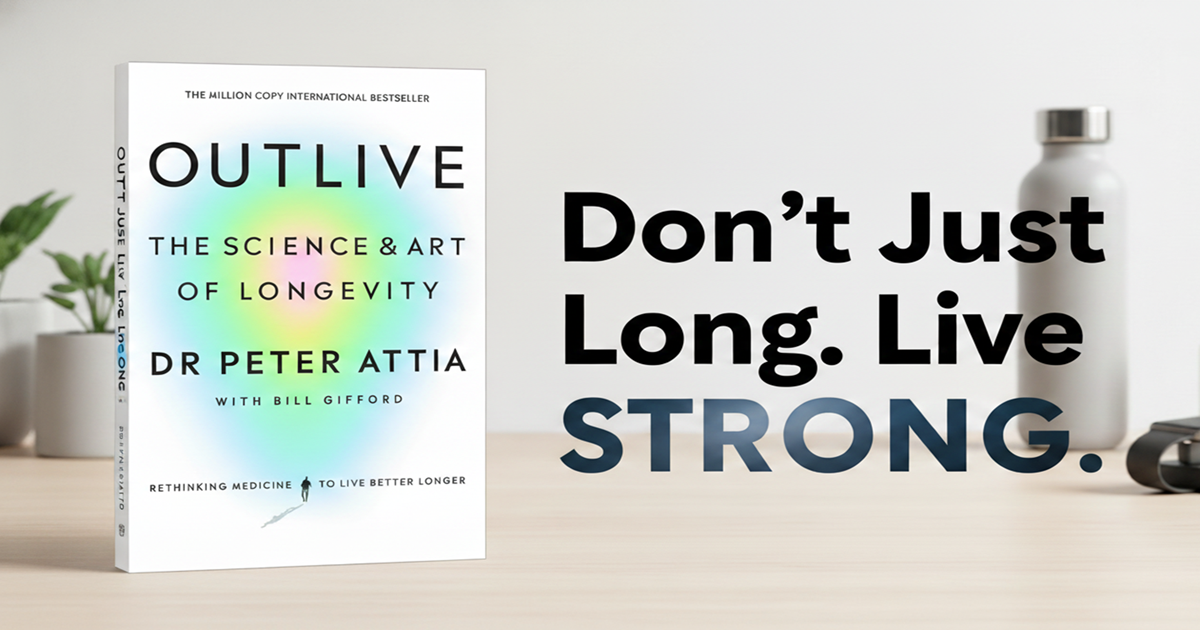
Most of us have accepted a silent deal with aging: work hard, retire, slow down, get sick, and eventually fade. Peter Attia, one of the world's foremost longevity physicians, thinks that deal is the worst contract you ever signed, and in Outlive: The Science and Art of Longevity, he tears it up completely.
This is not a book about living to 100 while hooked up to machines. It is about living well into your 80s and 90s with the strength, sharpness, and joy of someone half your age. And the gap between those two outcomes, Attia argues, is entirely within your control right now.
The Four Horsemen Nobody Is Warning You About
Attia opens with a sobering framework. The vast majority of people who die prematurely do so from four causes: heart disease, cancer, neurodegenerative disease (like Alzheimer's), and type 2 diabetes. He calls them the Four Horsemen.
Here is the uncomfortable truth he surfaces: modern medicine, what he calls Medicine 2.0, is extraordinarily good at treating these diseases once they have already destroyed decades of your health. It is terrible at preventing them from starting. Your annual physical is designed to catch problems after they have already taken root, not decades before they appear.
Attia proposes Medicine 3.0: a proactive, deeply personalized approach that treats prevention as the primary intervention, not the afterthought.
The Centenarian Decathlon: What Are You Training For?
One of the most memorable concepts in the book is what Attia calls the Centenarian Decathlon. He asks a deceptively simple question: what do you want to be physically capable of at age 85?
Carrying groceries. Playing with grandchildren on the floor. Hiking a trail. Taking the stairs without gripping the railing. These are not glamorous goals, but they require serious, consistent physical preparation starting now, not at 70.
The insight that hits hardest: the physical capacity you will have at 85 is a direct reflection of the physical capacity you build and preserve today. You cannot coast through your 40s and 50s and expect your 80s to be vibrant. The training for old age begins young.
Exercise Is the Most Powerful Drug Ever Discovered
Attia devotes significant sections to exercise, and his conclusion is blunt. Nothing in medicine, no drug, no supplement, no intervention, produces the longevity benefits that consistent physical training does.
He breaks exercise into four pillars: Zone 2 cardio (long, slow aerobic work that builds mitochondrial health), VO2 max training (brief, intense efforts that expand your cardiovascular ceiling), strength training (preserving muscle mass and bone density against aging), and stability work (the unglamorous stuff that keeps joints intact and prevents the falls that kill older adults).
Most people reading this article are doing too little of all four. Attia does not say this to shame anyone. He says it because the dose-response curve for exercise is steep at the low end, meaning even modest increases in activity produce dramatic health returns.
Nutrition Without the Religion
Unlike most longevity authors, Attia refuses to crown a single diet as the answer. He is skeptical of the nutritional tribalism that dominates wellness culture, the carnivore zealots, the vegan absolutists, the keto evangelists.
What the evidence consistently supports is simpler and less exciting: most people eat too much protein for muscle preservation, too many ultra-processed foods, and consume more calories than their metabolic health can handle. The specific dietary pattern matters less than these fundamentals.
He pays particular attention to metabolic health and insulin resistance, arguing that continuous glucose monitoring and metabolic testing reveal far more about your longevity risk than the cholesterol panel your doctor ordered at your last checkup.
Sleep and the Brain: The Chapter That Will Change Your Nights
The section on sleep and brain health is where many readers report a genuine shift in behavior. Attia explains the relationship between chronic sleep disruption and Alzheimer's risk in terms that are impossible to dismiss. The brain clears amyloid plaques (a key feature of Alzheimer's pathology) primarily during deep sleep. Consistently shortening or disrupting sleep is not a productivity hack. It is a slow tax on your cognitive future.
Attia is candid that he used to wear his own sleep deprivation as a badge of honor during his surgical residency. He now considers it one of the most damaging things he did to his long-term health.
The Chapter Most Doctors Skip: Emotional Health
Perhaps the most unexpected and affecting section of Outlive is the final portion on emotional health. Attia writes personally and vulnerably about his own psychological struggles, his workaholism, his emotional unavailability, and the intensive therapy that changed him.
His argument is not soft. He contends that emotional suffering, unresolved trauma, and disconnected relationships are as dangerous to longevity as smoking or metabolic disease. The science on social connection, purpose, and mental health as predictors of lifespan is robust and consistently underweighted in mainstream medicine.
You cannot optimize your way to a long, meaningful life with biohacks and perfect sleep hygiene while your relationships are hollow and your internal world is at war with itself. Attia understands that, and it makes the book far more human than the title might suggest.
Who Should Read This Book
If you are in your 30s, this book will feel like receiving a treasure map before the expedition begins. If you are in your 40s or 50s, it will feel like a well-timed wake-up call. If you are older, it will still offer actionable insight, because Attia is emphatic that it is never too late to change trajectory.
It is a demanding read. Attia does not talk down to his readers. There is biochemistry, clinical data, and technical nuance throughout. But it is written with enough clarity and narrative energy, much of that credit goes to co-author Bill Gifford, to remain accessible and genuinely gripping.
So, Is It Worth Your Time?
Outlive is not a wellness book dressed up in science. It is a rigorous, evidence-based argument that the way most of us are living is quietly sabotaging the last decades of our lives, and that a different outcome is available to almost everyone willing to make different choices.
Peter Attia is asking you to take the long view, not just of your lifespan but of your healthspan: the years you are truly alive, capable, and present.
That question alone is worth the price of the book.
If you want to understand the science behind living a longer, stronger, and sharper life, pick up Outlive by Peter Attia and Bill Gifford. It may be the most useful book you read this decade.
Found this useful? Share it with someone who thinks aging is just something that happens to them.