The most underrated cricket book of the decade is also the most quietly devastating portrait of English decline you will ever read.
It is July 1961. Old Trafford, Manchester. The Ashes are on the line. England are ahead for most of the match. Then, on the final day, Australia's captain strolls onto the field, whirls his wrist, and rips a series of leg-spin deliveries through the footmarks outside off stump. England collapse. Australia win by 54 runs. The Ashes are gone.
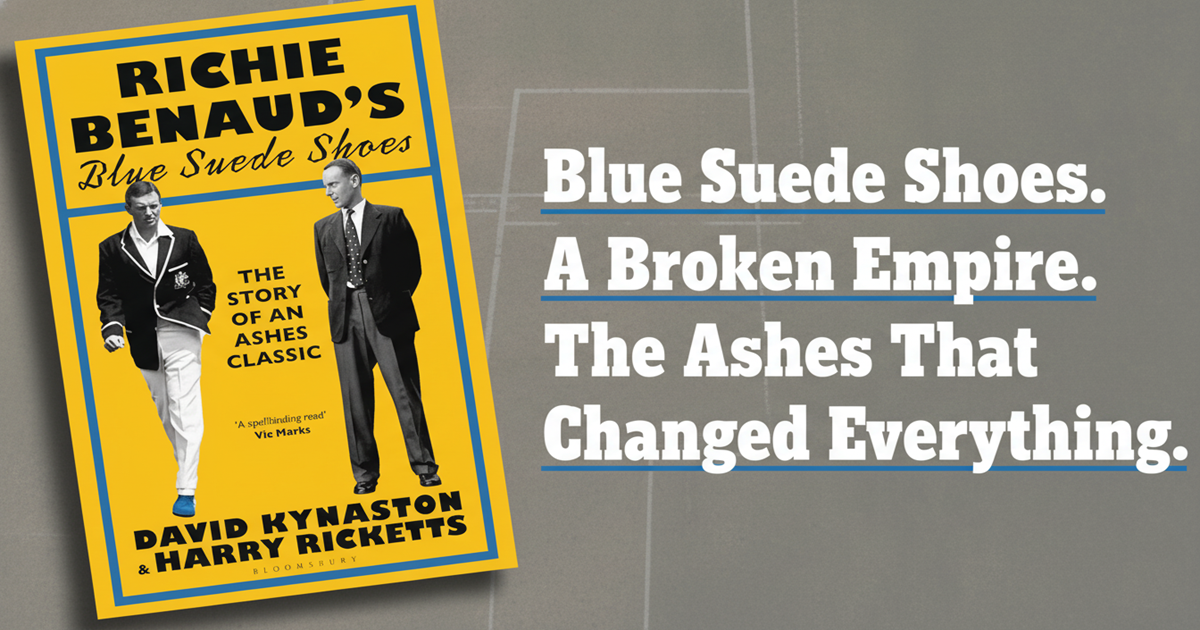
That captain was Richie Benaud. And he was, reportedly, wearing blue suede shoes.
In their award-winning book Richie Benaud's Blue Suede Shoes: The Story of an Ashes Classic, historians David Kynaston and Harry Ricketts take this single five-day Test match and use it as a lens through which to examine something far bigger: the collision between the old world and the new, between privilege and meritocracy, between the England that was and the England that was about to be born.
Two Captains, Two Worlds
At the heart of this book is one of the most fascinating contrasts in sporting history. On one side: Peter May, England's captain. Cambridge-educated, establishment to his marrow, risk-averse, a man described by a political columnist as someone who 'views life from behind his collar stud.' On the other: Richie Benaud. A small-town boy from New South Wales. A journalist by trade. Charismatic, media-savvy, instinctive, and entirely at ease in the coming television age.
Kynaston and Ricketts argue that this was not merely a sporting contest. It was a cultural one. Benaud represented a new meritocratic era knocking at the door. May represented an amateur-dominated institution clinging to an imperial legacy that the 1960s were about to make obsolete.
The baggy green caps won. And in retrospect, history was always going to side with the man in the blue suede shoes.
Cricket as a Mirror for Society
What sets this book apart from conventional cricket writing is the ambition of its authors. Kynaston is one of Britain's greatest social historians, responsible for the acclaimed 'Tales of a New Jerusalem' series on postwar Britain. Ricketts is a poet and biographer of rare elegance. Together, they do something exceptional: they reconstruct the world of early 1960s Britain through the prism of five days at Old Trafford.
They draw on match reports, Wisden, television and radio commentaries, and contemporary accounts to rebuild a world most readers will never have known, yet somehow will feel they remember. The result is what one reviewer in the Financial Times called 'an insightful account' that goes well beyond cricket to reveal the seismic cultural shifts underway in Britain at that moment.
Britain was turning from the black-and-white austerity of the 1950s into the vivid, restless energy of the 1960s. And there, at Old Trafford, in miniature, was the same transition playing out between the wickets.
The Lesson Peter May Never Learned
You do not need to love cricket to find this book essential reading. What Kynaston and Ricketts are really exploring is a question that never goes away: why do institutions resist change even when change is obviously necessary? Why do entrenched systems protect their own at the expense of results? And what happens when someone from outside the establishment simply refuses to play by the old rules?
These are questions with vivid relevance to any professional reading this today, whether you work in sport, business, technology, or leadership. The 1961 Ashes is a case study in what happens when talent, instinct, and adaptability go up against tradition, credential, and caution.
Spoiler: tradition loses.
What the Critics Said
The book won the Charles Tyrwhitt Sports Book Awards Cricket Book of the Year and the Cricket Writers' Club Derek Hodgson Book of the Year. It was also longlisted for the William Hill Sports Book of the Year Prize 2024. Critics have been almost uniformly glowing.
The Sunday Times called it gripping reading for any cricket buff. The Spectator said readers should go out and buy it immediately because the book is brilliant. The Telegraph praised its patient, scholarly storytelling that captures the hypnotic rhythm of a five-day Test match. The Literary Review described it as a minor classic.
And it is hard to disagree. This is a book that works on multiple levels simultaneously: as cricket history, as social history, as biography, and as a deeply absorbing narrative of one of sport's most dramatic final days.
The After-Lives: Where Did They All End Up?
One of the most compelling parts of the book is its final chapters, which track what happened to the key players after 1961. Peter May retired prematurely, struggled as a selector, and endured personal and financial difficulty. His legacy, once burnished, became complicated.
Benaud, meanwhile, went from strength to strength. He became a crime reporter, then the greatest television cricket commentator the game has ever produced, his voice the soundtrack to an entire era of the sport. The man in the blue suede shoes had known all along which way history was pointing.
The book also traces the careers of Ted Dexter, Bill Lawry, and Fred Trueman, and asks a question every England supporter has wrestled with across six more decades of Ashes rivalry: why does Australia usually beat us?
If you read one sports book this year, make it this one. Pick it up. Read it slowly. And the next time someone asks why England always seem to find a way to lose the Ashes, you will have a very rich, very human answer ready.