
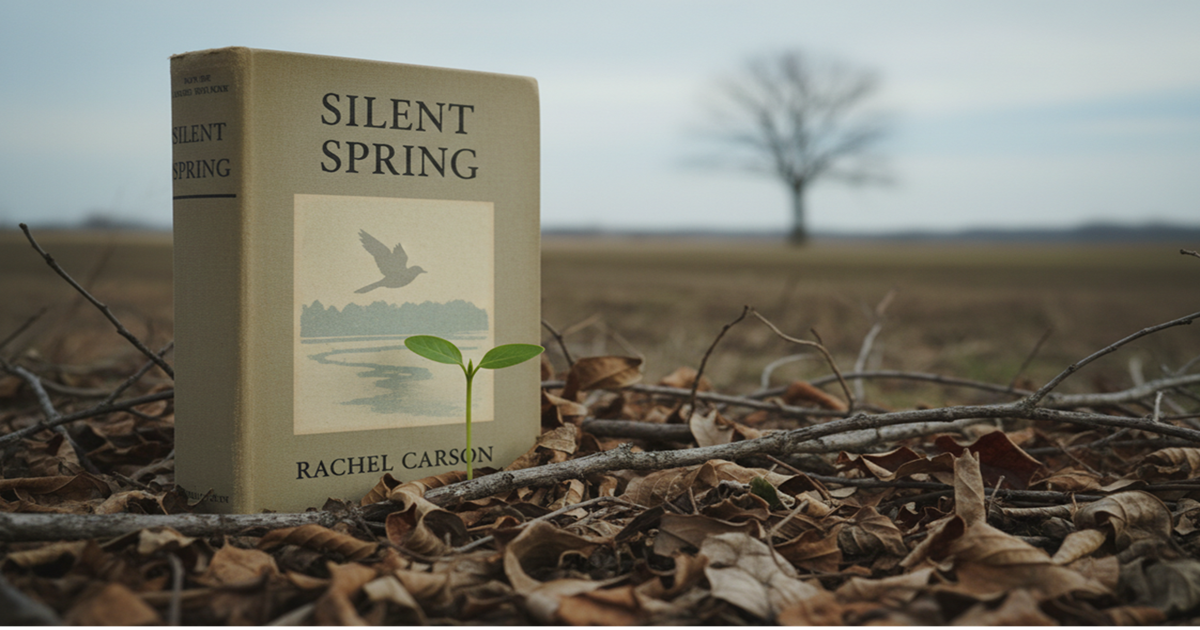
When Rachel Carson published Silent Spring in 1962, she ignited a firestorm that would transform humanity's relationship with the natural world. This groundbreaking work didn't just challenge the chemical industry, it awakened an entire generation to the invisible dangers lurking in their backyards, farms, and waterways.
The Woman Behind the Warning
Rachel Carson wasn't your typical rebel. A trained marine biologist and gifted writer, she had already captivated readers with lyrical books about the ocean. But nothing prepared the world for what came next. After receiving a letter from a friend describing mass bird deaths following pesticide spraying, Carson embarked on four years of meticulous research that would define her legacy.
Working against time, she was battling breast cancer, Carson compiled scientific evidence, interviewed experts, and connected dots that the agricultural and chemical industries desperately wanted to keep separate. The result was a book that read like a thriller but was grounded in rigorous science.
A World Without Birdsong
The book opens with a haunting vision: a town where spring arrives in silence. No birds sing, no bees buzz, and an eerie quiet blankets the countryside. This "fable for tomorrow" wasn't science fiction, it was a warning based on real events happening across America.
Carson's central argument was revolutionary for its time: synthetic pesticides, particularly DDT, were poisoning the environment in ways that cascaded through entire ecosystems. A farmer spraying crops to kill insects was unknowingly condemning birds, fish, and potentially humans to slow death by chemical accumulation.
The Science That Shocked America
What made Silent Spring so powerful was Carson's ability to translate complex biological processes into gripping narrative. She explained bioaccumulation, how toxins concentrate as they move up the food chain in terms anyone could understand. A little pesticide on crops became a lot of poison in the birds that ate contaminated insects.
Her evidence was damning. Robins convulsing on lawns after towns sprayed for Dutch elm disease. Bald eagles producing eggs with shells so thin they cracked under the parent's weight. Fish kills in rivers downstream from agricultural areas. These weren't isolated incidents but symptoms of a systemic problem.
Carson also challenged the hubris of "controlling nature." She argued that humans were part of nature, not separate from it, and that our war on insects was ultimately a war on ourselves. The chemicals industry had sold a fantasy of mastery that was actually a recipe for ecological catastrophe.
The Backlash Was Immediate and Fierce
Chemical companies launched a coordinated attack before the book even hit shelves. They questioned Carson's credentials, called her hysterical, and spent hundreds of thousands of dollars trying to discredit her work. One company threatened to sue her publisher. Trade groups produced their own literature dismissing her concerns.
The personal attacks were particularly vicious. Critics suggested that as an unmarried woman without children, Carson couldn't understand the need to protect families from insect-borne diseases. They painted her as anti-progress and anti-science, despite her impeccable scientific credentials.
But Carson had done her homework. Every claim was documented, every source vetted. When she appeared on CBS Reports to discuss the book, her calm expertise stood in stark contrast to the chemical industry spokesman's bluster. Public opinion began to shift.
The Legacy That Shaped a Movement
Silent Spring didn't just change minds—it changed laws. President John F. Kennedy ordered a federal investigation into pesticide use. By 1972, the United States banned DDT for agricultural use. The Environmental Protection Agency, created in 1970, owed its existence partly to the awareness Carson had raised.
Beyond policy, the book sparked the modern environmental movement. Earth Day, the Clean Water Act, the Endangered Species Act—all trace their roots to the consciousness Carson awakened. She taught people to think ecologically, to see connections between actions and consequences that might be separated by time and distance.
Writers, activists, and scientists credit Silent Spring as their inspiration. It demonstrated that one person armed with truth and eloquence could challenge powerful industries and win. It showed that environmental writing could be both scientifically rigorous and literary, poetic and precise.
Why Silent Spring Still Matters Today
More than six decades later, Carson's warnings feel prescient. We face new chemical threats: microplastics in our oceans, forever chemicals in our water, neonicotinoids threatening pollinators. The fundamental tension she identified between short-term economic gains and long-term ecological health remains unresolved.
Climate change represents the ultimate vindication of Carson's worldview. Just as she warned that invisible pesticides could accumulate to catastrophic effect, we now understand that invisible carbon emissions are reshaping our planet's climate. The lesson is the same: we cannot wage war on nature without becoming casualties ourselves.
The book also reminds us that scientific truth can overcome corporate propaganda, though the battle is never easy. In an age of misinformation, Carson's example of careful research and clear communication offers a template for how to engage complex issues.
Reading Silent Spring in the Modern Age
For contemporary readers, some aspects of Silent Spring feel dated, references to 1950s agricultural practices or Cold War anxieties about atomic radiation. But the core message transcends its era. Carson asks us to think critically about the unintended consequences of our technologies and to value the intricate web of life that sustains us.
The book is surprisingly readable, blending scientific explanation with vivid storytelling. Carson's background in marine biology and her gifts as a nature writer shine through. She makes you care about soil microorganisms and feel outrage at the poisoning of robins.
The Questions We Still Face
Carson didn't argue for a complete ban on all pesticides. She advocated for what we'd now call integrated pest management using chemicals sparingly and strategically, as a last resort rather than first response. She called for humility in the face of ecological complexity and precaution when introducing new substances into the environment.
These principles remain controversial. How do we balance agricultural productivity with environmental protection? Who bears the burden of proof when new chemicals are introduced? How do we weigh immediate benefits against long-term risks? Carson didn't provide easy answers, but she framed the right questions.
A Testament to Courage
Perhaps the most remarkable aspect of Silent Spring is that Carson wrote it while dying. She knew she wouldn't live to see the full impact of her work. Yet she persevered through pain, exhaustion, and attacks on her character because she believed the message was more important than personal comfort.
Rachel Carson died in 1964, just eighteen months after Silent Spring was published. She was 56 years old. But her ideas had already taken root, growing into a movement that would reshape environmental policy and consciousness for generations.
Conclusion: The Spring That Never Falls Silent
Silent Spring endures not just as a historical artifact but as a living document. Each generation rediscovers its relevance as new environmental challenges emerge. Carson's fundamental insight—that we are part of nature, not its master—remains radical in a world still oriented toward conquest and exploitation.
The book's title evokes loss, but its legacy is one of awakening. Thanks to Carson's courage, the spring silence she feared never fully arrived. Birds still sing, though they face new threats. Her work ensured that someone would always be listening, always be watching, always be willing to speak uncomfortable truths in defense of the living world.
In a very real sense, every environmental protection we enjoy today, every clean stream, every recovered species, every chemical banned before it could do irreversible harm exists because one woman decided to write one book. That's the enduring power of Silent Spring, and why Rachel Carson's voice still echoes through our ongoing conversations about how to live sustainably on this fragile planet.