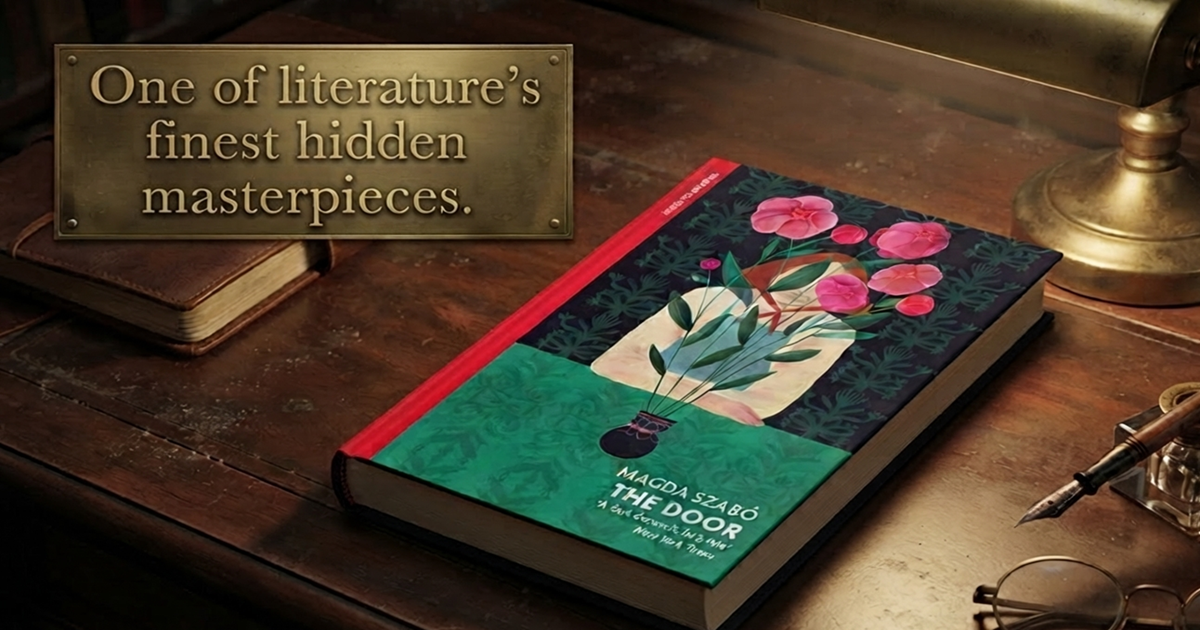
When Magda and her husband move into a new apartment in Budapest, they need someone to manage the house. A neighbour recommends Emerence, the woman who sweeps the entire street before sunrise and cleans for half the block.
Magda goes to ask Emerence for help. It does not go the way she expects. Emerence stands in her doorway, looks Magda up and down, asks her a series of blunt questions about her habits and her marriage, and only then decides whether Magda is worth working for. Emerence picks her employer. Not the other way around.
That single scene sets up everything that follows.
The House With the Locked Door
Emerence lives alone in a small house at the end of the street. Heavy curtains cover every window. The front door is always bolted. In the years that follow, Emerence cooks for Magda, nurses her through illness, drags a burst pipe's worth of flooded cellar water off Magda's ruined manuscript pages with her bare hands, and gives Magda a puppy, Viola, after her own dog dies. She becomes, without ever saying so, the most important person in Magda's life.
But no one, not Magda, not the local priest, not a single neighbour in twenty years, is allowed past that front door.
Piece by piece, Emerence lets details of her past slip out. A twin sister who drowned in a storm while their father held her. A broken engagement to a man later tied to the fascist Arrow Cross. Families she sheltered in that same locked house during the siege of Budapest, when trusting the wrong person could get you killed. Every fragment explains a little more of why she has spent her life making sure no one can ever again see inside her walls, or inside her.
The Choice That Breaks Everything
The turning point in the novel is not a twist. It is a decision.
Magda is awarded a major literary prize, the kind of recognition a writer waits an entire career for. Around the same time, Emerence, now old and worn down, falls seriously ill. Magda has to choose between staying with the one person who has shaped her life for two decades, and leaving to accept the honour she has worked toward for just as long.
She leaves.
While Magda is being celebrated at the ceremony, Emerence collapses alone in her house. By the time anyone realises how bad it is, the only way to reach her is to force the door open.
What Was Behind It
What the rescuers find is not what the neighbourhood gossip had guessed for twenty years. There is no scandal. There are rooms kept exactly as they were for relatives long dead. There are the strays she had quietly taken in over the years, cats and dogs no one else wanted. There is food and cloth and small preserved things, kept the way someone keeps supplies who has lived through war and famine and never fully believed it will not happen again. It is not a secret. It is a whole private life Emerence built so that she would never again have to depend on anyone seeing her at her most exposed.
And then she is seen at her most exposed anyway. Unconscious, she is washed and dressed by strangers, the exact violation she had spent her entire life avoiding.
She dies without ever forgiving Magda for the door, or for the ceremony, or for leaving.
Why This Story Still Cuts
Magda Szabó based Emerence on her own housekeeper, and that lived history is what makes the guilt in this novel feel so unresolved. There is no scene where Magda is let off the hook. The reader is left holding the same question she is left holding: was the door ever really about privacy, or was it the only power Emerence had left, and did Magda take it from her twice over, once for a television interview and once for a ceremony in Athens.
Read the last fifty pages and see which side of that question you land on. It rarely stays the same on a second read.