
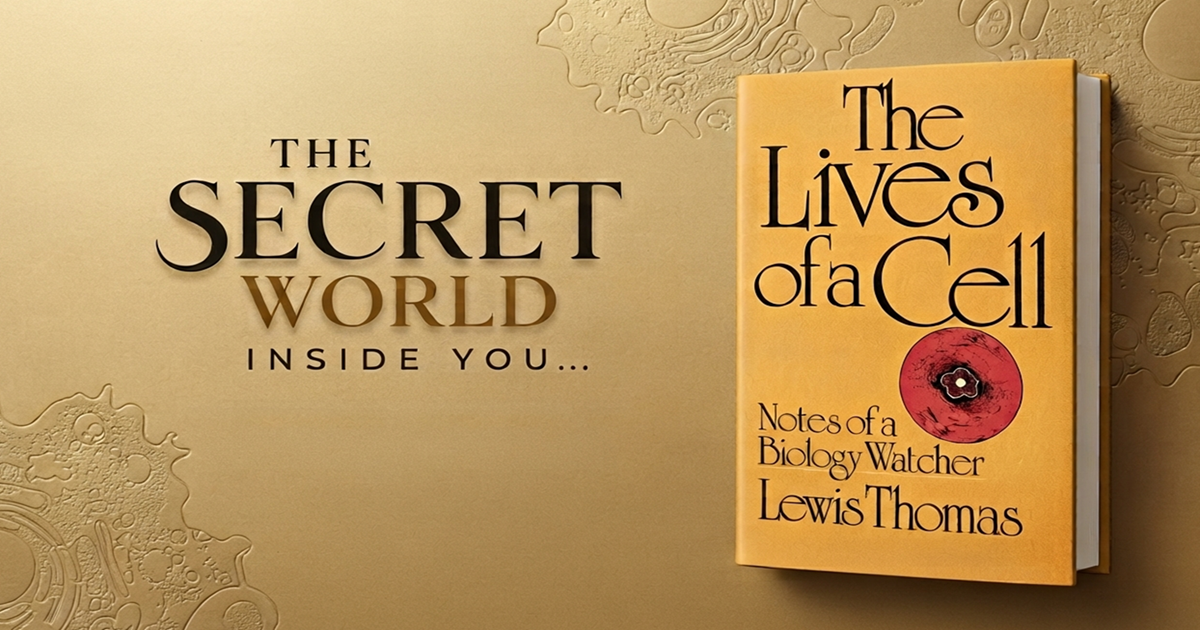
Here's an unsettling fact: the structures generating energy inside your cells right now, your mitochondria, weren't originally yours. Billions of years ago they were independent organisms. They moved in, struck a deal, and never left. You're not one thing. You're a colony that chose cooperation over competition.
That's the opening idea of The Lives of a Cell: Notes of a Biology Watcher, and it only gets stranger.
The Book That Turned Biology Into Poetry
Published in 1974, the book collects 29 essays that physician Lewis Thomas originally wrote for The New England Journal of Medicine, capped at 2,000 words each. Inside that limit, Thomas made hard science read like literature.
Readers responded. The book sold over 250,000 copies within five years, was translated into eleven languages, and won the U.S. National Book Award in two separate categories the same year, a near impossible double win.
Zoom Out. Then Zoom Out Again.
Thomas's signature move is scale. He starts microscopic, then pulls back until you're staring at the entire planet. Trying to describe Earth itself, he landed on the line that became the book's thesis: "it is most like a single cell."
In the title essay, he challenges the idea that a human being is a single organism at all. Our bodies, he argues, belong to trillions of cells working in tireless harmony to produce what we call consciousness. Then he goes further, asking us to picture Earth itself as one giant cell, and humanity as just a small, replaceable piece inside it.
You're not the main character. You're a passenger in something enormous.
Are We Just Ants Wearing Shoes?
Elsewhere, Thomas compares human populations to ant colonies, arguing that both species, zoomed out far enough, show group behaviors that raise a genuine question: are these groups actually a kind of organism? Termites, mold, and fish, he notes, sync behavior in eerily similar ways. It changes how you look at a crowded subway platform.
A Thought Experiment That Will Ruin Your Week
The book's sharpest moment might be a single paragraph. Thomas suggests humanity should refuse to launch a nuclear weapon until we can fully explain one complete living organism, and half seriously, nominates a microscopic creature living in the gut of termites. His point lands hard: if we can't explain something that small, what gives us the right to destroy something as large as a planet?
Why It Still Feels So Relevant
Thomas also takes aim at modern medicine, describing a system where expensive, half effective care gets funded generously while cheaper, more fundamental solutions go underused. It reads less like 1974 and more like this morning's headlines.
We live in an era obsessed with the self: personal brands, self-optimization, the individual as a lifelong project. The Lives of a Cell quietly argues the opposite. You were never a self-contained unit. You're a collaboration, connected to termites, ants, and everyone standing next to you at the bus stop.
Thomas ran Yale Medical School and Memorial Sloan-Kettering. The Modern Library ranked this book 11th on its list of the best nonfiction of the 20th century. Fifty years on, it still hasn't stopped rearranging how people see themselves.
If the mitochondria, the ants, or the termite gut microbe standing between us and nuclear war caught your attention, that's just the surface. Twenty-nine essays are waiting, and the strangest ones haven't come up yet.
If this idea made you rethink what it means to be human, the rest of the essays only widen the perspective.