You pick up a novel. The main character is a monk. A holy man. Someone the entire city looks up to. You think you know where this is going.
You are wrong.
By the time you reach the last page of The Monk by Matthew Gregory Lewis, that holy man will have committed acts so dark, so shocking, that even today the book makes readers stop and stare at the page. And the ending? It will stay with you for days.
This is not a slow, dusty classic. This is a thriller. A horror story. A psychological breakdown wrapped inside an 18th-century Gothic novel. And it was written by a 19-year-old.
The Story That Shocked England
Ambrosio is the most respected monk in all of Madrid. People line up just to hear him preach. He is brilliant, devout, and completely cut off from the outside world. He has lived inside a monastery his entire life.
That is exactly the problem.
One day, a mysterious figure named Matilda enters his life. Beautiful, clever, and nothing like anyone Ambrosio has ever met. And slowly, everything he has built, his reputation, his faith, his self-control, begins to fall apart.
But this is not just a story about a man who makes one bad choice. Ambrosio does not stumble. He falls. And then he keeps falling. With each chapter, his decisions get darker, more desperate, more horrifying. Lewis does not let him off the hook. Not once.
Running alongside Ambrosio's story are other plotlines that are equally gripping. A young couple separated by a terrifying secret. A ghost that haunts an old castle. A dungeon hidden beneath a convent. A sinister court that punishes in the cruelest ways possible. The novel keeps throwing things at you, and none of it feels wasted.
A Teenager Wrote This?
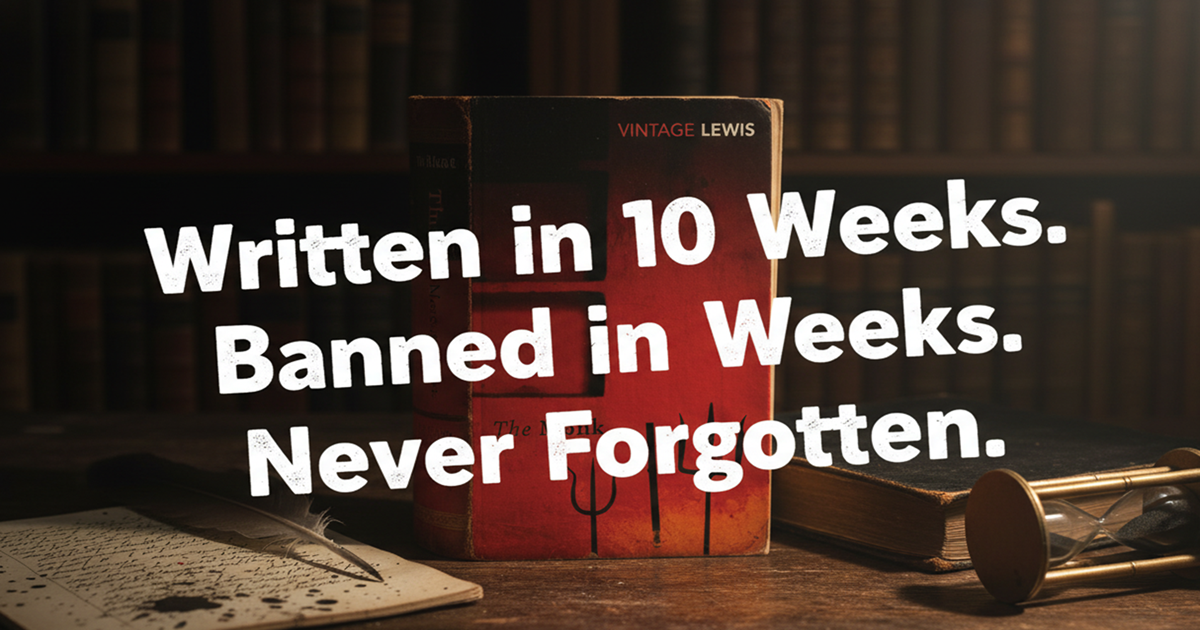
Here is a fact that makes the book even more remarkable. Matthew Gregory Lewis wrote the first draft of The Monk in ten weeks. He was 19 years old, far from home, and bored out of his mind in Weimar, Germany.
The book was published in 1796, when Lewis was still a young man working as a Member of Parliament. Almost immediately, it caused uproar. Priests condemned it. Critics called it immoral and dangerous. The House of Lords seriously debated whether Lewis should be prosecuted for writing it.
And yet Lord Byron loved it. The Marquis de Sade called it the greatest novel of its time. Readers bought it in secret and passed copies to each other like contraband.
Lewis was eventually pressured into toning down the most controversial parts for later editions. But by then, it did not matter. The damage, or rather the legend, was done.
Why Ambrosio Is So Hard to Look Away From
Most villains in fiction are easy to dismiss. You see them coming. You know they are bad from the start.
Ambrosio is different. At the beginning of the novel, you almost like him. He is sincere. He is dedicated. He genuinely believes in what he is doing. That is what makes his fall so disturbing. You watch a real person, not a cartoon monster, make one bad decision, and then another, and then another, each one worse than the last.
Lewis understood something that most writers of his time did not. The scariest stories are not about monsters from outside. They are about what happens when the monster is already inside us, kept locked away by rules and walls and routines, and then one day, it finds a way out.
Ambrosio is that story. And once you see it, you cannot unsee it.
The Book That Changed Everything
The Monk did not just entertain people. It changed what horror fiction was allowed to do.
Before Lewis, Gothic novels kept things polite. Strange noises. Hidden rooms. Mysteries that turned out to have rational explanations. Lewis threw all of that away. In his world, the supernatural is real. Evil is real. And there are no tidy resolutions.
The writers who came after him felt that shift. Mary Shelley. Edgar Allan Poe. Bram Stoker. All of them, in different ways, are writing in the shadow of The Monk. You can trace the DNA of Frankenstein, of Dracula, of a hundred modern horror novels back to this one book written by a restless teenager in 1794.
It is not an exaggeration to say that without The Monk, Gothic fiction as we know it would not exist.
Should You Read It?
If you have ever watched a horror film and thought the book would be better, read The Monk.
If you like stories where characters make terrible decisions and you cannot stop watching, read The Monk.
If you want to understand where modern dark fiction actually comes from, where all the morally complex villains, the corrupt institutions, the atmosphere of creeping dread first appeared in English literature, read The Monk.
It is not an easy read in the sense that it will comfort you. It is an easy read in the sense that once you start, you will find it very hard to stop.
Nearly 230 years after it first made England furious, The Monk has lost none of its power. That alone should tell you something.
Pick up your copy of The Monk by Matthew Gregory Lewis and find out why some books never go quiet.