
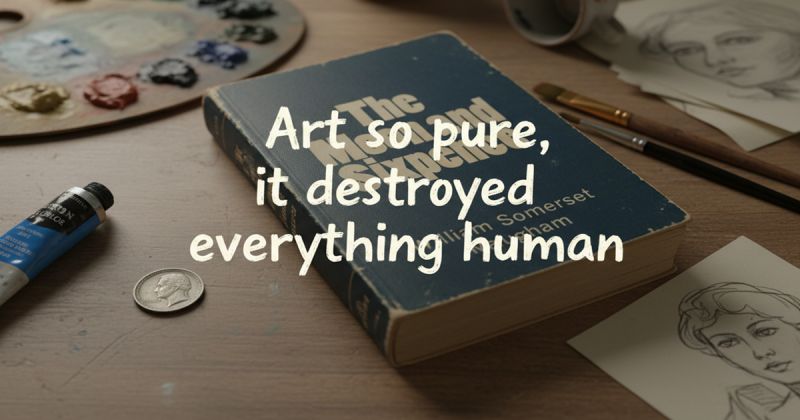
The Morning Everything Changed
You are having breakfast with your husband. He is quiet, as usual. Ordinary, as usual. You think nothing of it.
Then he leaves for work. And never comes home.
No fight. No goodbye letter. No other woman. Just... gone.
This is how The Moon and Sixpence begins. And from this single, stunning moment, W. Somerset Maugham pulls you into one of the most unsettling, thought-provoking novels ever written.
Published in 1919 and inspired by the life of French painter Paul Gauguin, this book asks a question that will follow you long after the last page:
What does it truly cost to become who you were meant to be?
Act One: The Ordinary Man Who Vanished
Charles Strickland is nobody. That is the point.
He is a London stockbroker. Middle-aged. Respectable. The kind of man you sit next to on a train and forget before you reach the next station. His wife hosts dinner parties. His children are well-behaved. Everything is exactly as it should be.
Then one day, he disappears to Paris.
The narrator, a writer who knows the family, goes to Paris to find him. He expects to discover some sordid affair. Instead, he finds Strickland in a tiny, dirty room, eating almost nothing, painting. That is all. Just painting.
'I tell you I've got to paint. I can't help myself.'
No apology. No guilt. No explanation beyond that one sentence. For Strickland, it is enough. For everyone around him, it is incomprehensible.
This is what makes the novel electric from the very first act. You are watching a man commit social suicide in slow motion, and you cannot look away.
Act Two: Paris, Poverty, and a Strange Kind of Freedom
Paris in those years was full of artists. But Strickland is not like the romantic, cafe-sitting, beret-wearing artist you might imagine. He has no interest in being seen. No interest in selling his work. No interest in being liked.
He is sick, poor, and completely at peace.
The narrator watches in growing fascination. He introduces Strickland to Dirk Stroeve, a Dutch painter who is kind, generous, and thoroughly mediocre. Dirk immediately recognizes that Strickland is a genius. He helps him. Feeds him. Opens his home to him.
And Strickland repays this kindness in the cruelest way possible. He destroys Dirk's marriage. Not out of love or passion, but almost out of boredom. And when the woman who left Dirk for Strickland realizes he does not love her either, the consequences are devastating.
Strickland does not destroy lives out of cruelty. He destroys them out of complete indifference. And somehow, that is worse.
This is where Maugham does something brilliant. He makes you despise Strickland. And then, quietly, he makes you understand him. Not agree with him. Not forgive him. Just... understand that his obsession is real, and it is bigger than anything else in his life, including other people.
Act Three: Tahiti, and the Masterpiece Nobody Was Meant to See
The final act of the novel shifts entirely. Strickland disappears from Europe. The narrator spends years wondering what became of him. Then, piece by piece, the story reaches him from the other side of the world.
Strickland has found his way to Tahiti. The island of Gauguin. The island of colour and heat and a life stripped down to its simplest form.
He marries Ata, a quiet Tahitian woman who asks nothing of him. She gives him a hut, food, and silence. He gives her the only thing he has. His time. His presence. His art.
For years, he paints. The hut slowly fills with colours. The walls, the ceiling, every surface becomes part of one enormous, consuming work. People who visit the hut later describe it as something they cannot explain. Not just beautiful. Something deeper. Something almost frightening.
He was going blind. He knew it. He kept painting anyway.
By the time Strickland dies, ravaged by disease, he has lost his sight. But before he goes, he gives one final instruction to Ata.
Burn it all. The hut. The paintings. Everything.
She does.
The greatest work ever created by the greatest artist nobody knew, gone forever. Seen by a handful of people in a jungle in Tahiti, then turned to ash.
Close the book. Sit with that for a moment.
What This Novel Is Really About
The Moon vs The Sixpence
The title is never explained in the book, but its meaning sits underneath every page. The sixpence is the world you live in. Bills. Reputation. Duty. Safety. The moon is the thing you actually want. The dream so far away it seems almost foolish to chase.
Strickland throws the sixpence in the gutter and spends his whole life staring at the moon. Most of us never dare to even look up.
The Question of Greatness
Can a man be a monster and still leave something beautiful behind? Maugham refuses to answer this. He just lays both truths side by side. Strickland is cruel. His art is transcendent. The novel dares you to decide if one cancels the other.
Freedom and What It Actually Costs
Every character in this novel wants something. The narrator wants to understand genius. Dirk wants to be loved. Strickland's wife wants her comfortable life back. Ata wants nothing, which is why she is the only one who survives intact.
Freedom, the novel suggests, is not about getting what you want. It is about being willing to lose everything else.
Why Book Lovers Cannot Stop Talking About This Novel
If you have read Of Human Bondage, Maugham's other masterpiece, you already know his voice. Precise. Cool. Deeply observant. He never tells you how to feel. He just shows you exactly what happened and lets you wrestle with it.
But The Moon and Sixpence is sharper. Stranger. It reads like a fever dream wrapped in the style of a biography.
The genius of the structure is that we never fully know Strickland. We only see him through the narrator's eyes, and the narrator freely admits he does not understand him. We are given fragments, stories, impressions. Like a painting seen from too close, it only makes sense when you step back.
And that final image, the burning hut, the destroyed masterpiece, the silence of Tahiti afterward, is one of the most powerful endings in all of English literature. It does not explain itself. It does not comfort you. It just ends. And it stays.
Some books you finish. Some books finish you. This is the second kind.
Read It. You Will Not Regret It.
The Moon and Sixpence is one of those rare novels that changes the way you think about your own life. Not by giving you answers. By forcing you to ask questions you have been avoiding.