
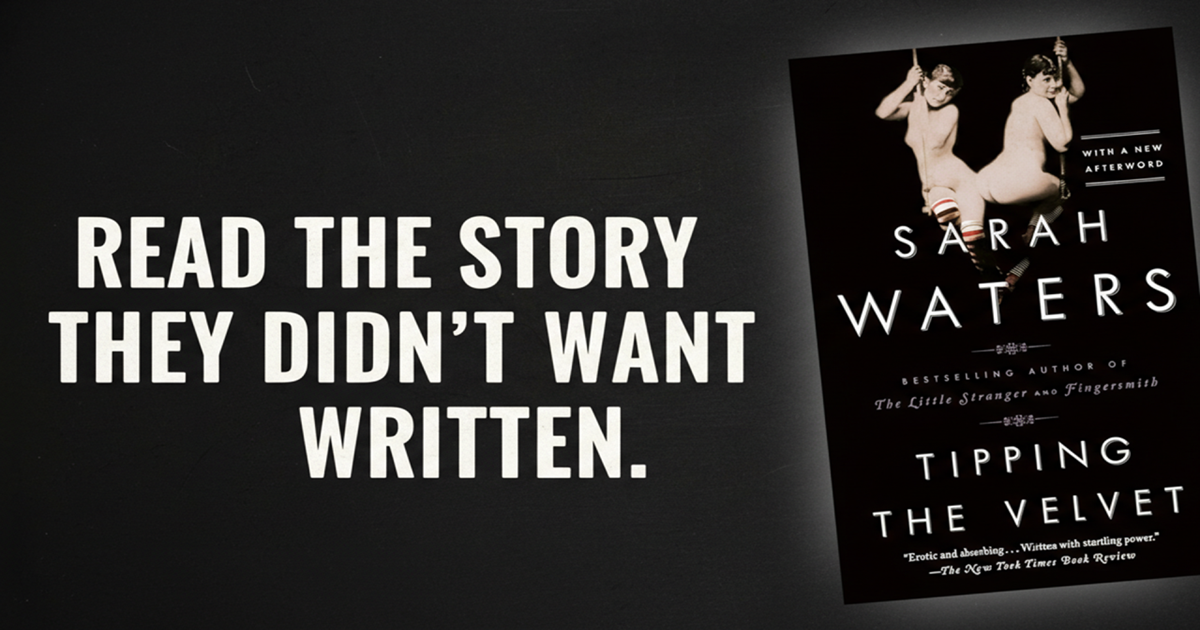
Sarah Waters' debut novel Tipping the Velvet (1998) is many things at once: a picaresque, a bildungsroman, a love story, and a meticulously researched excavation of a Victorian London that official history preferred to leave buried. It was controversial enough to be pulled from some library shelves. It was adapted by the BBC in 2002. And it remains one of the most significant works of historical fiction published in the last three decades.
What makes it remarkable is not just what it depicts, but where it chooses to look.
The London Waters Builds
Victorian London in Tipping the Velvet is not the London of Dickens or Conan Doyle. Waters is not interested in gaslit drawing rooms or the moral anxieties of the middle class. She is drawn instead to the music hall, the street, the rented room, the socialist meeting hall, and the spaces in between, places where class boundaries were porous and identity was something performed as much as it was lived.
The novel's protagonist, Nan Astley, moves through several distinct strata of late Victorian society over the course of the narrative. She begins in Whitstable, the daughter of an oyster-house keeper, before following Kitty Butler, a male impersonator she has fallen in love with, to the music halls of the West End. From there, her trajectory takes her through destitution on the streets of the East End, kept life in the wealthy townhouses of the city's west, and finally into the world of radical socialist politics in working-class south London.
Each of these settings is rendered with scholarly precision. Waters conducted extensive research into the culture of Victorian music hall, a form of entertainment that was genuinely transgressive in its time. Male impersonators like Vesta Tilley and Annie Hindle were celebrated performers whose gender-bending acts drew enormous crowds and, significantly, devoted female followings. Waters takes this documented cultural reality and asks a question mainstream historians rarely bothered with: what was actually going on in those audiences? What did those women feel?
History Never Forgot Her. Literature Did.
The 1880s and 1890s in Britain were a period of enormous social ferment. The labour movement was gaining strength. The first stirrings of organised feminism were being felt. And underneath the surface of respectable Victorian life ran currents of sexual and social nonconformity that contemporaries were often acutely aware of, even if they lacked the language we now use to describe them.
Waters understands this period intimately. The novel's later sections, set in the milieu of socialist and feminist activism, draw on the real history of organisations like the Fabian Society and the early trade union movement. Nan's political awakening in this part of the novel is never abstract. It is grounded in the concrete realities of working-class life in 1890s London, in the economics of domestic labour, in the geography of poverty, in the specific texture of what it meant to be a woman without money or protection in that city at that time.
This is where Tipping the Velvet separates itself from lesser historical fiction. Waters does not use the past as a picturesque backdrop. She uses it as an argument. The argument is that queer women existed in Victorian London in significant numbers, that they found each other, that they built communities and subcultures, and that their erasure from the historical record was a deliberate consequence of who got to write that record.
What Waters Does With the Novel Form
Waters writes in a mode of conscious homage to the Victorian novel itself, adopting its episodic structure, its use of coincidence and revelation, its delight in dramatic irony, while systematically subverting its moral assumptions. The Victorian novel, from Jane Eyre to The Portrait of a Lady, tends to resolve its heroines into domesticity or punish them for refusing it. Nan Astley refuses it repeatedly, and Waters refuses to punish her.
This is a more radical formal decision than it might initially appear. The shape of a story carries moral weight. By giving Nan the arc of a Victorian heroine while denying the expected Victorian ending, Waters rewrites not just a character but a convention.
Read the Book They Didn't Want You To
Tipping the Velvet is available wherever books are sold. If you have any interest in Victorian history, in the politics of narrative, in what literary fiction can do when it takes the past seriously, this novel rewards close attention. It is also, it should be said, propulsively readable. Waters is too skilled a storyteller to let her scholarship get in the way of the story.
Read it. Then read it again with the history in mind. It gets richer both times.