
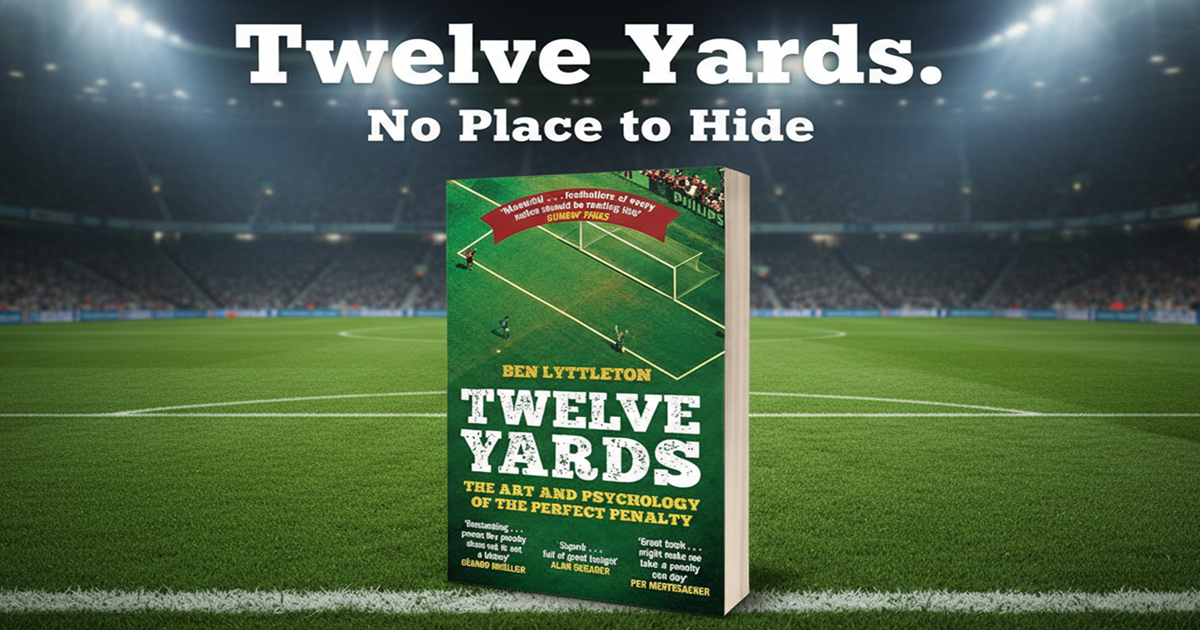
A review and reflection on Twelve Yards by Ben Lyttleton
There's a moment in the prologue of Twelve Yards that stops you cold.
Ben Lyttleton, journalist, broadcaster, football club co-owner, and now penalty coach is standing at Lansdowne Road, Dublin, about to take a penalty against Packie Bonner in a half-time shoot-out. He'd spoken to Shay Given beforehand. Given had given him advice. Simple advice. And now, standing over the ball in front of 25,000 fans, Lyttleton cannot remember a single word of it.
"My mind had gone blank. Had he told me to change my mind or not to change my mind?"
That moment, the brain dissolving under pressure is what this entire book is about.
Eight Feet High. Eight Yards Wide. One Person in the Way.
On paper, a penalty kick is absurdly straightforward. The goal is 24 feet wide and 8 feet high. The goalkeeper is roughly 6 feet tall. The ball is placed 12 yards from goal. No defender. No offside. Just you, the ball, and a keeper who statistically you should beat almost every time.
And yet.
Roberto Baggio. Gareth Southgate. David Beckham. Lionel Messi. The greatest footballers in the world, reduced to symbols of failure by a single kick. Why?
Twelve Yards is Lyttleton's attempt to answer that question properly, not with platitudes about "bottle" or "mental weakness," but with rigorous research, fascinating interviews, and an intellectual honesty that elevates it above the typical sports book.
What the Book Gets Right: It's Never Just About the Kick
The most valuable insight Lyttleton delivers is this: the penalty is decided long before the ball is struck.
Through conversations with psychologists, sports scientists, goalkeepers, and some of history's greatest penalty-takers, he dismantles the myth that the shoot-out is a lottery. It isn't. It's a contest of preparation, psychology, and self-knowledge and the teams and players who treat it that way win more often.
Consider a few of the book's revelations:
Preparation matters enormously. Antonín Panenka didn't invent his famous chip on a whim in the 1976 European Championship final. He spent two years developing it, the disguise, the run-up, the contact, the pace. When he stepped up, it wasn't bravery. It was the execution of a plan. Lyttleton, by contrast, had never practised his Panenka. The result was predictably disastrous.
Patterns can be read. Professor Ignacio Palacios-Huerta of the London School of Economics has spent decades analysing the penalty habits of kickers and goalkeepers. He can detect whether a player who kicks 70% of penalties to their natural side drops to 60% and that 10% difference is enormously exploitable. Before the 2010 World Cup final, his analysis was shared with the Dutch coaching staff. They were "highly impressed." It didn't save them from Iniesta, but it illustrates the edge that data can provide.
Mindset is everything — but it can be coached. Matt Le Tissier, who missed just one penalty in his entire professional career (47 out of 48), offers a masterclass in attitude. He wanted to take penalties. He looked forward to them. He practised them methodically, even paying youth goalkeepers £10 for every one they saved to ensure proper resistance in training. His advice to England? Stop telling yourselves you're rubbish. Perception becomes reality.
The English Disease
Chapter 1 is titled "The English Disease" and it's both a forensic analysis and a quietly damning indictment.
England have lost five major shoot-outs in a row (at the time of writing). Four different goalkeepers. Different players, different eras, different managers. Same result. And the excuses that follow are almost identical across decades:
1990: "In the end nobody could beat us in open play." — Bobby Robson
1998: "You can never recreate on the training ground the circumstances of the shoot-out." — Glenn Hoddle
2004: "It was as much down to the penalty spot as anything. When you get into that it is a lottery." — Gary Neville
The book's implicit argument is powerful: excuses are a self-fulfilling prophecy. If you believe it's a lottery, you won't prepare. If you don't prepare, you'll lose. And when you lose, you'll blame the lottery.
The teams that break this cycle, as England eventually did at Euro 2020 and the 2018 World Cup, do so by changing the culture. By treating the shoot-out as a skill, not a fate.
What This Means Beyond Football
I'd argue Twelve Yards is not really a football book. Or rather, it's not only a football book.
The penalty is a perfect microcosm of high-stakes performance in any field. The lessons translate directly:
1. Preparation is the antidote to pressure. When your mind goes blank under stress and it will, your body falls back on what it has rehearsed. If you haven't rehearsed, you're improvising in the worst possible moment.
2. Data doesn't replace intuition, it informs it. Palacios-Huerta's analysis doesn't tell a goalkeeper where to dive with certainty. It shifts the probabilities in their favour. That's all any good decision-support tool does.
3. Narrative shapes performance. England's penalty curse was partly self-constructed. The story a team or an organisation tells about itself becomes the ceiling on what it can achieve. Changing outcomes requires changing the story first.
4. Ego is the enemy of execution. Lyttleton's second penalty, the Panenka attempt, came from a dangerous place: "Confidence had been supplanted by arrogance. I knew I was going to score this one." He didn't. Overconfidence is just under-preparation wearing a different mask.
A Book With Skin in the Game
What makes Twelve Yards particularly credible is that Lyttleton hasn't just written about penalties, he lives them. Since joining Danish club Akademisk Boldklub as part of the ownership group in 2022, he has worked as a penalty coach. AB have won every shoot-out they've been involved in since his arrival.
That's not a coincidence. It's proof of concept.
The book was the research. The club is the laboratory. The results are the evidence.
The Ball Is Still Rolling
Near the end of the prologue, Lyttleton writes something that stuck with me:
"The penalty is football in its purest form: kicker, goalkeeper and ball. Nothing else. A test of technique and nerve. It's the essence of the game, football at its most elemental. And even then, it is far from simple."
That paradox, the deceptive simplicity of something profoundly difficult is what makes the penalty fascinating. And it's what makes Twelve Yards worth reading, whether you follow football or not.
Because somewhere in your professional life, there is a penalty waiting for you. A moment of singular pressure, just you and the challenge, no one else to share the burden. The question is: will you have prepared for it?
Have you read it? What's your take on how organisations can build a better "penalty culture" whether in sport or in business?