
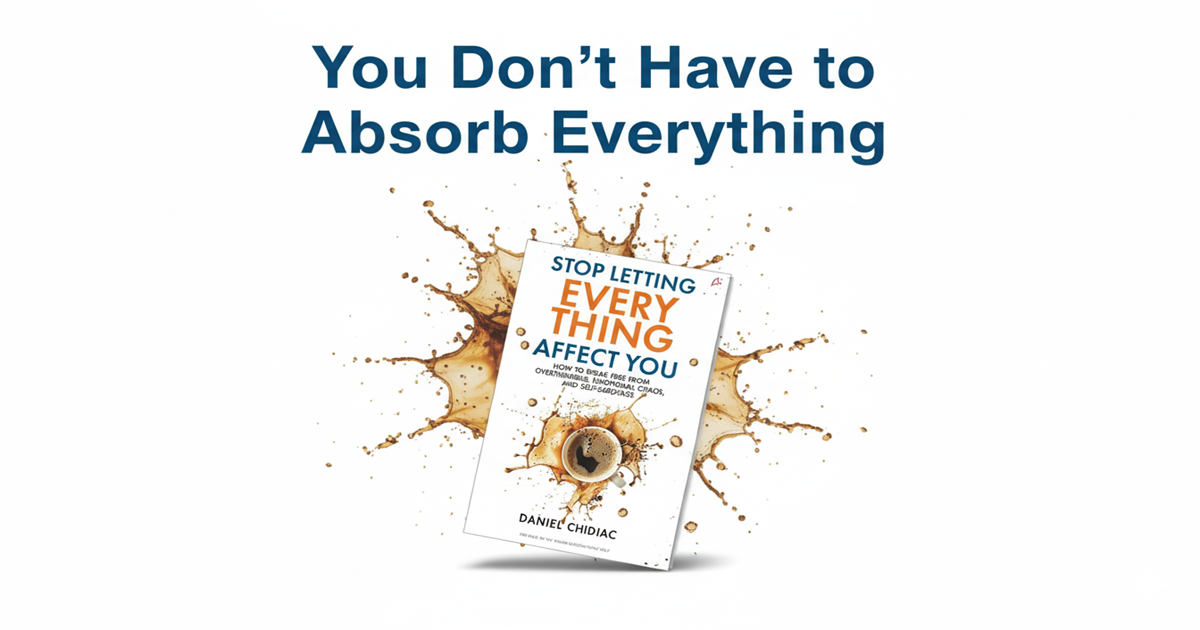
What if the reason you feel constantly drained isn't your workload but your inability to stop absorbing everything around you? Daniel Chidiac's latest book holds a mirror up to one of the most overlooked habits of high-achievers.
There's a moment most professionals know intimately: you walk into a meeting, everything is fine, and then one offhand comment from a colleague, a client, a stranger on LinkedIn unravels the rest of your day. By evening, you're replaying it on a loop, trying to make sense of something that was never about you in the first place.
Daniel Chidiac, the author behind the internationally acclaimed Who Says You Can't? You Do, returns with a book that feels less like a motivational read and more like a quiet intervention. Stop Letting Everything Affect You asks a deceptively simple question: why do we treat every external event as a direct message to our inner world?
"You are not a sponge for the world's chaos. You are allowed to be selective about what gets space inside you."
The invisible tax nobody talks about
Most productivity conversations focus on what you do with your time. Chidiac is interested in something far more costly, what you do with your energy. Every time you react to a passive-aggressive email, spiral after a vague piece of feedback, or absorb the anxiety of someone in your orbit, you're paying an invisible tax. And unlike money, you cannot earn that energy back by working harder.
This is particularly resonant for professionals. The higher you climb, the more inputs you receive: stakeholder pressure, team dynamics, market noise, social comparison. Without the skill to filter, the accumulation becomes a slow-burning burnout that looks, from the outside, like success.
Three ideas from the book that will change how you operate
Your reaction is not the same as the event. Chidiac draws a firm line between what happens and what you make it mean. The event is neutral. The suffering is almost always optional, constructed in the seconds between stimulus and response.
Not every emotion needs an audience. In a culture that rewards emotional expression as authenticity, Chidiac offers a quieter wisdom: you don't have to perform every feeling. Some things are better dissolved in silence than amplified in conversation.
Detachment is not indifference. Perhaps the most misunderstood concept in the book. Chidiac argues that you can care deeply about your work, your relationships, and your outcomes without being destabilised by every fluctuation. That is not coldness. That is maturity.
We've Never Had More Information and Less Peace
We are living through a period of relentless information density. Notifications, news cycles, and opinion feeds are engineered to provoke reaction because reaction is engagement, and engagement is currency. Nobody profits from your equanimity. Chidiac's work is, in that sense, quietly radical: it is an argument for reclaiming the right to choose what gets your attention, your energy, and your inner peace.
For leaders especially, the stakes are compounded. A leader who absorbs everything becomes the emotional thermostat of the room and not in a good way. Teams feel the turbulence. Decisions get made from anxiety rather than clarity. The ripple effects are real and measurable.
"Strength isn't about never being moved. It's about choosing which things are worth being moved by."
This isn't about becoming numb. It's about becoming free.
Chidiac is careful never to advocate for emotional shutdown. The goal isn't to stop feeling, it is to stop leaking. To stop giving every passing event the power to author your mood, your confidence, and your sense of self. That distinction is everything.
By the final chapter, you don't feel motivated in the pumped-up, fleeting sense. You feel something quieter and more durable: like someone has handed you back a piece of yourself you didn't realise had been slowly given away.
Ready to stop absorbing the world's noise?
If this piece resonated, the book will go further, practical, philosophical, and deeply human. Pick it up, underline it, and come back to it whenever the world feels like too much.