
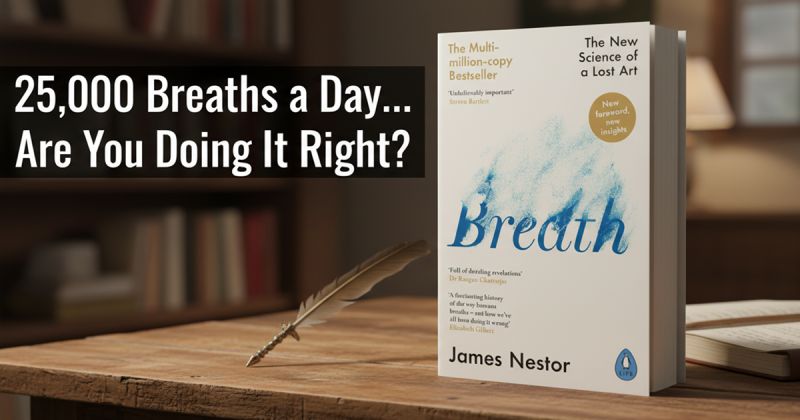
Take a breath right now. Go ahead. Did you breathe through your mouth? Did your chest rise? If so, science says you just did it wrong, and you have been doing it wrong probably since childhood. This is the uncomfortable, fascinating, and ultimately hopeful message at the core of James Nestor's bestselling book Breath: The New Science of a Lost Art. Published in 2020, the book became a global sensation for one simple reason: it told us something we never expected. The way we breathe is making us sick.
But Nestor does not stop at the diagnosis. He travels across continents, digs into forgotten medical texts, undergoes extreme self-experimentation, and interviews scientists, free divers, choir singers, and pulmonologists to piece together a roadmap for breathing better. The result is one of the most unexpectedly gripping health books of the decade.
Who Is James Nestor and Why Should You Listen to Him?
James Nestor is not a doctor. He is a science journalist, and that is precisely what makes Breath so accessible and compelling. He approaches the subject as a skeptic, not a guru. His journey into the world of breathing began after he attended a breathing class in San Francisco on a whim and discovered that something as basic as inhaling and exhaling had entire research fields, competitive sports, and ancient medical traditions built around it.
Nestor has written for publications like The New York Times, Outside, and Scientific American. His reporting style blends rigorous research with personal narrative, and in this book, he becomes a guinea pig in his own experiments, including spending ten days breathing exclusively through his mouth to document the consequences. Spoiler: it was not pleasant.
The Shocking Truth About Mouth Breathing
One of the most jarring revelations in the book is how harmful mouth breathing truly is. Nestor and researcher Dr. Jayakar Nayak at Stanford University Medical Center conducted a real-world experiment. They plugged their own noses for ten days and breathed exclusively through their mouths. What followed was a cascade of health problems: snoring, sleep apnea, elevated blood pressure, reduced oxygen levels, and serious mental fog.
When they removed the plugs and switched to nasal breathing, all of these symptoms reversed within days.
The nose, Nestor explains, is a sophisticated air-processing machine. It filters bacteria and allergens, regulates air temperature and humidity, produces nitric oxide (which kills pathogens and dilates blood vessels), and even plays a role in regulating blood pressure. The mouth, by contrast, was not designed for breathing. It is a digestive organ. Using it as your primary breathing apparatus is, in Nestor's words, like breathing through an open wound.
How Modern Humans Lost the Ability to Breathe Properly
This is where the book takes a surprising anthropological turn. Nestor examines skulls from ancient humans and compares them to modern skulls. The difference is stark. Ancient skulls had wide, spacious nasal passages, well-developed sinuses, and broad jaws with perfectly aligned teeth. Modern human skulls, by contrast, show crowded teeth, narrower jaws, and restricted airways.
The culprit? Soft, processed food. Ancient humans chewed hard foods like raw meat, fibrous roots, and tough grains. This constant chewing worked the jaw muscles and stimulated bone growth, keeping the airway open. When agriculture took over and food became softer, jaws began to shrink across generations. The result is that modern humans literally have too little space in their skulls for their airways to work properly.
This is not some fringe hypothesis. Nestor cites dental anthropologists, evolutionary biologists, and peer-reviewed research. The idea that our chronic sinus problems, widespread sleep apnea, and rampant orthodontic issues are the result of this evolutionary mismatch is both alarming and entirely plausible.
The Perfect Breath and the Magic Number 5.5
If there is one takeaway from Breath that you can start applying today, it is this: breathe slower. Nestor discovers through extensive research that across Buddhist, Hindu, Taoist, and even Native American traditions, the ideal breathing rate has independently converged on roughly 5.5 breaths per minute, with each breath lasting about 5.5 seconds in and 5.5 seconds out.
This finding shows up in the research of heart rate variability scientists, in the recitation rate of Catholic Ave Marias, and in the chanting patterns of Buddhist monks. The number 5.5 keeps appearing, as if biology discovered it long before anyone wrote it down.
Modern humans breathe an average of 15 to 20 times per minute. That is more than double the optimal rate. Faster breathing reduces carbon dioxide in the blood, which paradoxically reduces the amount of oxygen delivered to cells. It also keeps the nervous system in a low-grade state of stress. Slowing down, even modestly, has measurable effects on heart rate, blood pressure, and mental clarity.
Carbon Dioxide Is Not the Enemy
One of the most counterintuitive insights in the book is about carbon dioxide. Most of us think of it as a waste gas, something to breathe out and forget. But Nestor reveals that CO2 is actually a critical signaling molecule. It is what tells your body to release oxygen from red blood cells to the tissues that need it.
When you breathe too fast and exhale too much CO2, your blood becomes too alkaline, blood vessels constrict, and your cells actually receive less oxygen even though you are breathing more. This is why people who hyperventilate feel dizzy and can even faint. The goal is not to maximize oxygen intake but to maintain the right balance between oxygen and CO2. This insight reframes everything: breathing more is not always better. In many cases, breathing less is.
Ancient Wisdom Meets Modern Science
What makes Breath so rich is its willingness to look backward as well as forward. Nestor explores ancient pranayama breathing practices from India, Tibetan Tummo techniques used by monks to raise their body temperature in freezing conditions, and Sufi breathing rituals, and then cross-references them with modern scientific research.
He profiles figures like Wim Hof, the Dutch athlete who has climbed Everest in shorts and held world records in cold exposure, whose breathing method has been shown in clinical studies to affect the immune system in measurable ways. He also covers the work of Dr. Carl Stough, a choir conductor who discovered in the 1960s that teaching veterans to breathe diaphragmatically could reverse severe emphysema, a finding that mainstream medicine largely ignored.
The theme throughout is the same: cultures across history understood intuitively what we are only now beginning to prove scientifically. We have outsourced breathing to autopilot, and we are paying a steep physiological price.
How Breathing Affects Sleep, Anxiety, and Performance
The practical implications of Nestor's research are wide-ranging. Sleep is one of the most affected areas. Nestor explains how mouth breathing during sleep is a primary driver of snoring and sleep apnea, conditions that affect hundreds of millions of people and are linked to heart disease, diabetes, and cognitive decline. The simple fix of taping the mouth shut at night (yes, really) has helped thousands of people improve their sleep quality, and Nestor backs this up with data.
Anxiety and panic disorders are also deeply connected to breathing patterns. People who chronically overbreathe tend to have higher baseline anxiety because their nervous systems are already running at an elevated stress response. Learning to breathe slowly through the nose, particularly with extended exhales, activates the parasympathetic nervous system and creates a measurable calming effect.
Athletes have also discovered that nasal breathing during training, despite feeling harder at first, leads to better endurance and recovery. By building CO2 tolerance, the body becomes more efficient at delivering oxygen to muscles, even at high intensity.
Key Breathing Practices From the Book
Nestor does not just diagnose the problem; he offers practical techniques. Here are some key practices he highlights:
Nasal Breathing Always: Keep your mouth closed during rest, sleep, and light exercise. Use nasal strips or tape if necessary at night.
5.5 Breathing: Inhale for 5.5 seconds, exhale for 5.5 seconds. Do this for a few minutes a day to reset your baseline breathing rate.
Extended Exhale: Make your exhale longer than your inhale. Try a 4-count inhale and a 6 to 8 count exhale to activate the parasympathetic nervous system.
Breathe Less During Exercise: Train your body to breathe nasally even during moderate exercise. It is uncomfortable at first but dramatically improves CO2 tolerance over time.
Diaphragmatic Breathing: Breathe into your belly, not your chest. This uses the full lung capacity and is far more efficient.
Is the Science Solid?
It is worth noting that not all claims in Breath are backed by large-scale clinical trials. Some of the more extreme practices, like prolonged breath retention or Tummo, have limited peer-reviewed evidence. Nestor is generally transparent about this, and he does not claim that breathing is a cure for everything. The book sits at the intersection of solid science, compelling anecdote, and emerging research.
The core claims, however, including the harms of mouth breathing, the benefits of nasal breathing, the importance of slow breathing, and the role of CO2 tolerance, are well-supported by peer-reviewed research. The book's bibliography runs to over 40 pages. For a popular science book, it is unusually rigorous.
Why Breathing Deserves Your Attention Today
We live in an age of biohacking, wellness apps, and supplements promising to optimize every aspect of human biology. Yet we have almost completely ignored the one thing we do 25,000 times a day. Breathing is free, it is always available, and as Nestor shows, it is one of the most powerful levers for improving health that we have access to.
For anyone dealing with sleep issues, anxiety, chronic fatigue, poor athletic performance, or just a nagging sense that something is off, this book offers a surprisingly simple starting point: close your mouth and breathe through your nose. That single change, backed by centuries of tradition and decades of modern research, might be the most impactful health intervention you ever make.
Ready to Transform the Way You Breathe?
James Nestor's 'Breath: The New Science of a Lost Art' is available on Amazon, at your local bookstore, and as an audiobook. If even a fraction of what he uncovers is true, and the science strongly suggests most of it is, this could be the most important book you read this year. Pick up your copy today and start breathing the way your body was designed to.
Get 'Breath' by James Nestor.