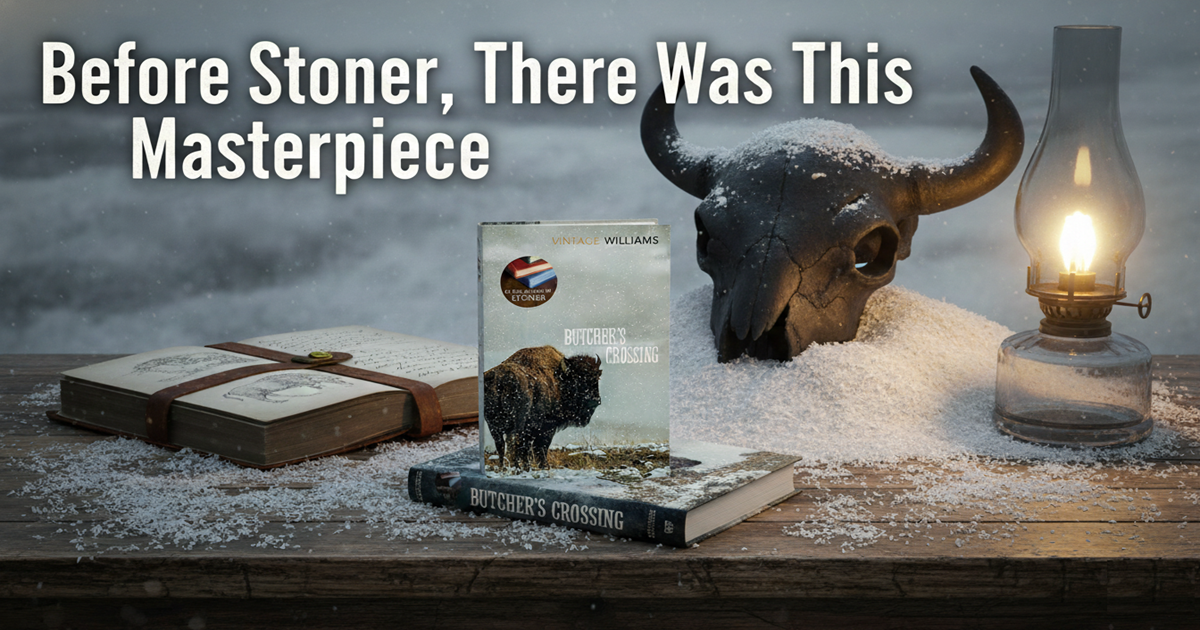
Most people who love books have never heard of Butcher's Crossing. That is a tragedy. John Williams wrote one of the most gripping, psychologically intense, and beautifully crafted American novels of the twentieth century, and for decades, it sat quietly in the shadows while lesser books grabbed all the glory.
Published in 1960, Butcher's Crossing arrived years before Williams received his long-overdue recognition for Stoner. But if Stoner is the book that made the world finally pay attention, Butcher's Crossing is the one that proves Williams was never a one-trick wonder. This is a raw, brutal, and deeply human story set against the vast American frontier, and it deserves a permanent spot on every serious reader's shelf.
What Is Butcher's Crossing Actually About?
The story follows Will Andrews, a young Harvard dropout who heads west in the 1870s, burning with the Emersonian dream of finding himself in the wilderness. He arrives in Butcher's Crossing, a small Kansas buffalo hunting town, and quickly falls in with Miller, a hardened, obsessive hunter who is convinced he knows the location of an untouched valley full of thousands of buffalo.
Andrews finances the expedition. The small group, including a skinner named Charley Hoge and a man called Schneider, sets off into the Colorado mountains. What follows is not a cowboy adventure. It is something far more disturbing and far more honest.
The hunt is successful beyond anyone's imagination. Miller finds his valley. The killing begins. And it does not stop.
Why This Book Hits Differently From Every Other Western
Butcher's Crossing is not a Western in the traditional sense. There are no gunfights, no sheriffs, no romanticized saloon scenes. Williams strips all of that away. What he gives you instead is the cold, unromantic reality of what the American frontier actually was: a place of relentless labor, indifferent nature, and moral collapse.
The buffalo massacre scenes are some of the most disturbing passages in American literature. Williams does not flinch. He describes the killing in meticulous, almost mechanical detail, and that is precisely the point. The slaughter becomes routine. The men become numb. And Andrews, who came west searching for transcendence, slowly understands that the wilderness does not care about him, his ideas, or his dreams.
This is a novel about what happens when a romantic idea collides with a brutal reality. And the collision is spectacular.
The Writing: Spare, Precise, and Unforgettable
John Williams had a gift that very few writers ever develop: the ability to write plainly about complex things without losing any of the depth. His prose is lean and controlled. There is no wasted sentence in Butcher's Crossing. Every paragraph is doing work.
The descriptions of the Colorado landscape are extraordinary. Williams makes you feel the cold, the altitude, and the vast silence of a world that existed before it was carved up and commercialized. You understand why Andrews was drawn to it. You also understand why it will destroy him if he lets it.
Miller, the hunter, is one of the great obsessives in American fiction. He belongs in the same conversation as Captain Ahab. His relationship with the hunt goes far beyond economics. It is something closer to a calling, a compulsion that consumes everything around it. Williams never explains him. He just shows him, and that restraint makes him terrifying.
The Deeper Theme Nobody Talks About Enough
On the surface, Butcher's Crossing is about a buffalo hunt gone wrong. But Williams is writing about something much larger: the destruction of the American myth.
Andrews carries the idealism of Emerson and Thoreau into the wilderness. He believes that nature will reveal something true and essential about human existence. What he finds instead is that nature is indifferent, that the frontier was built on destruction, and that the Romantic American idea of the West was always a fantasy covering up an ecological and human catastrophe.
Williams was writing this in 1960, but the book reads like a warning that is still relevant today. How often do we pursue something with total conviction, ignoring the damage we cause, because we are committed to a story we have told ourselves about what we deserve?
Who Should Read This Book?
Butcher's Crossing is not a comfortable read. If you are looking for a feel-good story, this is not it. But if you want a novel that stays with you, that makes you think about ambition, destruction, and what it really means to pursue something at all costs, this is essential reading.
Read it if you loved Stoner and want to see Williams working in a completely different register. Read it if you love Cormac McCarthy and want to find his spiritual predecessor. Read it if you are tired of Westerns that glamorize the frontier and want one that tells the truth about what that era actually cost.
Read it because it is one of the finest American novels of the twentieth century, and not nearly enough people know it exists.
Ready to Read Butcher's Crossing?
Stop sleeping on John Williams. Butcher's Crossing is available at most major bookstores and online retailers. Pick up a copy, clear your weekend, and prepare to have your idea of the American West completely dismantled.
Once you finish it, read Stoner. Then go back and read Butcher's Crossing again. You will notice things you missed the first time. That is the mark of a great book.
Get your copy of Butcher's Crossing today. You will not regret it.