
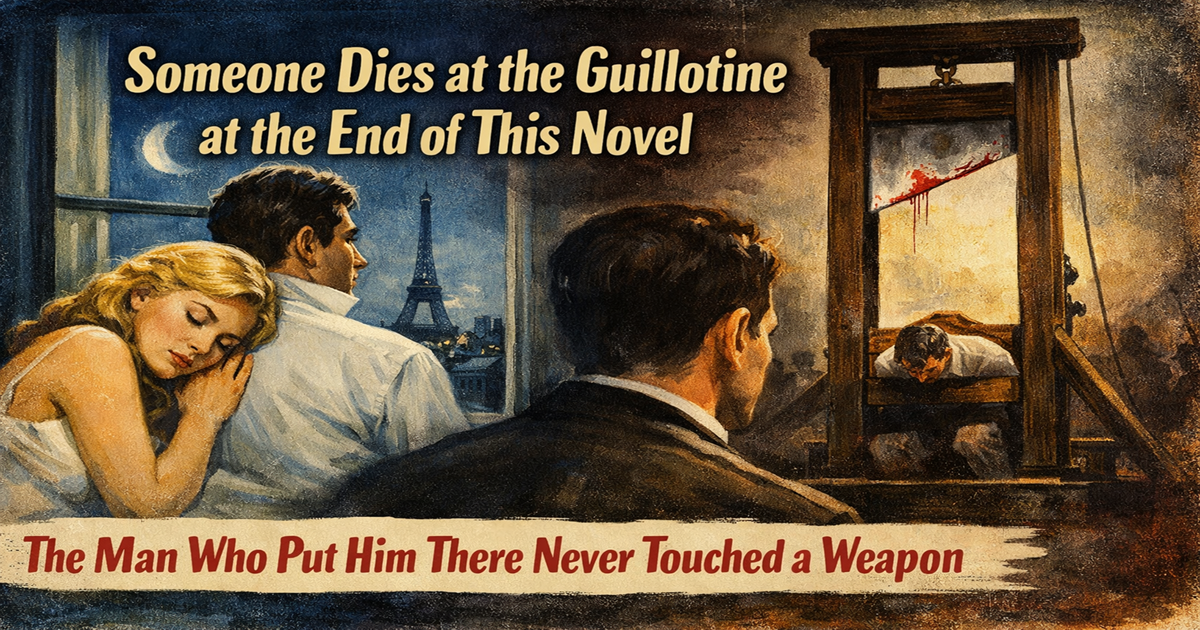
There is a man standing at a window in the south of France, drinking alone, watching his own reflection as night falls. By morning he will get on a train to Paris. Somewhere in that city, a young Italian man named Giovanni is going to die. And this man at the window, David, is the reason why.
That is the opening of Giovanni's Room, James Baldwin's second novel, published in 1956. It was the book his own publisher refused to release. It was the book that could have ended his career. Instead, it became one of the most important works of American fiction ever written, a slim, devastating novel that asks one question with the precision of a knife: what does it cost a person to refuse to be who they are?
The Setup: A Man, a Room, and a Decision That Destroys Everything
David is a young American living in Paris in the 1950s. He has a girlfriend, Hella, who is travelling through Spain. He has a vague plan: when she returns, they will get engaged, move back to America, and build the kind of life his father expects of him. Normal. Safe. Straight.
Then he meets Giovanni in a Paris bar where both of them work. Giovanni is warm, direct, and alive in a way David has never allowed himself to be. The attraction is immediate and undeniable. David, terrified, does what he has always done with desire he cannot name: he follows it anyway, then punishes himself for it afterward.
The two men begin a relationship in Giovanni's tiny room in Paris. Baldwin describes the room in a way that makes it feel like a living thing, cluttered and close and stifling, a space that holds every truth David is refusing to speak out loud. It is the most honest place David has ever been. He cannot stand it.
When Hella returns from Spain and says yes to his proposal, David chooses her. He walks out of Giovanni's room and back into the version of himself he has been performing his entire life. He believes, or wants to believe, that this is the responsible choice. The adult choice. The right choice.
Giovanni, abandoned and broken, ends up murdering the bar owner who had exploited him for years. He is arrested. He is sentenced to death. He is going to be executed by guillotine on the morning the novel opens. And David, standing at that window in the south of France, knows that his cowardice is threaded through all of it.
What Baldwin Is Actually Writing About
Baldwin is not writing a tragedy about being gay. He is writing a tragedy about dishonesty. The distinction is everything.
David's destruction of Giovanni does not come from his desire for him. It comes from his inability to own that desire. Every lie David tells, every retreat into performed straightness, every time he treats Giovanni as a shameful secret rather than a person, chips away at the life of a man who loved him honestly.
Baldwin draws a direct line from David's early life to this moment. As a teenager in Brooklyn, David had a brief physical encounter with his best friend, Joey. The morning after, he woke up and looked at Joey sleeping and felt tenderness, warmth, love, and immediately felt disgusted by all of it. He cut Joey out of his life completely, was cruel to him, watched him move away. The shame was not the desire. The shame was the suppression of the desire.
This is the pattern that brings David to that window. He has spent his life running from himself, and running from himself has made him someone who destroys the people who get too close to the real him. Giovanni saw the real him. That is why Giovanni had to be abandoned.
Giovanni: The Person David Refuses to See as a Person
One of the most remarkable things about this novel is how clearly Baldwin renders Giovanni as a full human being even though we only experience him through David's self-serving narration. Giovanni has a backstory that is genuinely heartbreaking: a failed marriage in Italy, a child who died, an escape to Paris that did not turn out to be an escape at all. He ended up working in a bar owned by a man who used his financial desperation as leverage.
When Giovanni is with David, he is present in a way David cannot allow himself to be. He argues, teases, loves, rages, hopes. He believes that their life in the room is a real life, not a detour. When David leaves, Giovanni does not understand it as a choice David made. He understands it as a sentence passed on him.
The reader understands, even when David does not, that Giovanni's murder of the bar owner is the act of someone who has been slowly stripped of everything, including the one person he trusted. David's abandonment did not cause the murder directly. But Baldwin makes you feel the architecture of how it contributed.
Why Baldwin Wrote All His Characters White
Every major character in Giovanni's Room is white. Baldwin, a Black American man, wrote a novel about desire and shame with no Black characters at all. This was a deliberate choice, and it is one of the most discussed aspects of the book.
Baldwin explained his reasoning in interviews: he wanted the novel to be taken seriously as a novel about universal human experience, not dismissed as a niche story about Black queer life. He knew that American publishing and American readers in 1956 would use the race of his characters as a reason to ignore or contain the book's argument. By removing race from the equation, he forced the question of desire and self-deception into a frame that no one could easily bracket away.
This decision still generates debate. Some critics argue it was a strategic concession to white readership that should not have been necessary. Others argue it was a sophisticated move that gave the novel its particular staying power, allowing it to be read across different communities as a story about the self-betrayal that is available to anyone. Both arguments are worth sitting with.
The Writing Itself Is Something Else
People who have not read Baldwin sometimes assume his prose will be difficult, heavy, academic. It is not. It is lucid, physical, and devastatingly precise. He can describe a feeling in a sentence that takes your breath away not because it is ornate but because it is exactly right.
The novel is structured as a confession. David is narrating backward through the events of his recent past on the final night before Giovanni's execution. This structure means the reader always knows the ending: Giovanni dies. What changes as the story progresses is our understanding of how completely David's choices contributed to that ending, and how aware David himself is of this.
Baldwin uses physical description with extraordinary skill. The way David perceives Giovanni's body changes as David's emotional state changes. The room they share shifts in the telling, sometimes claustrophobic, sometimes intimate, always weighted with meaning. The Paris streets around them feel both beautiful and indifferent.
What the Novel Feels Like to Read in 2026
The obvious answer is: still devastating. But the way it is devastating has shifted slightly depending on when you read it.
In 1956, the novel was radical simply for portraying queer desire with dignity and seriousness, without the usual literary convention of ending the queer character's story in punishment or self-destruction as a moral comment. Baldwin insists that the punishment here comes from the suppression of desire, not from the desire itself. That was a genuinely radical position in 1956.
Today, the novel reads less as a gay novel and more as a novel about the violence of inauthenticity. David's problem is not the era he was born into, though that shapes his options. His problem is that he values the performance of acceptability over the reality of his own life, and he uses other people to sustain that performance. Giovanni is the most extreme victim of this, but Hella is also destroyed by it in a different way.
Readers in 2025 encounter this novel differently depending on what they bring to it. Some read it as a queer history text and find liberation and grief in equal measure. Some read it as a novel about masculinity and find it surgically accurate about the particular damage done by certain performances of manhood. Some read it as a novel about Paris in the 1950s and find it beautifully atmospheric. It holds all of these readings without collapsing under any of them.
The Ending That Stays With You
By the end of the novel, David has lost everything. Giovanni is dead. Hella has left him after discovering his relationship with Giovanni was not what he claimed. He is alone in the house in the south of France.
The final pages of the novel are among the most striking in American fiction. David is watching himself in the window, and what he sees is a man he does not recognize, a man who was given the chance to be real and refused it, and now has nothing. Baldwin does not offer redemption here. He offers something harder and stranger: the beginning of self-knowledge arriving too late to save anything.
The image of the window recurs throughout the book. David watches his reflection constantly. He is always looking at himself from the outside, always performing for an imagined audience, never inhabiting himself from the inside. The window is the perfect metaphor for this: you can see through it, but you are always also seeing yourself in it, and you can never be sure which one you are primarily doing.
Why Giovanni's Room Is Still Required Reading
There are books that matter because of when they were written. Giovanni's Room matters because of what it is. It is a precise, unsparing, deeply humane examination of what happens to a person who treats their own inner life as an enemy, who outsources the cost of that internal war to everyone around them.
Baldwin was 30 years old when he finished it. He was living in Paris himself, an exile who had left America partly to survive it. He wrote the novel out of something he knew in his own bones, which is why every sentence in it feels earned rather than constructed.
The novel is not long. You can read it in a day. But it follows you for much longer than that, asking quiet, uncomfortable questions about the distance between who you are and who you let yourself be seen as, and what that gap costs the people who are foolish enough to love you.
Giovanni's Room is not a comfortable book. It was not meant to be. It was meant to be true. And nearly 70 years after it was first published, it still is.