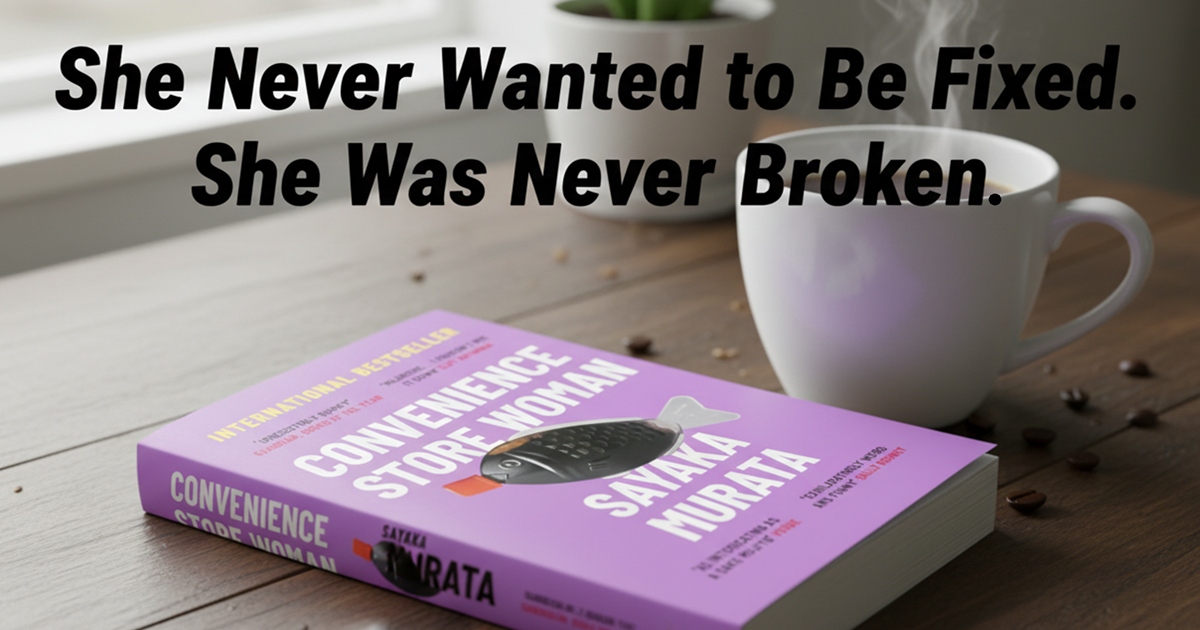
A novel about a woman the world cannot leave alone, and why it cannot stop you from loving her.
There is a moment early in Convenience Store Woman when Keiko Furukura, our narrator, describes the sound of the store coming to life in the morning. The beep of the register. The refrigerators humming at a precise temperature. The exact rustle of a plastic bag being opened at the counter. She knows all of it. She has known it for eighteen years. And when she writes about it, she sounds the way people sound when they talk about home.
That is the first thing Sayaka Murata does to you. She makes you understand, in your chest and not just your head, that this store is not a trap. It is the only place in the world where Keiko Furukura makes complete sense. And then she spends the rest of the novel showing you how desperately, furiously, lovingly the world tries to drag her out of it.
Keiko Is Not Who You Think She Is
When you hear 'a 36-year-old woman who has worked in a convenience store her whole life,' your mind probably builds a particular picture. Sad. Stuck. Unfulfilled. A cautionary tale about dreams deferred.
Forget that picture entirely.
Keiko Furukura is not sad. She is not waiting for something better. She is not secretly crying in the stockroom. From childhood, she has understood the world differently from everyone around her. Not worse, not better. Just differently. As a little girl, she could not understand why a dead bird on the playground needed to be mourned. She offered to cook it for dinner. She thought this was practical. Her teachers did not agree.
She has spent her entire life learning, carefully and consciously, how to perform being a person that other people find acceptable. She watches how the other women at the store stand, how they speak, how they laugh. She adjusts. She copies. She becomes fluent in a language that is not native to her.
And then she goes home, and she is alone, and she is fine.
That is what makes this novel quietly devastating. Keiko does not suffer from being different. She suffers from living in a world that cannot tolerate it.
The Store As the Only True Thing
Murata writes the convenience store the way other novelists write landscapes: with texture, with life, with meaning. The Hiiromachi Station Smile Mart is not a backdrop. It is almost a character. It has rules, rhythms, temperatures. It expects things from Keiko, and she can meet those expectations exactly. Every time.
Picture Keiko standing at the entrance at 7 a.m., uniform pressed, voice calibrated to the correct pitch of cheerfulness, ready to greet the first customer with a phrase she has said thousands of times and means every single time. There is no irony in her. No performance. This is not a woman going through the motions. This is a woman who has found, in the repetition of a small life, something that feels to her like grace.
You may have felt this too, in smaller ways. The comfort of a familiar routine. The relief of knowing exactly what is expected of you and being able to deliver it. Murata takes that feeling and builds an entire interior world around it. Then she asks you: why is this considered less than enough?
Shiraha: The Mirror That Shows Everything Ugly
Halfway through the novel, a man named Shiraha joins the store as a part-timer. He is one of the most precisely drawn villains in recent literary fiction, and what makes him so effective is that he never thinks of himself as a villain at all.
Shiraha is lazy, resentful, and delusional. He believes that society has cheated him. He does the least work possible. He complains constantly. He has contempt for the customers, for his coworkers, for the store itself. He is, by any honest measure, a terrible person.
And yet, this is where Murata twists the knife, the world gives him more grace than it has ever given Keiko. Because he is a man who wants to get married and settle down. He fits the shape society expects, even if he is a disaster inside that shape. His failures are forgivable. His ambitions, however hollow, are legible. The world knows what to do with him.
Keiko, who is competent and kind and genuinely content, remains a problem to be solved.
In one of the most darkly comic plot turns in the novel, Keiko allows Shiraha to live in her apartment. Not because she loves him. Not because she pities him. But because having a man in her life might finally make people stop asking questions. She treats him with the same detached efficiency she applies to stocking shelves. He accepts this arrangement because it suits him. It is a grotesque parody of a relationship, and it works better for everyone around them than Keiko's honest, solitary happiness ever did.
Murata is not being subtle here. She is furious, and she is letting you feel it through comedy.
What This Novel Does to You
About two-thirds through the book, you will notice something happening. You will start to feel, on behalf of Keiko, a very particular kind of anger. Not for her choices, but at every person who cannot accept them. The sister who worries with her eyes. The old friends at the reunion who ask, with such warm and lethal concern, whether she is seeing anyone. The coworkers who circle her like something that needs to be diagnosed.
None of them are evil. That is Murata's most precise cruelty as a writer. They are just people doing what people do: enforcing the shape of a life they have decided is correct, gently, relentlessly, with absolute confidence that they are helping.
You will recognize them. You may have been them.
And you will sit with that recognition for much longer than the 163 pages take to read.
The Ending Will Stay With You
There is a moment near the end of this novel that is, without exaggeration, one of the most emotionally precise passages in contemporary fiction. Keiko makes a choice. It is not the choice the world wanted her to make. It is not a choice that most novels would allow a woman like her to make without consequence or apology.
She makes it anyway.
And in the way Murata writes that moment, clean and certain and completely free of sentimentality, you feel something release in your own chest. Something you perhaps did not know was held tight.
Why This Book, Why Now
Convenience Store Woman was published in Japan in 2016. The world it describes, where a woman's worth is measured in marital status, biological timelines, and career trajectories that conform to expectations, has not exactly improved. If anything, the pressure is louder now, and it comes from more directions.
Keiko Furukura exists as a kind of quiet refusal. She does not argue. She does not protest. She does not write manifestos. She simply continues to be exactly who she is, with a completeness that the world around her finds intolerable. In doing so, she holds up a mirror that is very hard to look away from.
This is a novel about belonging. About what we do to people who find belonging in unexpected places. About the labour of being perceived as normal when you are not. And about what it costs, what it quietly and continuously costs, to be a person who loves what they love without shame, in a world that has decided it should be otherwise.
Read It This Weekend.
163 pages. You will finish it in one sitting. You will think about it for weeks. Keiko will stay with you: quiet, certain, unmoved, long after you close the cover.