
An economist who looks at a sumo wrestling tournament and sees corruption. Who looks at a real estate agent and sees a conflict of interest. Who looks at parenting advice and sees decades of statistical noise.
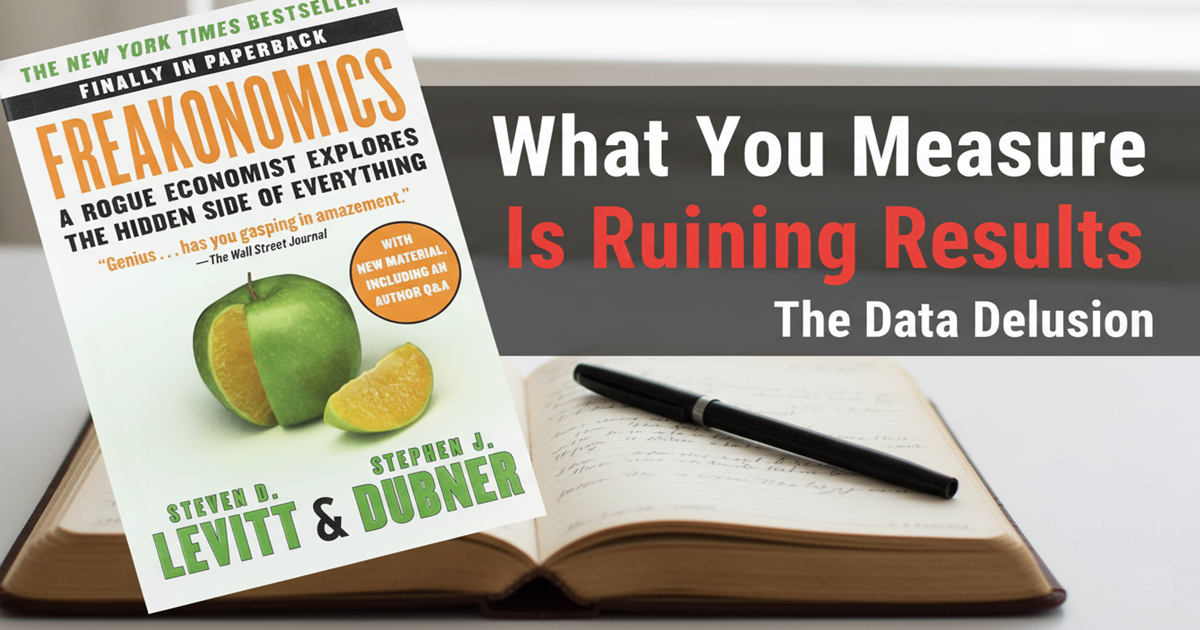
That economist is Steven D. Levitt, and his book Freakonomics, co-written with journalist Stephen Dubner, has sold over five million copies because it does something most business books refuse to do: it tells you the truth behind the numbers.
"Morality represents the way that people would like the world to work. Economics represents how it actually does work."
The One Idea That Changes Everything
Levitt's central argument is deceptively simple: incentives are the cornerstone of modern life. Every person, every institution, every market is shaped by what people stand to gain or lose. Once you see this, you cannot unsee it.
This applies at your company right now. Your sales team hits quota but sandbags deals to protect next quarter's numbers. Your HR policy encourages long hours but actually breeds resentment. Your customer service script measures call time, so agents rush you off the phone. None of these people are bad. They are all responding rationally to the incentives placed in front of them.
Why Experts Cheat and What That Means for Your Team
One of the book's most shocking chapters reveals how Chicago schoolteachers were caught manipulating standardized test results. Not because they were criminals, but because the incentive structure made cheating the rational response. Bonuses, job security, and school rankings all depended on test scores. The data made the cheating visible only because Levitt knew what to look for.
Ask yourself: what does your current performance review system actually incentivize? If the answer makes you uncomfortable, that is the point.
Information Asymmetry: The Hidden Power Game in Every Negotiation
Levitt devotes a large portion of the book to how information asymmetry shapes outcomes. When one party knows more than the other, they almost always use that advantage. Real estate agents, car dealers, insurance brokers, even doctors operate within this dynamic.
In the age of AI-generated summaries and instant data access, this gap is narrowing rapidly. The professionals who thrive in 2026 are the ones who understand not just what the data says, but what it means and what it is missing. That is the Freakonomics skill.
What This Book Teaches You That an MBA Does Not
Business school teaches frameworks. Freakonomics teaches questions. Levitt models the habit of asking: what does the data actually show versus what does conventional wisdom claim? These two things are almost never the same.
He applies this to crime rates, parenting outcomes, drug dealer economics, and online dating profiles. The method is always the same. Strip away the assumption. Find the data. Follow the incentive. The conclusion will surprise you.
"Knowing what to measure and how to measure it makes a complicated world much less so."
How to Apply Freakonomics Thinking This Week
Pick one process in your organization that is underperforming. Instead of asking "why are people not doing what they are supposed to?" ask "what are they actually being rewarded for?" Then look at the data without any assumptions. You will almost certainly find a gap between the intended incentive and the actual one.
That gap is where Freakonomics lives. And fixing it is where leadership actually happens.