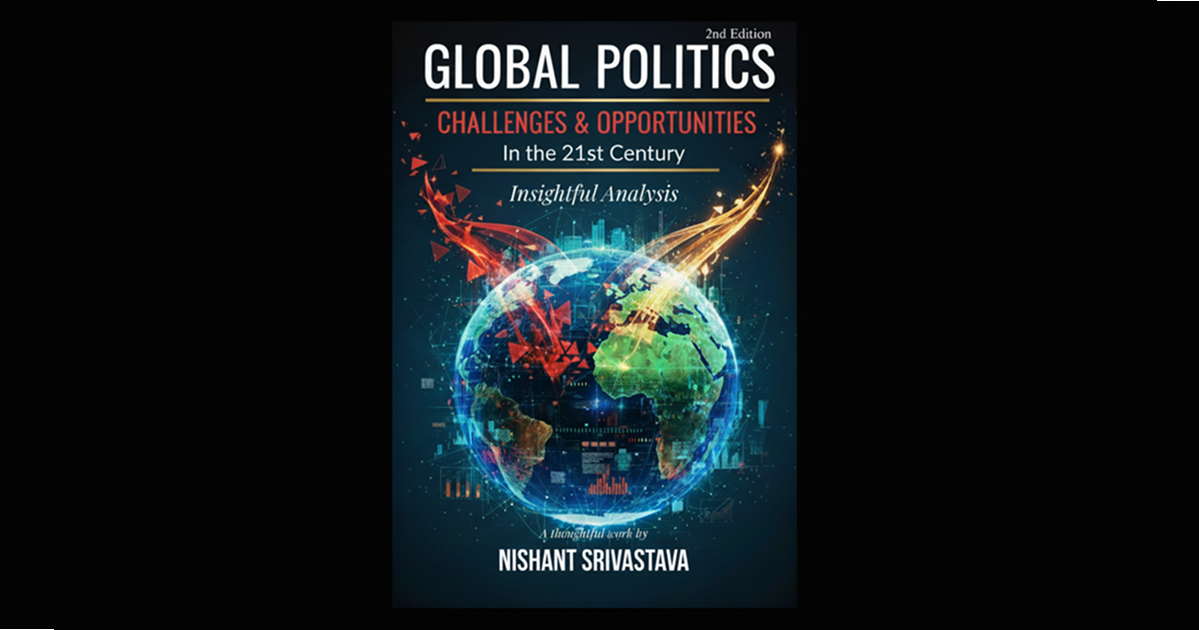
In an era where international boundaries blur and global events ripple across continents within seconds, understanding the intricate web of global politics has become essential for students, professionals, and engaged citizens alike. Nishant Srivastava's "Global Politics: Challenges and Opportunities in the 21st Century" emerges as a definitive guide through this complex landscape, offering readers a thoughtfully structured exploration of contemporary international relations that balances academic rigor with practical insights drawn from decades of teaching experience.
Understanding the Vision Behind the Book
Nishant Srivastava brings a unique perspective to the study of global politics, shaped by over 25 years of experience mentoring aspiring civil servants through the complexities of polity and international relations. His approach transcends traditional textbook methodology, instead offering readers a living, breathing analysis of how nations navigate the turbulent waters of 21st-century diplomacy. This second edition reflects not just updated information but an evolved understanding of how rapidly changing circumstances demand fresh analytical frameworks for comprehending international affairs.
What distinguishes Srivastava's work from countless other texts on international relations is his ability to bridge the often-frustrating gap between theoretical concepts and real-world applications. Students preparing for India's most competitive examinations will recognize the practical value of this approach, as will researchers and general readers seeking clarity amid the noise of daily global events. The book refuses to treat global politics as an abstract academic exercise, instead grounding every concept in the concrete realities of how governments actually function, how diplomats negotiate, and how international institutions either succeed or fail in addressing collective challenges.
Navigating Shifting Power Dynamics in the Modern World
The contemporary international system bears little resemblance to the relatively stable bipolar order of the Cold War or even the brief unipolar moment that followed. Srivastava dedicates substantial attention to analyzing these shifting power dynamics, examining how the rise of new economic powerhouses, particularly in Asia, challenges established hierarchies and demands new thinking about global governance. The book explores how China's economic ascent and increasingly assertive foreign policy reshape strategic calculations across multiple regions, how India's growing influence creates new possibilities for South-South cooperation, and how middle powers navigate between competing great power blocs.
Rather than offering simplistic predictions about which nation will dominate the 21st century, Nishant Srivastava presents a nuanced examination of multipolarity's complexities. He analyzes how power itself is transforming, with traditional measures like military strength and territorial control increasingly supplemented by technological capabilities, economic interdependence, and soft power influence. This multidimensional understanding of power helps readers appreciate why contemporary global politics often seems so unpredictable and why outcomes frequently confound conventional wisdom rooted in older paradigms.
The second edition's treatment of power dynamics incorporates recent developments that have accelerated these shifts, from trade tensions and technological competition to pandemic responses that revealed both strengths and vulnerabilities in different governance models. Srivastava guides readers through these complex interactions without losing sight of underlying patterns and enduring principles that continue shaping state behavior regardless of immediate circumstances.
Technological Disruption and Its Geopolitical Implications
Few aspects of 21st-century global politics prove as transformative yet poorly understood as technology's role in reshaping international relations. Nishant Srivastava devotes considerable analysis to examining how technological disruption creates both unprecedented opportunities and novel security challenges. The book explores how cyber capabilities blur traditional distinctions between war and peace, how artificial intelligence raises questions about autonomous weapons systems and algorithmic warfare, and how information technology enables new forms of influence operations that bypass conventional diplomatic channels.
Srivastava's treatment of technology avoids both techno-utopianism and alarmism, instead examining concrete ways that technological change affects state capabilities, alliance structures, and international cooperation. He analyzes how nations compete for dominance in emerging technologies, recognizing that leadership in artificial intelligence, quantum computing, and biotechnology may prove as strategically significant as nuclear weapons were during the Cold War. The book also addresses how technology democratizes certain capabilities, enabling non-state actors to project influence and even threaten state security in ways previously impossible.
The global politics of technology extends beyond security concerns to economic competition and regulatory challenges. Srivastava examines ongoing battles over technology standards, data governance, and digital sovereignty, showing how these technical disputes carry profound implications for economic competitiveness and national autonomy. His analysis helps readers understand why seemingly arcane debates about 5G networks or semiconductor supply chains become flashpoints in international relations, revealing the strategic dimensions underlying technological choices.
Climate Change as a Defining Challenge of Our Era
Perhaps no issue better exemplifies the complexity of contemporary global politics than climate change, which simultaneously demands unprecedented international cooperation while triggering competitive dynamics over energy transitions, resource access, and economic adjustment burdens. Nishant Srivastava provides thorough examination of climate politics, analyzing both the scientific consensus on anthropogenic climate change and the geopolitical obstacles to effective collective action.
The book explores why climate cooperation proves so challenging despite widespread recognition of the threat. Srivastava examines how historical emissions patterns create tensions between developed and developing nations over responsibility for mitigation, how fossil fuel dependencies shape national interests and domestic politics, and how the costs and benefits of climate action distribute unevenly across countries and social groups. Rather than simply advocating for stronger climate agreements, he helps readers understand the genuine dilemmas policymakers face in balancing environmental imperatives against economic development needs and political constraints.
Srivastava also analyzes emerging opportunities within the climate challenge, including how the renewable energy transition creates new economic possibilities and potentially reshapes global power relationships. Countries investing heavily in clean energy technologies may gain strategic advantages as fossil fuel dependencies decline, while nations controlling critical minerals for batteries and solar panels occupy newly important positions in global supply chains. This balanced perspective helps readers appreciate climate politics as a complex arena where threats and opportunities coexist, demanding sophisticated policy responses rather than simple solutions.
Security Challenges in an Interconnected World
Traditional security studies focused primarily on military threats between states, but 21st-century global politics demands broader conceptions of security encompassing terrorism, transnational crime, pandemic diseases, cyber threats, and economic vulnerabilities. Nishant Srivastava's comprehensive treatment of security challenges reflects this expanded understanding while maintaining attention to enduring military and strategic dimensions of international relations.
The book examines how globalization creates security interdependencies that transcend national borders, making isolation impossible even for the most powerful nations. Srivastava analyzes transnational terrorism and how it challenges conventional security approaches rooted in territorial defense, exploring why military force alone proves insufficient against networked non-state actors. He also addresses how economic interdependence creates vulnerabilities, as supply chain disruptions or financial crises in one region cascade globally with devastating consequences.
Srivastava's discussion of security extends to human security concerns including food security, water scarcity, refugee flows, and humanitarian crises. He shows how these issues intersect with traditional security challenges, as resource competition contributes to conflicts and instability generates refugee movements that strain international cooperation. This holistic security framework helps readers understand why contemporary global politics requires integrating diverse policy domains rather than treating security, economics, and social issues as separate spheres.
The Future of Global Cooperation and International Institutions
International institutions from the United Nations to the World Trade Organization face mounting criticism and questions about their effectiveness in addressing 21st-century challenges. Nishant Srivastava provides balanced assessment of these institutions, acknowledging their limitations while recognizing their continued importance for managing interdependence and facilitating cooperation. His analysis helps readers move beyond simplistic narratives of institutional failure or success toward understanding the complex factors that enable or constrain institutional effectiveness.
The book examines why institutions designed for the post-World War II era struggle to adapt to contemporary power distributions and new challenge types. Srivastava analyzes debates over institutional reform, including proposals for expanding the UN Security Council, reforming international financial institutions to reflect changing economic realities, and creating new mechanisms for addressing climate change and technology governance. He explores tensions between sovereignty and supranational authority, showing why nations simultaneously seek international cooperation and resist constraints on their autonomy.
Looking forward, Srivastava considers how global cooperation might evolve, including possibilities for regional arrangements, plurilateral agreements among like-minded states, and informal networks supplementing formal institutions. He avoids both naive optimism about global governance and cynical dismissal of cooperation's possibilities, instead examining conditions under which states overcome collective action problems to address shared challenges. This realistic yet constructive approach helps readers appreciate both the obstacles to enhanced cooperation and the imperatives driving nations to seek collaborative solutions despite their differences.
Why This Book Matters for Civil Services Aspirants
Students preparing for India's civil services examinations face the daunting task of mastering vast amounts of information across multiple subjects while developing analytical capabilities that allow them to address complex, multi-faceted questions. Nishant Srivastava's global politics text serves these students exceptionally well, providing systematic coverage of essential topics while modeling the analytical thinking examiners seek. His 25 years of experience mentoring civil services aspirants informs every chapter's structure and emphasis, ensuring the content aligns with examination requirements while developing genuine understanding rather than mere memorization.
The book's treatment of international relations extends beyond descriptive facts to causal analysis, helping students understand not just what happens in global politics but why events unfold as they do. This deeper comprehension proves invaluable when facing examination questions that demand explanation, comparison, or evaluation rather than simple recall. Srivastava's integration of contemporary examples with theoretical frameworks also helps students connect current affairs with underlying principles, enabling them to analyze breaking news through conceptual lenses rather than treating each event as isolated and unique.
For aspirants specifically, the book's balanced coverage of India's foreign policy challenges and opportunities provides crucial perspective on how India navigates great power competition, manages neighborhood relationships, and pursues national interests in various international forums. Srivastava helps students appreciate India's distinctive position in global politics while understanding broader international dynamics that shape possibilities for Indian diplomacy. This dual focus on global trends and Indian applications makes the text particularly relevant for examinations emphasizing both international relations theory and practical policy implications for India.
Accessibility and Pedagogical Approach
Despite addressing sophisticated concepts and complex international dynamics, Nishant Srivastava maintains remarkable accessibility throughout the text. His writing style balances scholarly precision with clarity, avoiding unnecessary jargon while introducing essential terminology systematically. Readers without extensive background in international relations will find the book approachable, while those already familiar with the field will appreciate its analytical depth and engagement with ongoing scholarly debates.
The pedagogical approach reflects Srivastava's deep experience in teaching, with each chapter building logically on previous material while remaining comprehensible if read independently. Concepts receive thorough explanation before application to specific cases, ensuring readers develop solid conceptual foundations. The integration of contemporary examples brings abstract ideas to life, helping readers see how theoretical frameworks illuminate real-world events and policy challenges.
Srivastava also demonstrates admirable evenhandedness in addressing controversial issues, presenting multiple perspectives on contested questions rather than simply advancing his own views. This approach encourages critical thinking, helping readers develop their own analytical capabilities rather than passively accepting authoritative pronouncements. For students preparing for examinations requiring balanced analysis of policy debates, this modeling of fair-minded evaluation proves invaluable.
Connecting with Ongoing Learning Through Diplomacy Diaries
Understanding global politics requires continuous learning, as international events constantly reshape the landscape Nishant Srivastava maps in his book. Recognizing this, Srivastava extends his teaching beyond the printed page through Diplomacy Diaries, a multifaceted platform offering ongoing reflections, analyses, and perspectives on unfolding global developments. Through Facebook, Instagram, and YouTube channels under the Diplomacy Diaries and @nishantsirpolity handles, he maintains dialogue with students and interested readers, helping them apply the book's frameworks to current events.
This integration of book learning with digital engagement creates a comprehensive learning ecosystem that serves students particularly well. The book provides systematic coverage and analytical frameworks, while the social media channels offer timely commentary connecting those frameworks to breaking news. Together, they enable learners to develop both deep understanding of enduring principles and the ability to analyze rapidly changing circumstances. For civil services aspirants juggling multiple subjects and current affairs preparation, this combination proves especially valuable.
The Diplomacy Diaries platform also reflects Srivastava's commitment to making international relations accessible and engaging for diverse audiences beyond examination candidates. His content speaks to anyone seeking to understand the forces shaping our interconnected world, demonstrating that sophisticated analysis need not remain confined to academic specialists. This democratization of international relations knowledge aligns with the book's own accessible approach, extending its reach beyond formal educational contexts.
The Second Edition's Relevance for Contemporary Readers
Publishing a second edition of any text on global politics acknowledges that international relations evolve too rapidly for any single snapshot to remain current indefinitely. Nishant Srivastava's updated edition incorporates developments that have reshaped the international landscape since the first edition, ensuring readers engage with the most relevant challenges and debates. From pandemic impacts on globalization to accelerating U.S.-China competition to new urgency around climate action, the second edition addresses issues defining contemporary global politics.
Beyond simply updating factual information, the new edition reflects evolved thinking about analytical frameworks appropriate for understanding emerging patterns. Srivastava demonstrates intellectual honesty in reconsidering earlier assessments where events have revealed their limitations, modeling the kind of adaptive thinking essential for anyone seeking to comprehend international affairs. This willingness to update and refine analysis distinguishes serious scholarship from dogmatic adherence to outdated frameworks, showing readers that understanding global politics requires intellectual flexibility and openness to evidence.
The second edition's timing proves particularly valuable as multiple international trends reach critical junctures simultaneously. The future of globalization, the trajectory of great power competition, the effectiveness of international institutions, and the possibility of coordinated climate action all face decisive moments in the coming years. Nishant Srivastava's updated analysis helps readers navigate these uncertainties with conceptual tools for understanding alternative scenarios and their implications, preparing them to engage thoughtfully with whatever developments unfold.
Conclusion: An Essential Resource for Understanding Our World
Global politics shapes every aspect of contemporary life, from economic opportunities and security threats to cultural exchanges and technological innovation. Understanding the forces that drive international relations no longer represents merely academic interest but practical necessity for anyone seeking to navigate our interconnected world effectively. Nishant Srivastava's "Global Politics: Challenges and Opportunities in the 21st Century" stands as an essential resource for developing this understanding, offering comprehensive coverage, analytical sophistication, and practical relevance in one accessible package.
For students preparing for civil services examinations, researchers exploring international relations, or engaged citizens seeking deeper comprehension of global affairs, Srivastava's text provides invaluable guidance through the complexities of 21st-century diplomacy and international cooperation. His decades of experience teaching these subjects infuses every chapter with hard-won insights about how to make sense of global politics' often bewildering complexity. The book succeeds not by offering simple answers to complicated questions but by equipping readers with the analytical tools and conceptual frameworks necessary to develop their own informed assessments.
As we face an uncertain future marked by multiple simultaneous challenges from climate change and technological disruption to security threats and economic instability, the need for sophisticated understanding of global politics only grows more urgent. Nishant Srivastava's comprehensive guide offers readers the foundation necessary for engaging thoughtfully with these challenges, making it an indispensable addition to any serious student's library and an invaluable resource for anyone committed to understanding the forces shaping our shared global future.