
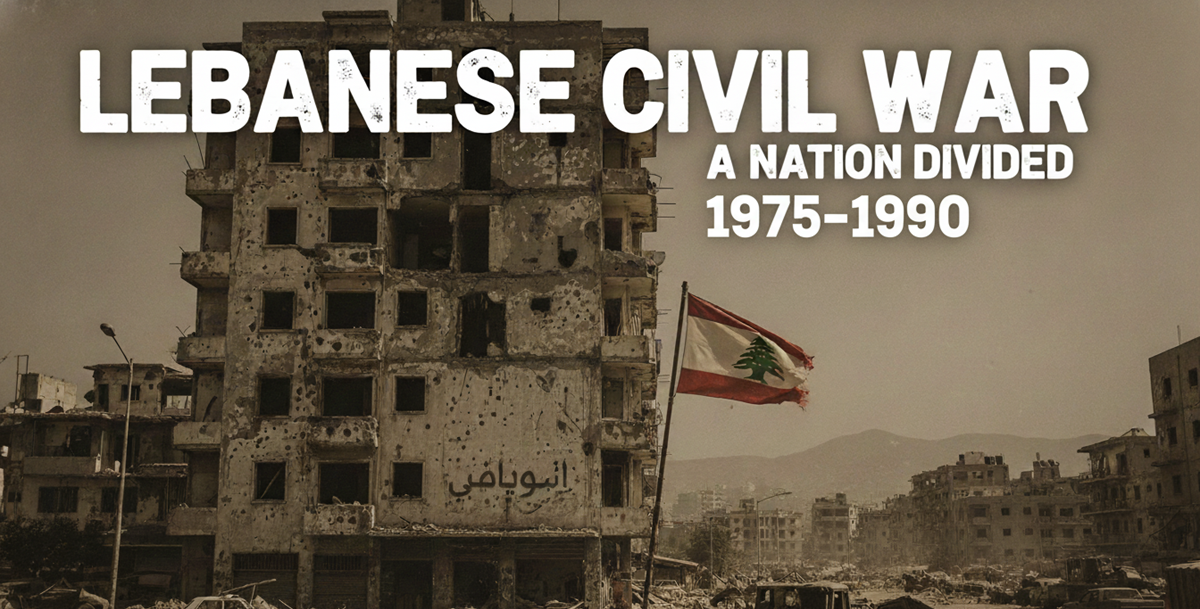
Lebanon's Devastating Conflict
The Lebanese Civil War stands as one of the most complex and devastating conflicts of the twentieth century. Spanning fifteen years from 1975 to 1990, this multifaceted war transformed Lebanon from the prosperous "Paris of the Middle East" into a fractured nation struggling with deep sectarian divisions. The conflict claimed approximately 120,000 lives, displaced nearly one million people, and left scars that continue shaping Lebanese society today.
Understanding this war requires examining not just the internal tensions within Lebanon, but also the broader regional dynamics that turned this small Mediterranean nation into a battleground for competing interests.
Historical Background and Root Causes
The Fragile Sectarian System
Lebanon's political structure, established during the French Mandate period and formalized in the 1943 National Pact, distributed power among religious communities. The presidency was reserved for Maronite Christians, the prime ministership for Sunni Muslims, and the speaker of parliament position for Shia Muslims. This confessional system worked when demographics remained relatively stable, but by the 1970s, significant shifts had occurred.
The Christian population, once the majority, had declined proportionally while the Muslim population grew. This demographic reality clashed with the political arrangement that still favored Christian representation, creating fundamental tensions about power sharing and national identity.
Palestinian Presence and Regional Politics
Following the 1948 Arab-Israeli War and subsequent conflicts, Lebanon hosted hundreds of thousands of Palestinian refugees. The arrival of the Palestine Liberation Organization after its expulsion from Jordan in 1970 dramatically altered Lebanon's internal dynamics. The PLO established a virtual state within a state, particularly in southern Lebanon, conducting cross-border operations into Israel.
Many Lebanese Christians viewed the Palestinian armed presence as threatening Lebanon's sovereignty and demographic balance. Conversely, many Lebanese Muslims sympathized with the Palestinian cause, seeing it as part of broader Arab nationalist aspirations. This division over the Palestinian question became a major fault line.
Socioeconomic Inequalities
Beyond sectarian and regional issues, Lebanon faced significant socioeconomic disparities. Wealth concentrated in Beirut and Christian-dominated areas, while predominantly Muslim regions, particularly the south and the Beqaa Valley, remained underdeveloped. These inequalities fueled resentment and provided fertile ground for radical political movements.
The War Begins: 1975-1976
The Bus Massacre and Initial Violence
The civil war's conventional starting point is April 13, 1975, when Phalangist gunmen attacked a bus in the Ain el-Remmaneh district of Beirut, killing 27 Palestinian passengers. This incident, a retaliation for an earlier attack on a Phalangist leader, ignited violence that quickly spread throughout the capital.
Fighting initially pitted Christian militias, primarily the Phalangists led by the Gemayel family, against an alliance of Palestinian groups and Lebanese leftist organizations known as the Lebanese National Movement. The conflict rapidly evolved from street battles into full-scale warfare, with Beirut becoming divided along the infamous Green Line separating Christian East Beirut from Muslim West Beirut.
Syrian Intervention
As violence escalated throughout 1975, Syria, under President Hafez al-Assad, watched with growing concern. In 1976, Syrian forces entered Lebanon, initially supporting Christian factions against the Palestinian-leftist alliance. This counterintuitive move reflected Syrian strategic calculations: Assad feared a Palestinian-leftist victory might provoke Israeli intervention or create an ungovernable radical state on Syria's border.
Syrian intervention prevented outright victory by either side but failed to restore peace. Instead, Syria became a major player, its forces remaining in Lebanon for nearly three decades.
Shifting Alliances and International Involvement: 1976-1982
The Fragmentation of Power
Following Syrian intervention, Lebanon fragmented into multiple zones of control. No central authority could impose order. Instead, various militias controlled different territories, establishing their own governance structures, collecting taxes, and providing services to populations within their domains.
Christian militias consolidated control over Mount Lebanon and East Beirut. Palestinian organizations dominated refugee camps and southern Lebanon. Leftist groups controlled West Beirut and parts of the south. The Druze community, led by Walid Jumblatt's Progressive Socialist Party, held the Chouf Mountains. Meanwhile, Syrian forces occupied the Beqaa Valley and northern regions.
The Rise of Shia Political Power
The war's progression brought profound changes to Lebanon's Shia community, traditionally the most marginalized major sect. The disappearance of prominent Shia cleric Imam Musa al-Sadr in 1978 created a leadership vacuum eventually filled by new movements.
Amal, founded by Musa al-Sadr before his disappearance, emerged as a major Shia militia. Later, with Iranian backing following the 1979 Islamic Revolution, Hezbollah formed as a more radical resistance movement, initially focused on combating Israeli occupation in the south.
The Israeli Invasion: 1982
Operation Peace for Galilee
In June 1982, Israel launched a massive invasion of Lebanon, officially aimed at eliminating PLO threats to northern Israel. Israeli forces rapidly advanced, besieging Beirut and engaging Syrian forces in the Beqaa Valley. The invasion achieved its immediate objective when PLO forces, including leader Yasser Arafat, evacuated Lebanon under international supervision by late August.
The Sabra and Shatila Massacre
Following PLO departure, newly elected Lebanese President Bashir Gemayel was assassinated on September 14, 1982. Days later, Christian Phalangist militiamen entered the Sabra and Shatila refugee camps in Israeli-controlled territory, massacring hundreds of Palestinian and Lebanese Shia civilians over two days. International outrage followed, particularly directed at Israeli Defense Minister Ariel Sharon for failing to prevent the atrocity.
Multinational Force and American Involvement
A multinational peacekeeping force, including American, French, Italian, and British troops, deployed to Beirut to help stabilize the situation. However, perceptions that foreign forces favored certain factions led to attacks. The devastating October 1983 bombings of US Marine and French paratrooper barracks, killing 299 servicemen, exemplified the dangers of foreign intervention in Lebanon's complex conflict. These attacks, attributed to Iranian-backed militants, led to Western withdrawal by early 1984.
The War of the Camps and Continued Chaos: 1985-1988
Intra-Sectarian Fighting
As the war progressed, fighting increasingly occurred within sectarian communities, not just between them. The "War of the Camps" between 1985 and 1988 saw Amal militia besiege Palestinian refugee camps, attempting to prevent PLO reconstitution in Lebanon. This bitter conflict reflected both Syrian interests in controlling Palestinian presence and Shia resentment of Palestinians.
Christian militias also turned on each other. The Lebanese Forces, which had absorbed the Phalangists, fought bitter battles with rival Christian factions, particularly forces loyal to President Amin Gemayel. These intra-Christian conflicts shattered the myth of Christian unity.
The Collapse of State Authority
By 1988, Lebanon effectively had no functioning government. When President Gemayel's term ended in September 1988, parliament could not agree on a successor. Gemayel appointed General Michel Aoun, the Maronite Christian army commander, as interim prime minister. However, the incumbent prime minister, Sunni Muslim Selim al-Hoss, refused to recognize this appointment, resulting in two rival governments.
General Aoun declared a "War of Liberation" against Syrian forces in Lebanon, leading to devastating artillery exchanges that destroyed much of what remained of Beirut. This final phase of fighting proved particularly destructive, with civilians caught between competing forces.
The Path to Peace: The Taif Agreement
Regional and International Pressure
By 1989, regional and international actors recognized that the Lebanese conflict had become unsustainable. Saudi Arabia, with American backing, sponsored negotiations. The collapse of Cold War tensions also changed calculations, as the Soviet Union no longer counterbalanced American influence in the region.
The Taif Accord
In October 1989, surviving members of Lebanon's 1972 parliament met in Taif, Saudi Arabia, reaching an agreement that fundamentally restructured Lebanese governance. The Taif Agreement maintained the confessional system but adjusted power distribution, giving Muslims greater representation. Parliamentary seats were divided equally between Christians and Muslims, reflecting demographic changes. The prime minister's powers increased relative to the president's authority.
The agreement also mandated Syrian military withdrawal, though this provision remained unimplemented for years. Crucially, all militias except Hezbollah were to disarm, with Hezbollah's weapons justified as resistance against Israeli occupation of southern Lebanon.
Implementation and Aoun's Defeat
Implementation required removing General Aoun, who rejected the agreement. In October 1990, Syrian forces, with tacit American approval granted in exchange for Syrian participation in the coalition against Iraq following its invasion of Kuwait, attacked Aoun's positions. After fierce fighting, Aoun sought refuge in the French embassy before eventually fleeing to exile in France, ending the civil war's active combat phase.
Legacy and Long-Term Impact
Human and Material Costs
The war's toll on Lebanon proved catastrophic. Beyond the estimated 120,000 deaths, hundreds of thousands suffered injuries. Approximately 17,000 people disappeared during the conflict, their fates unknown. Nearly one million people, roughly a quarter of the population, fled abroad, creating a substantial Lebanese diaspora.
Infrastructure destruction reached massive proportions. Beirut's once-vibrant downtown lay in ruins. Schools, hospitals, utilities, and transportation networks required complete reconstruction. The economic cost exceeded billions of dollars, transforming Lebanon from a regional financial hub into a heavily indebted nation.
Continued Syrian Influence
Following the war, Syria maintained approximately 30,000 troops in Lebanon, exercising tremendous influence over Lebanese politics. Syrian intelligence services monitored Lebanese affairs closely, and major political decisions required Syrian approval. This presence continued until 2005, when massive protests following the assassination of former Prime Minister Rafik Hariri, widely blamed on Syria, forced Syrian withdrawal.
Sectarian Divisions Entrenched
Rather than healing sectarian divisions, the Taif Agreement institutionalized them more deeply. The confessional system remained intact, ensuring that sectarian identity continued determining political representation and opportunity. Lebanese citizens still cannot vote for representatives outside their religious community, and government positions remain allocated by sect rather than merit.
Political leaders often exploit sectarian fears to maintain support, perpetuating divisions. The absence of a comprehensive truth and reconciliation process meant that war crimes went unaddressed, and collective memory remained fragmented along sectarian lines. Different communities remember different events, with little shared national narrative about the war.
Hezbollah's Emergence as Regional Power
Hezbollah evolved from a small resistance movement during the civil war into Lebanon's most powerful military and political force. Its refusal to disarm after the war, justified by continued Israeli occupation of southern Lebanon until 2000, meant that one heavily armed non-state actor remained while other militias disbanded.
Hezbollah's military capabilities eventually exceeded those of the Lebanese Army, creating a state-within-a-state dynamic reminiscent of the PLO presence that contributed to the civil war's outbreak. This has generated ongoing tensions between communities supporting Hezbollah's arsenal as resistance against Israel and those viewing it as threatening Lebanese sovereignty.
Ongoing Political Instability
Lebanon never fully recovered political stability after the civil war. The sectarian quota system makes governance inherently difficult, requiring consensus among communities with diverging interests. Repeated political crises, including an 18-month presidential vacancy from 2014 to 2016, demonstrate the system's dysfunction.
Economic mismanagement, corruption, and the burden of hosting over one million Syrian refugees following Syria's own civil war after 2011 created additional pressures. The catastrophic economic collapse beginning in 2019 and the devastating Beirut port explosion in August 2020 revealed the depth of Lebanon's continuing crisis, with roots traceable to unresolved civil war legacies.
Lessons and Historical Significance
The Danger of Sectarian Political Systems
Lebanon's experience demonstrates the dangers of organizing political systems along religious or ethnic lines. While confessionalism initially aimed to protect minority rights and ensure representation, it instead entrenched divisions, making sectarian identity the primary political currency and preventing development of cross-sectarian civic nationalism.
Regional Conflict and Small State Vulnerability
The civil war illustrated how small nations can become proxy battlegrounds for regional and international powers. Lebanese actors constantly sought external patrons, while regional powers pursued their interests through Lebanese proxies, perpetuating conflict. Syria, Israel, Iran, Iraq, Libya, and various Palestinian factions all intervened, each pursuing distinct agendas often at odds with Lebanese national interests.
The Limits of Military Solutions
Despite fifteen years of intense fighting and multiple military victories by various sides, no faction achieved decisive triumph. The war ended not through battlefield victory but through negotiated settlement, demonstrating that military force alone cannot resolve deeply rooted political conflicts requiring compromise and power-sharing arrangements.
Importance of State Institutions
Lebanon's civil war showed how quickly state authority can collapse when institutions are weak and politicized. The army fragmented along sectarian lines early in the conflict, unable to maintain national unity. Rebuilding effective state institutions remains Lebanon's central challenge decades later.
Conclusion
The Lebanese Civil War represents one of modern history's most complex conflicts, involving shifting alliances, multiple external interventions, and deep-rooted sectarian tensions. While the Taif Agreement ended active combat in 1990, many underlying issues persist. Lebanon continues struggling with sectarian divisions, external influence, economic crisis, and the challenge of building inclusive national identity transcending religious communities.
Understanding this conflict remains crucial not only for comprehending Lebanese history but also for drawing lessons about sectarianism, foreign intervention, and the difficulties of peace-building in divided societies. The war's legacy serves as both a warning about how quickly societies can descend into violence and a testament to human resilience, as Lebanon continues seeking stability and prosperity despite enormous challenges.
The Lebanese people's experience offers profound insights into the costs of conflict and the essential requirements for lasting peace: inclusive political systems, strong state institutions, respect for sovereignty, and willingness to prioritize national unity over sectarian advantage. Whether Lebanon can fully learn these lessons and build a stable, prosperous future remains one of the Middle East's most important ongoing questions.