Most philosophy books take 400 pages to say something obvious.
This one takes 150 pages to say something you will never be able to unsee.
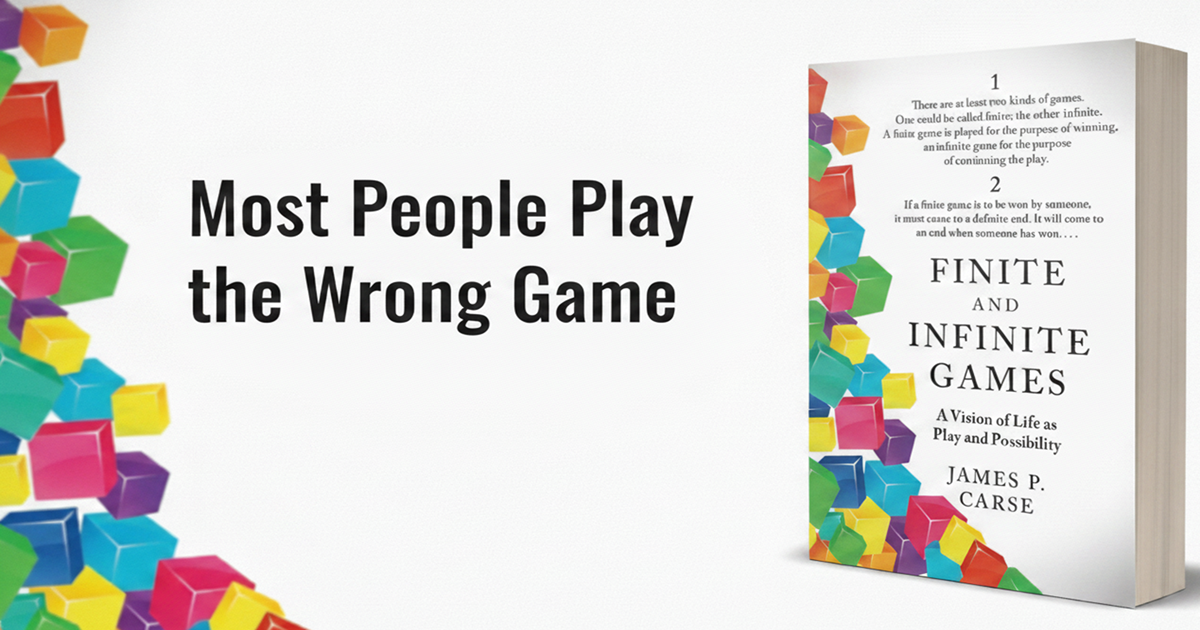
James P. Carse, a professor of religion and history at New York University, published Finite and Infinite Games in 1986. It is not a self-help book. It is not a business book. It does not have a five-step framework or a morning routine. It has one idea, and that idea is enough.
There are two kinds of games.
Finite games are played to win. Infinite games are played to keep playing.
That is the entire premise. And Carse spends the rest of the book showing you how this single distinction applies to everything. Careers. Relationships. Culture. War. Religion. Death. The way you read. The way you love. The way you compete.
The Difference Between Finite and Infinite Players
A finite player enters a game to end it in their favour. They want the title, the promotion, the victory, the applause. The rules are fixed. The boundaries are clear. Someone wins. Someone loses. The game is over.
An infinite player enters a game to continue it. They are not chasing a finish line because they understand there is no finish line worth chasing. The goal is to stay in play, to keep growing, to keep the game going for everyone involved.
Here is where it gets uncomfortable.
Most of us were raised to play finite games. Get the grade. Win the argument. Reach the target. Beat the competition. We were trained to treat every situation as something to be won or lost.
But the things that actually matter in life, the relationships that sustain you, the work that fulfils you, the person you become over decades, none of these are finite games. And when you play them like they are, you lose something far more important than any single round.
The Line That Will Stay With You
Carse writes:
"Education leads toward a continuing self-discovery; training leads toward a final self-definition."
Read that again slowly.
Training tells you who you are. Education keeps asking who you might become. One closes the question. The other keeps it open.
Most institutions train. Very few educate. And the difference shows up not in what people know, but in how they respond when the rules change.
Why Readers Will Recognise This Immediately
If you have been a reader for any significant part of your life, you already know what an infinite game feels like.
There is no moment when you have read enough. No certificate at the end. No finish line you cross and declare yourself done. Every book opens three more. Every idea raises two questions. The horizon keeps moving, and somehow that is exactly the point.
Reading is not a habit. It is an infinite game. And the people who stick with it are not the ones chasing a number or a status. They are the ones who genuinely cannot stop because stopping would mean the game is over. And the game is too good to end.
Is This Book Easy to Read?
No.
Carse writes in short, dense aphorisms. Some paragraphs will stop you mid-sentence. Some ideas will not land until fifty pages later. A few will only make sense after you finish and start thinking back.
This is not a book you race through in an afternoon. It is a book you sit with. You will probably read certain sections twice. You might dog-ear pages and return to them weeks later.
That is not a flaw. That is the design.
Should You Read It?
If you want a quick actionable read with bullet points and takeaways, this is not it.
If you want a book that gives you a new pair of eyes, one that changes how you see competition, ambition, love, and time, then yes. Read it. The 150 pages will do more work than most 400-page books you have ever picked up.
Finite and Infinite Games has been in print for nearly four decades. It has been cited by philosophers, business thinkers, athletes, and artists. Not because it tells you what to do. But because it changes what you see.
And once you see it, you cannot stop seeing it.