
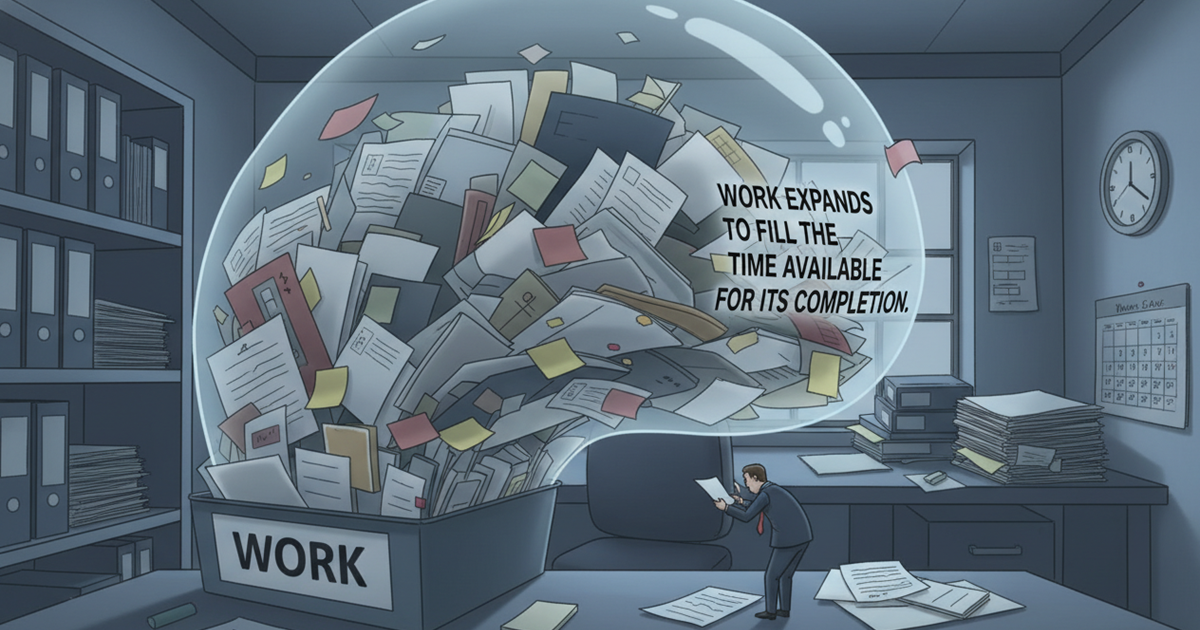
Have you ever noticed how a simple email that could take five minutes somehow consumes an entire hour when you have nothing else pressing? Or how a project assigned three months in advance only gets serious attention in the final week? Welcome to Parkinson's Law in action.
What Is Parkinson's Law?
Coined by British historian Cyril Northcote Parkinson in a 1955 essay for The Economist, Parkinson's Law states that "work expands so as to fill the time available for its completion." This seemingly simple observation has profound implications for how we approach productivity, deadlines, and time management in both professional and personal contexts.
Parkinson developed this principle while observing the British civil service, where he noticed that bureaucracies grew and work became more complex regardless of whether the actual workload increased. His insight revealed a fundamental truth about human behavior and organizational dynamics that remains strikingly relevant decades later.
Why Does Work Expand to Fill Available Time?
Understanding the psychology behind Parkinson's Law helps explain why we fall into this productivity trap:
Perfectionism creeps in. When we have abundant time, we obsess over minor details that add little value. That presentation gets endless tweaks, that report undergoes countless revisions, and simple decisions become unnecessarily complex.
Procrastination takes hold. With a distant deadline, urgency disappears. Our brains rationalize that there's plenty of time, so we delay starting until pressure forces action. This creates a false sense of security that leads to last-minute scrambles.
Scope expansion happens naturally. Extra time invites feature creep and mission drift. A straightforward project accumulates unnecessary elements simply because time permits their inclusion, not because they add meaningful value.
Mental energy dissipates. Without time constraints, focus fragments. We allow interruptions, multitask ineffectively, and let low-priority activities consume attention that should go toward important work.
Real-World Examples of Parkinson's Law
This principle manifests everywhere in modern life. Students consistently pull all-nighters before exams despite having weeks to prepare. Companies allocate year-long timelines for projects that intense focus could complete in months. Meetings scheduled for an hour invariably fill that hour, even when the agenda could be covered in twenty minutes.
Consider the software development world, where sprints and tight iterations often produce better results than open-ended development cycles. Or think about your own inbox: responding to emails with same-day urgency typically takes minutes, while those you plan to answer "when you have time" linger for days.
How to Beat Parkinson's Law: Practical Strategies
Recognizing Parkinson's Law is the first step. Defeating it requires deliberate action:
Impose artificial deadlines. Don't wait for external pressure. Create your own tight timelines that force focused execution. If something could reasonably take three days, give yourself one day to complete a solid first version.
Use time blocking strategically. Allocate specific, limited time slots for tasks. When you dedicate exactly 30 minutes to draft a memo rather than leaving it open-ended, you harness productive urgency without actual crisis.
Break projects into smaller chunks. Large projects with distant deadlines invite procrastination. Divide them into weekly or daily milestones with concrete deliverables. This creates recurring moments of accountability.
Eliminate buffer time where possible. While some buffer helps manage uncertainty, excessive padding guarantees inefficiency. Challenge yourself to trim timelines by a third and discover what's truly essential.
Embrace the power of constraints. Limited resources often spark creativity and efficiency. Challenge yourself with questions like "How would I complete this if I only had half the time?" The answers often reveal unnecessary complexity in your current approach.
Practice timeboxing. Set a timer and commit to working on a single task until it rings. This technique combines focus with urgency, preventing the wandering attention that makes work expand unnecessarily.
Parkinson's Law in the Modern Workplace
Today's remote and hybrid work environments amplify Parkinson's Law. Without the natural structure of an office environment, work can easily bleed into all available hours. The always-on culture of digital communication means that tasks expand not just to fill the workday but to consume evenings and weekends.
Smart organizations combat this by implementing sprint methodologies, establishing clear priorities, and respecting boundaries. They recognize that longer hours don't equal better output, and that tight, focused work periods often outperform marathon sessions.
The Flip Side: Parkinson's Law of Triviality
Parkinson also identified a related phenomenon called the "law of triviality," where people give disproportionate weight to trivial issues while glossing over complex, important ones. Picture a committee quickly approving a million-dollar budget but debating for hours about the color of a bike shed.
This happens because trivial matters feel manageable and allow everyone to contribute, while complex issues require expertise and mental effort many prefer to avoid. Awareness of this tendency helps teams stay focused on what truly matters.
Turning Parkinson's Law to Your Advantage
Rather than viewing Parkinson's Law as purely negative, savvy professionals use it strategically. By intentionally restricting time for routine tasks, you force efficiency and preserve energy for high-value work. The goal isn't constant urgency but deliberate pressure that prevents comfortable expansion.
The most productive people don't fight against time constraints; they design them deliberately. They understand that deadlines aren't just about when work is due but about creating the conditions for focused, efficient execution.
Conclusion: Mastering Time Before It Masters You
Parkinson's Law reveals an uncomfortable truth: we're often our own worst enemies when it comes to productivity. Left unchecked, our work habits naturally drift toward inefficiency, filling whatever time we allow with activity that may or may not create value.
The solution isn't working frantically at all times or creating unsustainable pressure. Instead, it's about recognizing this natural tendency and designing systems that counteract it through smart deadlines, clear priorities, and deliberate constraints.
By understanding and applying Parkinson's Law, you transform time from an enemy into an ally. You work with greater intention, focus on what matters, and discover that you can accomplish more in less time than you ever thought possible. The question isn't whether Parkinson's Law affects you—it does. The question is whether you'll let it control your productivity or harness it to your advantage.