
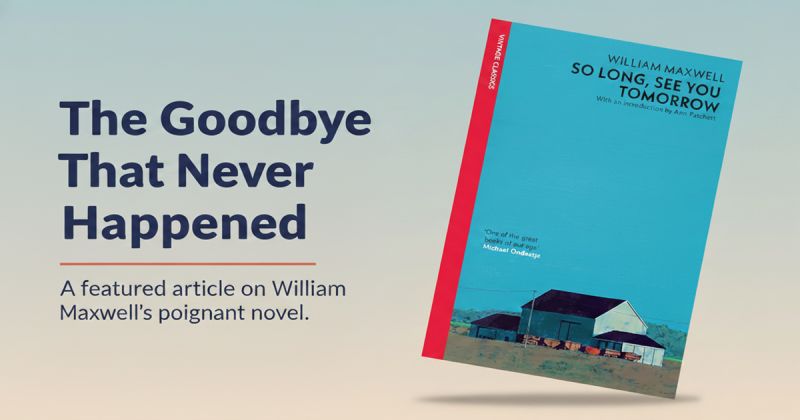
What if a single moment of silence cost you a friendship for the rest of your life? What if the guilt of that moment never quite left you, no matter how many decades passed? These are the questions at the heart of William Maxwell's slim but devastating novel, So Long, See You Tomorrow, a book that has quietly earned its place among the greatest works of American literary fiction.
Published in 1980 and winner of the American Book Award, this novel is short enough to finish in a single sitting, yet rich enough to leave you thinking about it for years. If you have never read it, you are in for one of the most quietly profound reading experiences of your life.
Who Was William Maxwell?
Before diving into the novel itself, it helps to understand the man who wrote it. William Maxwell (1908-2000) was an American author and longtime fiction editor at The New Yorker, where he worked for over four decades and shaped the careers of writers like John Updike, J.D. Salinger, and Eudora Welty.
Maxwell was known for writing that was restrained, precise, and emotionally devastating without ever being melodramatic. His own life was marked by early grief: his mother died in the influenza epidemic of 1918 when he was just ten years old. That loss echoes through much of his writing, and So Long, See You Tomorrow is widely considered his masterpiece.
What Is the Novel About?
The story is set in a small town in rural Illinois in the 1920s. The narrator, an elderly unnamed man, looks back on two interwoven events from his youth. The first is the dissolution of his own family following his mother's death. The second is a shocking act of violence in a neighbouring farm: a man named Lloyd Wilson is shot dead by his best friend, Clarence Smith, who discovered that Lloyd had been having an affair with his wife.
The narrator had been close friends with Clarence's son, Cletus. After the murder and the resulting destruction of both families, the boys lose touch. Years later, in a school hallway, the narrator spots Cletus and says nothing. He simply walks past the boy whose world had been shattered. That failure to act, that moment of cowardice born from confusion and grief, becomes the wound that the narrator carries through his entire life.
The novel is his attempt, decades later, to understand what happened and to offer a kind of retrospective apology to a boy he never properly said goodbye to.
The Structure: A Novel Built Like a Memory
One of the most distinctive features of So Long, See You Tomorrow is its structure. The novel does not follow a clean linear narrative. Instead, it moves the way memory actually moves: circling back, speculating, admitting uncertainty, and filling gaps with imagination.
Maxwell openly acknowledges that he cannot know everything about what happened. He was a child at the time, and he was not present for the events involving the Smith and Wilson families. So he imagines them. He reconstructs scenes he could not have witnessed, and he tells us he is doing exactly that. This narrative honesty is not a weakness; it is one of the novel's greatest strengths.
By blending memory with imagination, the narrator does what all of us do when we try to understand the past: we fill in the blanks as best we can, knowing we might be wrong. The result is a story that feels truthful precisely because it admits to its own limitations.
Themes That Stay With You
Guilt and the Weight of What We Did Not Do
The central emotional engine of the novel is guilt, but not the guilt of having done something terrible. It is the quieter, more persistent guilt of having done nothing. The narrator did not hurt Cletus. He simply failed to acknowledge him, failed to reach across the silence and say: I see you, I am sorry, I am still your friend. That failure haunts him for a lifetime, and Maxwell renders this with extraordinary precision.
Grief and Its Ripple Effects
The novel understands grief not as a single event but as something that reshapes everything in its wake. The narrator's mother has died. Cletus's father has committed murder. Both boys are, in different ways, orphaned by loss. Maxwell shows how grief in one generation creates damage that flows downward and outward, touching people who had nothing to do with the original wound.
Memory and Its Unreliability
Perhaps the most intellectually interesting aspect of the novel is its exploration of memory itself. Maxwell does not pretend to have perfect recall. He questions what he remembers, acknowledges what he has constructed, and wonders whether his version of events is fair to the people involved. This is a deeply honest approach to autobiographical fiction, and it gives the novel a philosophical depth that extends well beyond its rural Illinois setting.
Maxwell's Prose: Simple, Precise, Devastating
It would be a mistake to describe Maxwell's writing as simple, even though it avoids elaborate ornamentation. Every sentence is precisely weighted. Nothing is wasted. The prose has the quality of something that has been refined over a long time until only the essential remains.
He writes about grief and guilt and longing in a voice that is calm on the surface but trembling underneath. Readers who prefer dramatic, high-energy prose may at first find this quietness unremarkable. But those who give it their full attention will discover that the restraint is itself a form of power. The novel delivers its emotional blows softly, which makes them land all the harder.
Silence Never Goes Out of Style
In an era of fast content and instant reactions, So Long, See You Tomorrow asks you to slow down and sit with discomfort. It does not offer easy resolutions. The narrator never finds Cletus. He never gets to apologise. The guilt does not dissolve. The book ends not with catharsis but with a kind of tender, aching acceptance that some things simply cannot be undone.
That is a genuinely mature thing to say about human life, and it is one of the reasons this novel has endured. It does not lie to us. It acknowledges that we carry our failures with us, that the people we have hurt or neglected may never know how much we regret it, and that we must live with that.
At the same time, the novel is not despairing. The act of writing it, of trying to imagine Cletus's experience, of attempting to bear witness to a boy who was never properly seen, is itself an act of grace. Maxwell cannot undo the past, but he can refuse to pretend it did not matter.
Who Should Read This Book?
This novel is for anyone who has ever carried regret about a friendship that faded without a proper goodbye. It is for readers who love language that is careful and intentional. It is for those who find themselves drawn to books that treat ordinary lives with the seriousness and compassion they deserve.
It is also an ideal entry point for readers discovering American literary fiction of the twentieth century, or for those who enjoy works by writers like Marilynne Robinson, Tobias Wolff, or Alice Munro: writers who understand that small lives can contain enormous depths.
A Book That Earns Its Place on Your Shelf
So Long, See You Tomorrow is not a book that announces its greatness. It does not have a sweeping plot or a cast of dozens. It is under 200 pages, and it is set in a world that most modern readers have never known. But it achieves something rare: it makes you feel the full weight of a human life and the long shadow that one moment of silence can cast.
William Maxwell spent a lifetime editing other people's stories. When he finally turned his full attention to his own, the result was this: a perfect, sorrowful, beautiful little book that deserves to be read and re-read.
Ready to Read It?
Pick up a copy of So Long, See You Tomorrow by William Maxwell today.
At under 200 pages, it is a gift you can give yourself in a single afternoon.
Do not let another year pass without reading it.