
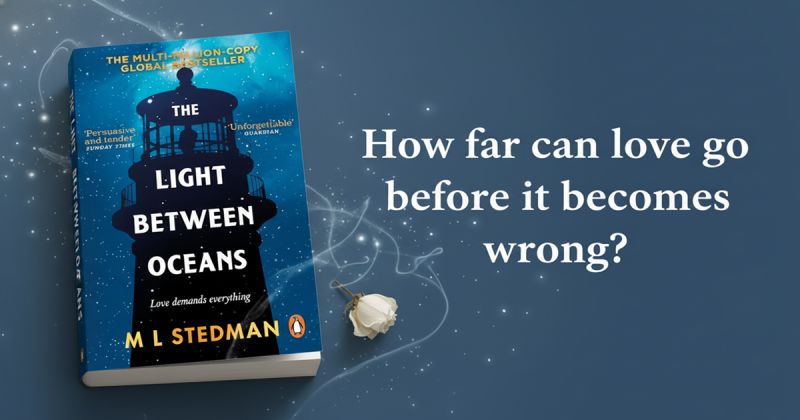
What would you do if a boat washed ashore with a dead man and a crying baby, and the only thing standing between that child and an uncertain world was your arms? This is the haunting question at the heart of The Light Between Oceans, a debut novel by Australian author M.L. Stedman that gripped readers around the world and later became a major film. Simple in its setting but enormous in its emotional weight, this book dares to ask what love truly means when it collides head-on with truth and justice.
A Remote Lighthouse and an Impossible Choice
The story is set in the years after World War One, on a small, isolated island off the coast of Western Australia called Janus Rock. Tom Sherbourne, a quietly haunted war veteran, takes up the role of lighthouse keeper there. He soon falls in love with and marries Isabel Graysmark, a warm and spirited young woman from the nearby mainland town of Partageuse.
Their life on the island is simple and peaceful, but it is also marked by deep grief. Isabel suffers two miscarriages and a stillbirth, and her longing for a child grows into something desperate. Then one day, a small boat drifts to shore. Inside is the body of a man and a living, healthy baby girl. Tom wants to report the incident to the mainland, as rules and duty demand. But Isabel, broken by loss, pleads with him to keep the child as their own. Tom, unable to bear her pain, agrees.
That single decision sets off a chain of consequences neither of them can stop or predict.
What Makes This Novel So Powerful
Stedman writes with a quiet intensity that sneaks up on you. She does not shout or preach. Instead, she lays out the facts of this moral situation slowly and carefully, letting the reader form their own feelings about what is right and wrong. And here is the brilliant and uncomfortable truth: you will find yourself understanding everyone in this story, even when their choices are painful.
Tom and Isabel are not villains. They are good people who made a terrible choice out of love. The little girl they name Lucy grows up happy and healthy, loved beyond measure. But on the mainland, there is a real mother, Hannah Roennfeldt, who has spent years mourning the baby she lost. When these two worlds eventually collide, the devastation is total.
There are no easy answers here. Stedman refuses to let any one character carry all the blame or all the goodness. Every person in this book is fully human, flawed, and deeply believable.
The Writing Style: Beautiful and Restrained
One of the most impressive things about this book is the quality of the prose. Stedman writes with a restraint that gives her emotional scenes more power, not less. The descriptions of the island, the sea, the lighthouse at night, and the long silences between characters are all rendered with quiet beauty.
The isolation of Janus Rock becomes its own character. The lighthouse beam sweeping through the dark feels like a metaphor for the story itself: something meant to guide and protect, but also something that can expose what was meant to stay hidden.
The pacing is deliberate. Some readers may find the early chapters slow, but Stedman is doing important work, building intimacy between the reader and these characters so that when things fall apart, the grief feels personal.
Tom and Isabel: A Love Story Undone by a Secret
The relationship between Tom and Isabel is one of the most complex in recent fiction. They clearly love each other, but their love is slowly tested by what they have done and by how each of them handles the secret. Tom carries a constant sense of guilt. Isabel chooses to bury hers in the joy of motherhood.
As the years pass and Lucy grows older, the distance between Tom and Isabel grows too. The lie that was supposed to hold them together quietly starts to pull them apart. Stedman captures this erosion with great sensitivity, showing how even deep love can be fractured by moral compromise.
When Tom finally decides to do what he believes is right, the results are devastating for everyone, including the little girl at the center of it all.
Hannah Roennfeldt: The Woman You Cannot Forget
Hannah Roennfeldt is perhaps the most tragic figure in the novel. She is not given nearly as much page time as Tom and Isabel, but when she appears, her presence is devastating. She is a mother who never stopped grieving, never stopped hoping. When the truth finally comes to light, her reaction is completely human and utterly heartbreaking.
Stedman is careful not to make Hannah simply a victim or a villain. She has her own complicated feelings about justice, mercy, and what is truly best for her daughter. The scenes between Hannah and the child are some of the most emotionally charged in the entire book.
Themes That Will Stay With You
The Light Between Oceans is rich with themes that linger long after the last page. Some of the most prominent include:
The nature of parenthood. Is a parent defined by biology or by love and care? The book does not offer a simple answer, and that is what makes it so thought-provoking.
Moral duty vs. personal loyalty. Tom faces this conflict throughout the novel. His sense of right and wrong pulls him in one direction while his love for Isabel pulls him in another.
The cost of silence. Keeping secrets does not protect people in this story. It only delays and deepens the pain.
Forgiveness. Can people forgive those who have caused them immense suffering? Stedman shows that forgiveness is not a single moment but a long and difficult journey.
Grief and healing. Every major character in this book is carrying a wound. The novel explores how grief can push people toward both beautiful and terrible choices.
How It Was Received: A Global Sensation
Published in 2012, The Light Between Oceans became an international bestseller almost immediately. It was longlisted for the Miles Franklin Literary Award and shortlisted for the Australian Book Industry Awards. Readers in over forty countries connected deeply with its story, and it was eventually adapted into a film in 2016, starring Michael Fassbender, Alicia Vikander, and Rachel Weisz.
For a debut novel, the critical acclaim was extraordinary. Reviewers praised Stedman for her emotional intelligence, her confident prose, and her ability to write a story that felt both intimate and universal.
Should You Read It?
If you enjoy literary fiction that challenges you emotionally and morally, this book belongs on your reading list. It is not a light or easy read, but it is a deeply rewarding one. By the end, you may not be entirely sure whose side you are on, and that is a mark of truly great storytelling.
It is ideal for book clubs because every major decision in the novel is open to debate. You and your friends may disagree loudly about Tom and Isabel, and that disagreement is the point. The book holds a mirror up to how we think about love, responsibility, and the choices we make in the dark.
Be warned: you will likely need a quiet moment after the final chapter.
The Light Fades, But the Story Doesn't
The Light Between Oceans is one of those rare novels that earns its emotional impact honestly. It does not manipulate you with cheap tricks or melodrama. Instead, it builds a world, populates it with real people, and then asks you to sit with an impossible question until the very end.
M.L. Stedman announced herself with this book as a writer of considerable talent and moral seriousness. If you have been looking for a novel that moves you, stays with you, and gives you something to think about for days afterward, look no further than this lighthouse at the edge of the ocean.