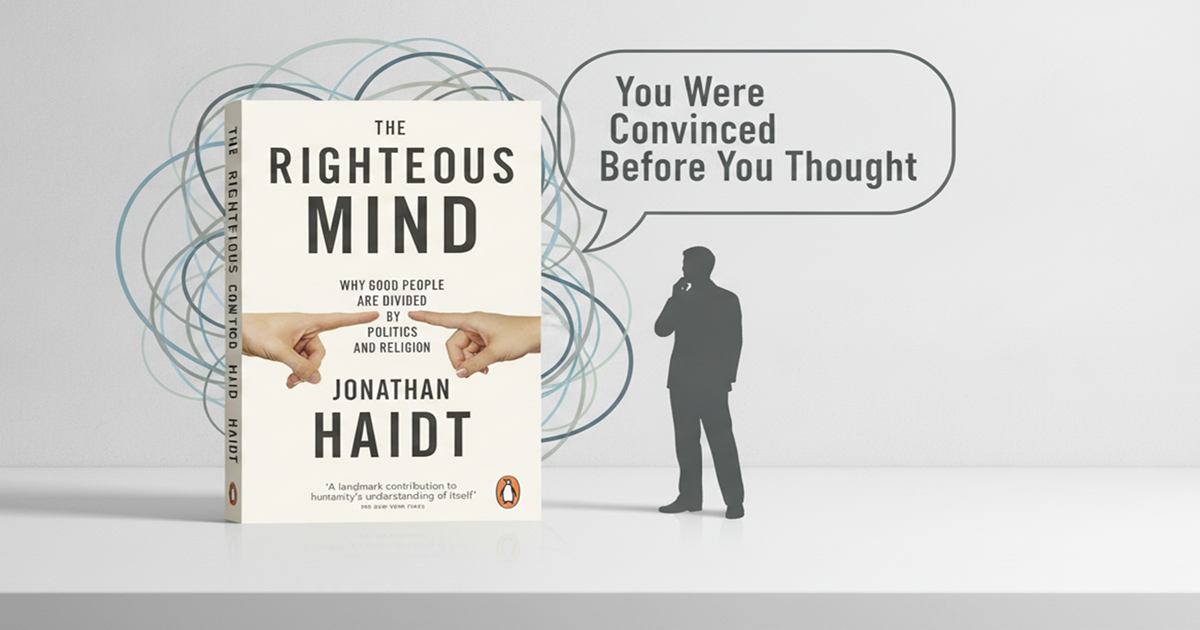
You think you arrive at your political opinions through careful reasoning. You weigh the evidence, consider different perspectives, and land somewhere rational. Jonathan Haidt spent years studying moral psychology before concluding, bluntly, that this is almost never true. The Righteous Mind is his case for why and it is one of the most uncomfortable, illuminating books written about human nature in the last two decades.
Haidt is a social psychologist at NYU Stern School of Business. His research sits at the intersection of morality, politics, and culture, and this 2012 book brings together years of fieldwork, cross-cultural surveys, and cognitive science into a unified argument. It is not a polemic. It does not tell you that one side is right. That is precisely what makes it worth your time.
The Elephant and the Rider: Intuition Runs the Show
The central metaphor Haidt uses is simple and brutal: your moral reasoning is a rider sitting on top of an elephant. The elephant is your intuition -- fast, emotional, automatic. The rider is your conscious reasoning -- slow, verbal, deliberate. You assume the rider is in charge. He is not. The elephant decides where to go. The rider's job is to justify the journey afterward.
This is not a metaphor invented for effect. It is backed by decades of experimental evidence. When people are shown morally troubling scenarios and asked to explain why they feel something is wrong, they often cannot. They stammer, they confabulate, they reach for reasons that do not quite fit. Haidt calls this "moral dumbfounding." The feeling came first. The explanation is retrofitted.
This single insight reframes almost every political argument you have ever had. You were not trying to find the truth together. You were both defending a conclusion you had already reached emotionally, using logic as a weapon rather than a tool.
Six Flavours of Morality, Not One
The second major contribution of this book is Moral Foundations Theory. Haidt argues that morality is not one thing -- harm and fairness, as secular Western liberals tend to assume. It is at least six things: Care, Fairness, Loyalty, Authority, Sanctity, and Liberty. Different cultures and political groups dial these up or down differently.
Political liberals in the West tend to score high on Care and Fairness and relatively low on the rest. Conservatives score more evenly across all six. This is not Haidt saying conservatives are right. It is him saying that conservative moral thinking is not simply defective liberal thinking. It is drawing on a broader moral palette. Whether those additional foundations are virtues or liabilities is a separate question.
The practical consequence of this is significant. When a conservative objects to something on grounds of sanctity or loyalty, a liberal who only speaks the language of harm and fairness will find the objection literally incomprehensible. Not wrong -- incomprehensible. This is a major reason political conversations fail. People are not speaking different dialects of the same language. They are speaking different languages entirely.
Religion is Not a Bug in Human Software
The third part of the book is where Haidt takes on the New Atheists. Richard Dawkins, Christopher Hitchens, and their intellectual circle treated religion as a kind of virus -- irrational, tribal, dangerous, a relic of pre-scientific thinking that enlightened people should discard. Haidt disagrees, and his disagreement is grounded in evolutionary social psychology, not personal faith.
His argument is that religion evolved as a set of mechanisms for binding groups together and enabling cooperation at scale. Shared rituals, sacred objects, collective worship -- these create what he calls "hive psychology," a capacity for humans to temporarily lose themselves in something larger. Groups with this capacity outcompeted groups without it. Religion is not a mistake. It is an adaptation.
This does not mean religion is always good, or that its claims are true. Haidt is not making a theological argument. He is making a functional one: if you want to understand why religion persists and why it generates such fierce loyalty, you need to understand what it does for groups, not just what it costs individuals. Dawkins, he implies, was asking the wrong question.
Where the Book Gets Uncomfortable
Reading this book is a quietly destabilizing experience. Haidt is even-handed to the point where no reader is left feeling entirely comfortable. Liberals will find their confidence in reason challenged. Conservatives will find their moral foundations subjected to evolutionary rather than divine explanation. Atheists will find their dismissal of religion called naive. Believers will find their certainties reframed as psychology.
There are legitimate criticisms of the book. Some researchers dispute aspects of Moral Foundations Theory, arguing that the six-foundation model is not as universal across cultures as Haidt suggests. Others note that his account of liberal morality as "thinner" than conservative morality carries implicit normative weight even when he denies it. And the book, published in 2012, could not anticipate the specific dynamics of the polarization that followed -- social media's algorithmic tribalism, the collapse of institutional trust, the rise of identity-first politics.
None of these criticisms erase the core contribution. The rider-and-elephant model alone is worth the read.
Who Should Read This
The Righteous Mind is not a self-help book. It does not tell you how to win arguments or become a better person. What it does is explain, with considerable rigor and some intellectual humility, why moral disagreement is so intractable -- and why the standard liberal or rationalist prescription ("if people just thought more carefully, they would agree with me") is almost certainly wrong.
If you have ever been genuinely baffled by how intelligent, decent people can hold views that seem to you obviously wrong -- about abortion, immigration, economic policy, religious practice, anything politically charged -- this book will not resolve the disagreement. But it will make the disagreement comprehensible. That is rarer and more valuable than it sounds.